UNILAG Student's Revolutionary Livestock Tracker Secures Victory at Red Bull Basement Global Tech Competition!

Published 11 hours ago5 minute read
UNILAG Student's Revolutionary Livestock Tracker Secures Victory at Red Bull Basement Global Tech Competition!

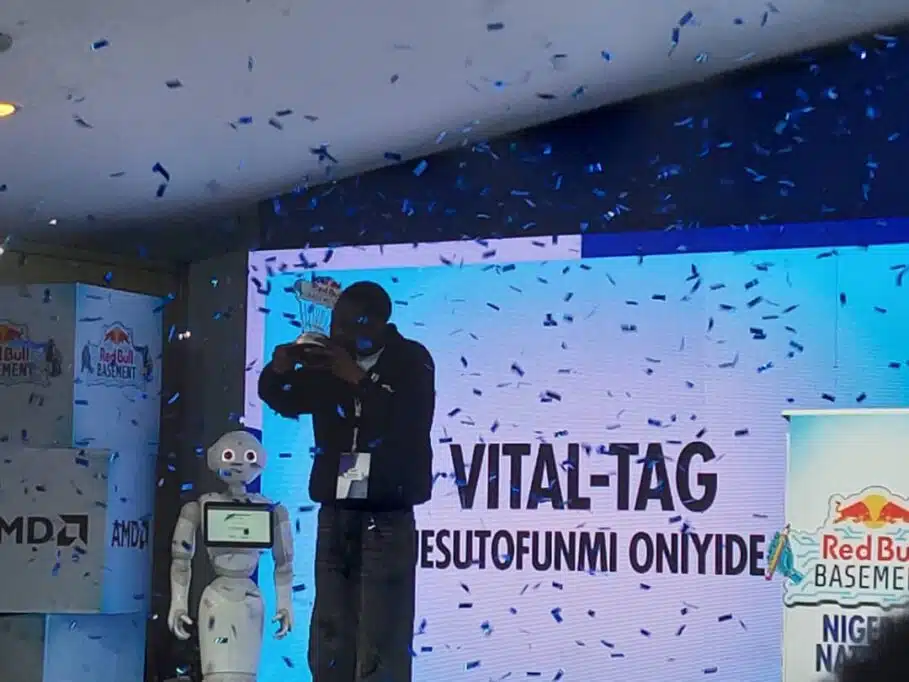
On April 4, 2026, Jesutofunmi Oniyide, a final-year Mechatronics Engineering student at the University of Lagos (UNILAG), emerged as the triumphant winner of Red Bull Basement Nigeria. He distinguished himself from a pool of over 3,000 talented students and entrepreneurs from across the nation. Red Bull Basement, a global innovation program, is dedicated to empowering student founders and first-time entrepreneurs by transforming their ambitious concepts into tangible, real-world solutions. The program offers invaluable mentorship and global exposure, equipping young innovators to develop products that can significantly impact various industries and communities.

Oniyide's groundbreaking idea, Vital-Tag, captivated the judges, including prominent figures like Odunayo Eweniyi of PiggyVest and software engineer Mercy Thadeus, who lauded it as both practical and innovative. His inspiration stemmed from a simple yet profound observation: the devastating financial repercussions of livestock deaths for farmers. Expressing his conviction during his pitch, Oniyide stated, “I thought it didn’t make sense that with the amount of technology available today, things like this still happen.”

Vital-Tag is an intelligent Internet of Things (IoT) device meticulously engineered to be affixed to livestock such as cows, pigs, and sheep. Worn comfortably around the animal's neck, the device diligently tracks crucial health indicators, including temperature, heart rate, and jaw movement. This vital data is then transmitted to farmers via SMS at regular intervals. These specific vitals are the cornerstone indicators that veterinarians traditionally rely on to ascertain livestock health. Scientific research substantiates that alterations in temperature and heart rate frequently serve as the earliest detectable signs of disease, often manifesting even before visible symptoms appear.

What further elevates Vital-Tag’s utility is its unique ability to monitor animal behavior, specifically jaw movement. By tracking this, the device attempts to monitor feeding patterns, which is a critically important signal in animal health. In extensive livestock research, a reduction in feeding or rumination activity is widely acknowledged as a significant early warning sign of impending illness. However, it is important to note that these signals are not infallible. Fluctuations in temperature and heart rate can also occur due to stress, heat exposure, or increased physical activity. Consequently, systems like Vital-Tag achieve maximum effectiveness when they can establish an individualized baseline for each animal and subsequently flag meaningful deviations from this baseline, rather than merely isolated spikes.

A notable feature of Vital-Tag is its impressive battery longevity. According to Oniyide, the device is capable of operating for an extraordinary period of up to three years without requiring a recharge. This extended lifespan is attributed to its power source: an industrial-grade nickel-based battery, a deliberate choice over the more commonly used lithium-ion alternatives. While such longevity might initially seem ambitious, it is plausible within the realm of low-power IoT systems. The battery life in such devices depends less on the battery type itself and more on the efficiency of the device's power management. Sensors that predominantly remain in sleep mode and transmit data only periodically can indeed function for years on a single battery.

However, this efficiency often comes with certain trade-offs. Frequent data transmission, continuous real-time monitoring, or a higher degree of sensing accuracy can substantially diminish battery life. Therefore, a three-year lifespan for Vital-Tag likely implies that the device sends updates at specific intervals or primarily when it detects significant anomalies. Environmental factors such as extreme heat, humidity, and physical wear can also degrade battery performance over time. Despite these constraints, Vital-Tag's approach remains highly commendable, particularly in contexts where an unreliable power supply renders frequent charging impractical, as a device capable of operating for years without intervention could dramatically enhance adoption rates among farmers.

While Vital-Tag rightfully claimed the top honor, the Red Bull Basement finals also showcased several other compelling innovations, underscoring the diverse range of problems young Nigerian innovators are passionately addressing. One such solution was Navidyne, developed by Daniel Balogun, a Petroleum and Gas Engineering student, in collaboration with Mechatronics Engineer David Ojabo. Their company, Navidyne, focuses on designing and deploying underwater robots specifically engineered to detect and repair oil pipeline leaks. The team’s primary objective is to tackle Nigeria's pervasive oil spill crisis, with Ojabo highlighting that the nation experiences the loss of tens of thousands of barrels to spills annually, leading to severe environmental degradation and significant health consequences for affected communities. Their innovative solution leverages an AI-powered robot, meticulously trained on thousands of subsea pipeline images, enabling it to identify anomalies with greater speed and precision than conventional methods.

Another impactful innovation was Liferoute AI, conceived by medical students Enribi Salami and Anjola Akinsoyinu. Their inspiration for Liferoute AI stemmed from firsthand observations of critical delays in emergency response times. Salami recounted during her pitch, “I saw how a few extra minutes could have saved someone’s life.” Liferoute AI functions as a specialized navigation system tailored for ambulances. Beyond simply identifying optimal routes, it intelligently directs emergency responders to hospitals that currently have the lowest patient load, thereby possessing the capacity to admit new patients. This intelligent routing has the potential to drastically reduce delays in critical medical situations. While not all these innovative solutions may ultimately reach commercial market viability, they collectively offer a compelling glimpse into the forward-thinking mindset of young entrepreneurs. With the Nigerian government already providing substantial grants of up to ₦50 million to student entrepreneurs, there is a distinct possibility that future unicorns may very well originate from within the confines of a dorm room.

Loading...
Loading...
Loading...

You may also like...