Rejecting 'Till Death Do Us Part': Why Gen-Z Won't Stay In Bad Marriages
Gen-Z is redefining marriage by rejecting dysfunction, prioritising mental health, and walking away from toxic relationships. This deep dive explores why divorce is rising—not from a lack of love, but from a refusal to suffer in silence.

When older generations describe Gen-Zs, they tend to describe them as audacious and lacking tolerance to disrespect and toxic environments/situations. And they are not far from the truth.
Gen-Zs have proven to reject whatever disrespect that comes their way in audacious ways that make older generations hold their breaths. This audacity has been transferred to the marriage institution.
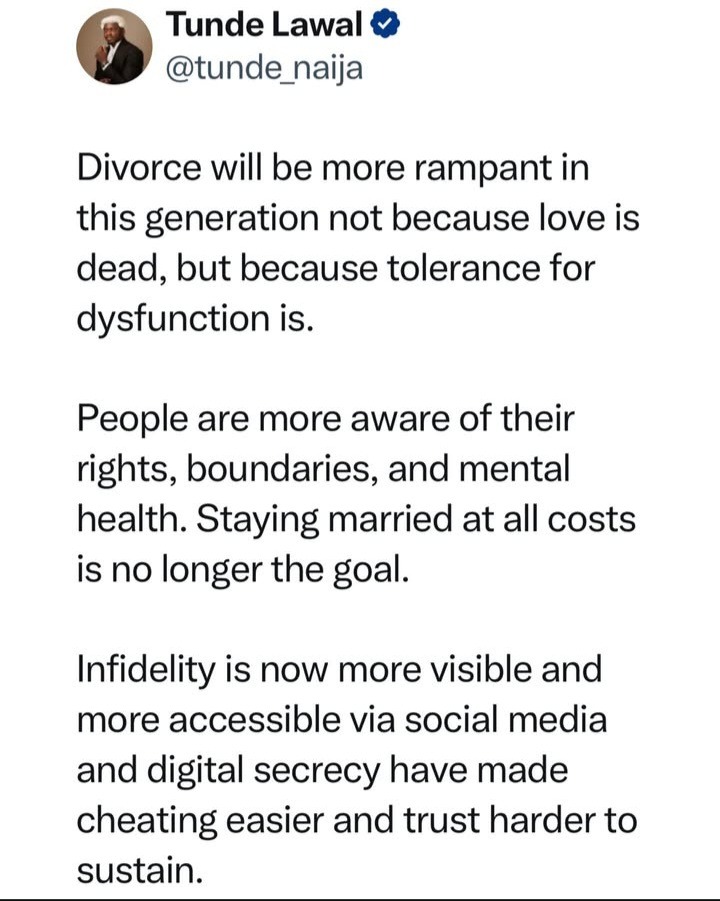
A recent social media post captured this shift perfectly: "Divorce will be more rampant in this generation not because love is dead, but because tolerance for dysfunction is." The tweet resonated with thousands because it named what many young people already know but older generations struggle to accept.
Gen-Z is not interested in suffering for the sake of a marriage certificate.
Your Parents Stayed. So What?
For many decades, the given solution to every marital problem, usually directed to the women, is: stay, pray for your husband, think about your children and marital vows, and work harder. And with that, a lot of couples pushed through infidelity, domestic violence, emotional abuse, financial manipulation and soul-crushing unhappiness.
Sad truth? Many kids saw this and they are saying NO to the same experiences. They saw mothers who smiled in public but cried themselves to sleep. They witnessed fathers who provided financially but checked out emotionally. They grew up in houses where their parents barely spoke to each other except to argue or coordinate logistics. And they decided: never again.
The older generation points to couples who stayed married for 40, 50, 60 years as proof of commitment and love. Gen-Z looks at those same couples and asks uncomfortable questions: Were they happy? Did they respect each other? Or did they simply endure because they had no other option?
This is not about disrespecting the sacrifices previous generations made. It is about refusing to repeat them.
The Mental Health Revolution
This generation is very big on mental health. They are aware and they are not ashamed to talk openly about their anxieties, fear, depression, boundaries and emotional needs that would have raised brows about thirty-something years ago.
This perspective has completely reframed how they view relationships. Where older generations saw constant conflict as "just how marriage is," Gen-Z recognizestoxicity.
Where previous couples dismissed emotional neglect as normal, younger people understand it as a dealbreaker. They know the language of emotional abuse, gaslighting, stonewalling, and manipulation because they have educated themselves.
More importantly, they refuse to accept these behaviours as the price of partnership. Staying married at all costs is not a badge of honor when that cost is your mental health, your sense of self, or your basic dignity. Gen-Z has decided that their wellbeing is not negotiable, not even for marriage.
Social Media Made Cheating Easier and Exposed Faster
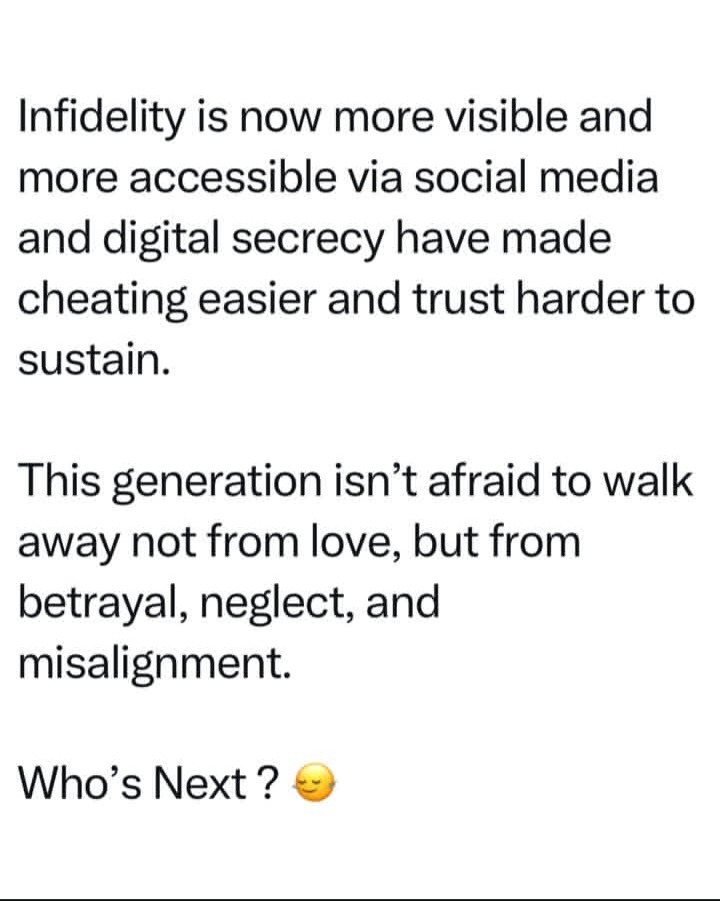
The tweet highlighted something crucial: "Infidelity is now more visible and more accessible via social media and digital secrecy have made cheating easier and trust harder to sustain."
Social Insight
Navigate the Rhythms of African Communities
Bold Conversations. Real Impact. True Narratives.
This is the double-edged sword of technology. Dating apps, Instagram DMs, and encrypted messaging have created infinite opportunities for betrayal. The person who would never have physically gone to a bar to meet someone can now carry on entire emotional or physical affairs from their phone. The barriers to infidelity have never been lower.
However, technology has also made it almost impossible to keep secrets. That notification that pops up at the wrong time. The screenshot a friend forwards.
The location tag that doesn't match the story. The suspicious app download history. What previous generations might have hidden for years gets exposed in weeks.
Gen-Z understands that once trust is broken, especially through betrayal facilitated by the same devices you use every day, rebuilding becomes nearly impossible. And unlike their parents who might have swallowed the pain and pretended everything was fine, Gen-Z asks: why should I?

Walking Away Isn’t Giving Up
"This generation isn't afraid to walk away not from love, but from betrayal, neglect, and misalignment."

This is the part that gets misunderstood. Critics accuse Gen-Z of being uncommitted, of treating marriage like a disposable relationship, of running at the first sign of trouble. But that is not what is happening.
Gen-Z knows the difference between a rough patch and a broken foundation. They understand that every relationship has challenges, that conflict is normal, that growth requires discomfort. What they refuse to accept is chronic disrespect disguised as commitment.
If your partner repeatedly cheats, they are not working through it with them for the third, fourth, fifth time. If someone consistently violates boundaries, they are not staying to see if year six is when things finally change.
If their values have fundamentally diverged to the point where they want completely different lives, they are not pretending compatibility exists where it doesn't.
This is clarity. Gen-Z has been raised with enough self-awareness to know when they are holding onto a relationship out of love versus holding onto it out of fear, obligation, or the sunk cost fallacy.
The Economics of Walking Away
Let's be honest about something previous generations won't admit: many people stayed in terrible marriages because they could not afford to leave. Women especially had limited economic options. Leaving meant potential poverty, losing social standing, being cut off from family support.
Gen-Z, particularly Gen-Z women, have more financial independencethan any generation before them. They are educated, career-focused, and earning their own money. Marriage is not an economic necessity. It is a choice.
When you don't need someone to survive, you can afford to ask: do I actually want this person in my life? Does this relationship enhance my existence or diminish it? And if the answer is the latter, leaving becomes possible in ways it was not for your grandmother.
This applies to men too. With more equitable expectations around domestic labour and childcare, and with shifting definitions of masculinity, men are also recognizing when partnerships have become unbalanced or unfulfilling. The model of the stoic, long-suffering husband who never expresses needs or desires is dying.
They're Not Anti-Marriage, They're Anti-Suffering
Social Insight
Navigate the Rhythms of African Communities
Bold Conversations. Real Impact. True Narratives.
One thing to understand is Gen-Z is not anti-marriage. They are getting married later, more intentionally, and with clearer expectations. When they do commit, they take it seriously.
What they have rejected is the idea that commitment means enduring anything and everything. They have rejected the notion that love requires self-abandonment. They have rejected the false choice between staying in dysfunction or being labeled a quitter.
Gen-Z believes in partnerships built on mutual respect, emotional safety, shared values, and genuine compatibility. They believe in relationships where both people are actively choosing to stay, not just passively unable to leave. They believe that healthy love should not hurt.
And when those conditions are not met, when betrayal breaks trust, when neglect erodes connection, when misalignment becomes undeniable, they believe in walking away with dignity rather than staying out of obligation.
Commitment, Redefined
"Till death do us part" used to be the gold standard of commitment. But Gen-Z is proposing something that might actually be more demanding: till we both keep choosing this.
Every day, both partners wake up and decide to stay. Not because they are trapped. Not because leaving would be shameful. Not because they have invested too much to walk away. But because the relationship deserves their continued presence.
That kind of commitment requires active investment, honest communication, mutual respect, and the ongoing work of maintaining emotional intimacy. It means you can't coast on the wedding vows you made years ago. You have to keep making the choice.
And when you stop choosing each other, when betrayal or neglect makes the partnership untenable, when staying would require sacrificing who you are, Gen-Z believes you should be free to leave.
This is not the death of commitment. It is commitment with consciousness. It is partnership with purpose. It is love with self-respect intact.
The older generations may not understand it. They may shake their heads and reminisce about the days when people "had sense" and stayed married no matter what. But Gen-Z is not interested in returning to a time when suffering in silence was considered virtuous.
They are building something different. Something harder to maintain, actually, because it can't survive on obligation alone. Something that requires both people to show up fully or not at all.
And honestly? That sounds like the kind of marriage worth having.