Pontiff Under Fire! Pope Leo's Historic Africa Tour Erupts in Controversy as Trump Launches Scathing Attacks
Pope Leo XIV embarks on an extensive 10-day African tour to four nations, aiming to shift global focus to the continent's needs and its significant Catholic population. This landmark journey, laden with diplomatic and spiritual objectives, is overshadowed by intense public criticism from U.S. President Donald Trump and local concerns about political implications in Cameroon.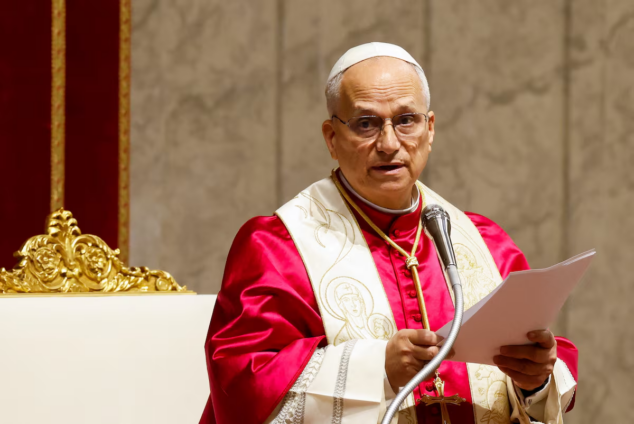
Pope Leo XIV has embarked on an ambitious 10-day, four-country tour across Africa, aiming to draw global attention to the continent's diverse needs and its substantial Catholic population. The first U.S. pope's journey encompasses Algeria, Cameroon, Angola, and Equatorial Guinea, involving visits to 11 cities and towns, covering nearly 18,000 kilometers over 18 flights. This extensive tour, described by senior Vatican official Cardinal Michael Czerny as a mission "to help turn the world's attention to Africa," is among the most complicated arranged for a pontiff in decades. More than 20% of the world's Catholics reside in Africa, with over half the populations in the three sub-Saharan nations on his itinerary identifying as Catholic. This marks the 24th papal trip to Africa since the late 1960s.
The pontiff's itinerary includes 25 planned speeches addressing a multitude of topics pertinent to the four nations, which face diverse issues. Vatican spokesperson Matteo Bruni indicated likely subjects include the exploitation of natural resources, Catholic-Muslim dialogue, and the dangers of political corruption. This is particularly relevant in countries like Cameroon and Equatorial Guinea, whose presidents have been in power for decades and face accusations of human rights abuses, which they deny. The largest event of the tour is anticipated to be a Mass in Douala, Cameroon, where some 600,000 attendees are expected. Pope Leo, fluent in several languages, plans to speak Italian, English, French, Portuguese, and Spanish during the trip.
The tour began in Algeria, marking the first time the overwhelmingly Muslim country, with a small Catholic community, has hosted a Catholic pope. Shortly after landing in Algiers, Pope Leo addressed political leaders and later called for "forgiveness" in a speech honoring victims of Algeria's war of independence from France (1954-1962). This remark, made amid heightened tensions between Algeria and France, underscores the visit's aim to "build bridges between the Christian and Muslim worlds," as articulated by Archbishop of Algiers Jean-Paul Vesco. The visit also holds personal significance for Pope Leo, who is a member of the Augustinian religious order inspired by Saint Augustine of Hippo. He visited Annaba, formerly the ancient town of Hippo, to pray privately in a chapel dedicated to priests and nuns murdered during Algeria's 1992-2002 civil war.
However, the landmark visit commenced under the shadow of scathing public criticism from U.S. President Donald Trump. Pope Leo, an outspoken critic of the U.S.-Israeli war on Iran and the Trump administration's immigration policies, had previously deemed Trump's threat to destroy Iranian civilization "unacceptable" and called for "deep reflection" on the treatment of migrants in the U.S. In response, Trump publicly attacked the pontiff, labeling him "WEAK on Crime and terrible for Foreign Policy" and claiming Leo was only elected pope because he was American and easier for the White House to manage. Trump further amplified his grievances on Truth Social, even posting an AI-generated image of himself as Jesus Christ. Pope Leo, addressing reporters aboard the papal plane, stated he had "no intention to debate with" Trump, affirming he was "not a politician."
The Cameroon leg of the tour, where Pope Leo is scheduled to meet President Paul Biya—the world's oldest head of state, in power since 1982 and recently re-elected for an eighth term amidst violent protests—has stirred controversy. Some Cameroonian Catholics and clergy voiced fears that the visit might serve to bolster Biya's international image. Influential priest Ludovic Lado publicly questioned the Pope's decision to accept Biya's invitation while rejecting Trump's, while opposition figure Jean-Baptiste Homsi expressed concerns that the visit could be perceived as an "endorsement" of a "dictatorial regime." Despite these reservations, other prelates, such as Archbishop Samuel Kleda of Douala, framed the visit as a crucial opportunity for the pontiff to encourage peacemaking, address ongoing crises, and speak to "sinners who taint and destroy the lives of millions of Cameroonians," including those imprisoned after post-election unrest. Archbishop Jean Mbarga of Yaounde, however, close to the country's leadership, denied any "division" within the Catholic community regarding the visit. Throughout this complex journey, Pope Leo aims to foster peace and reconciliation, emphasizing respect and consideration for all peoples.