Malami Under Fire: Ex-AGF Battles EFCC, Demands Release Amid Explosive Abacha Loot Allegations and Unexplained Wealth
Former Attorney-General Abubakar Malami faces serious corruption allegations, including a $16.9 million legal fees scam and unexplained wealth, leading the EFCC to seek his remand. Malami decries the probe as a politically motivated witch-hunt, accusing the EFCC Chairman of personal vendetta, while the anti-graft agency asserts Malami jumped bail and denies political bias. The escalating dispute highlights a critical battle over accountability and due process within Nigeria's legal and political landscape.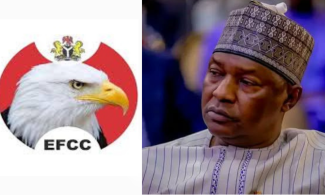
Abubakar Malami, SAN, the former Attorney-General of the Federation and Minister of Justice, is currently embroiled in a significant corruption scandal, facing multiple petitions and an investigation by the Economic and Financial Crimes Commission (EFCC). The anti-graft agency has filed an application before the High Court of the Federal Capital Territory, Abuja, seeking a 14-day remand order for Malami and his associate, Temitope Isaac Adebayo, pending further investigation into allegations of a $16.9 million legal fees scam, money laundering, abuse of office, and the accumulation of assets far exceeding his legitimate earnings.
The core of the allegations, stemming from petitions by organizations such as the Human and Environmental Development Agenda (HEDA), Karlos Community Development and Empowerment Initiative, and Grassroot Advocacy for Peace and Good Governance (GAPAG), centers on the alleged fraudulent payment of $16.9 million in legal fees. The EFCC's preliminary investigation indicates that Malami, during his tenure as the nation's chief law officer, authorized these substantial payments to "new lawyers" for the recovery of funds traced to the late General Sani Abacha. Petitioners contend that these services had already been completed and fully paid for by foreign legal counsel previously engaged by the Federal Government, rendering the fresh payments unnecessary and illicit. Furthermore, Malami is accused of using his office to confer undue advantage on his associate, Adebayo, in transactions under scrutiny. The EFCC has stated that its investigation reveals a prima facie case of criminal conspiracy, corruption, criminal breach of trust, and money laundering against the respondents.
Beyond the specific $16.9 million payment, the petitions extensively detail Malami’s "unexplained wealth," pointing to high-value assets allegedly disproportionate to his known income. These properties include the Azbir Hotel and Azbir Arena, an expansive hospitality complex in Birnin Kebbi said to be worth billions of naira, along with Rayhan Rice Mill, Rayhan Private Academy, and Rayhan University, all located in Kebbi State. Numerous other residential and commercial properties in Abuja, Kano, and Kebbi, valued in hundreds of millions, are also listed. Petitioners assert that Malami could not have legitimately acquired such assets prior to or during his appointment as Attorney-General in 2015, urging the EFCC to investigate the funding sources and freeze associated assets and bank accounts. Additional allegations include Malami's purported facilitation of unauthorized auctions of seized crude oil vessels, distribution of luxury vehicles valued at over ₦1 billion, and attempts to interfere in high-profile corruption cases by recommending the discontinuation of prosecutions involving politically exposed persons.
The EFCC stated that Malami reported to the Commission on November 28, 2025, and was subsequently granted provisional administrative bail. However, the agency alleges that Malami failed to meet the stringent bail conditions and consequently "jumped" the temporary bail. The Commission further informed the court of intelligence suggesting Malami's plans to flee the country and intimidate potential witnesses, actions that could severely impede the investigation and any future prosecution. On this basis, the EFCC is seeking his remand to preserve the integrity of the probe.
In response to these developments, Malami has vehemently denied the allegations, describing the investigation as a "politically motivated witch-hunt." In a statement issued on Monday, December 15, he claimed that the probe and his detention are driven by personal animosity from the EFCC Chairman, linked to Malami's recent defection from the All Progressives Congress (APC) to the African Democratic Congress (ADC). Malami argued that the EFCC Chairman harbors a "deep-seated historical animosity" stemming from the Justice Ayo Salami Judicial Commission of Inquiry, which investigated corruption within the EFCC during Malami’s tenure and where the current Chairman served as Secretary, with adverse findings against him. Malami characterized the current investigation as bearing "all the hallmarks of retaliatory persecution motivated by personal vengeance," marked by "illegal detentions, media harassment, and procedural abuses."
Demanding immediate action, Malami called for the EFCC Chairman to recuse himself from the investigation and for the matter to be transferred to another government agency to ensure impartiality and credibility. He also urged the current Attorney-General of the Federation to intervene, warning of potential institutional damage and abuse of prosecutorial powers. Malami insisted on immediate arraignment before a competent court, citing Sections 35(3), (4), and (5) of the Nigerian Constitution as safeguards against unlawful detention, emphasizing that only a court, not a "politically compromised agency," can lawfully adjudicate the matter. He further accused the EFCC of planning to use "questionable witnesses," including individuals convicted abroad, to bolster its case, a tactic he labeled "desperate, scandalous, and corrosive to the integrity of Nigeria’s criminal justice system." His legal team has formally requested certified copies of the petitions and investigation reports to prepare his defense, with Malami stating his objective is to "clear my name openly and transparently before a court of competent jurisdiction," rather than seeking political settlement.
Human rights lawyer Deji Adeyanju, however, has dismissed Malami’s claims of political vendetta as "baseless and regrettable," insisting that the EFCC must proceed with the investigation and prosecution. Adeyanju emphasized that holding public office is a public trust, requiring accountability from all past and present officials, especially concerning the Abacha loot recovery. He noted Malami's record of wielding state power against others while in government, asserting that the former minister cannot now escape the same process.
The EFCC, on its part, has denied Malami’s assertions of political persecution, labeling them "patently false and misleading." The agency affirmed its apolitical stance, guided strictly by law. It clarified that Malami's administrative bail was revoked due to his failure to meet the specified conditions, not because he attended a political gathering, contrary to Malami's public claims. The EFCC also disclosed that Malami, who was scheduled for further interrogation on December 1, 2025, wrote to the Commission on December 4, citing ill-health. While granted compassionate leave, the agency noted that Malami failed to submit any medical report or credible proof of his alleged condition to justify the repeated delays in his compliance with bail terms.