Judicial Firestorm: Supreme Court Nominee Forson Sparks Debate on Justice, AI, and Court Limits!
Supreme Court nominee Anthony Forson Jnr. outlined his views on key legal issues during his vetting, advocating for AI as a complementary tool in legal practice, opposing a cap on Supreme Court justices, and proposing ICT solutions for case backlogs. He also endorsed the Public Tribunals Act, emphasizing constitutional compliance.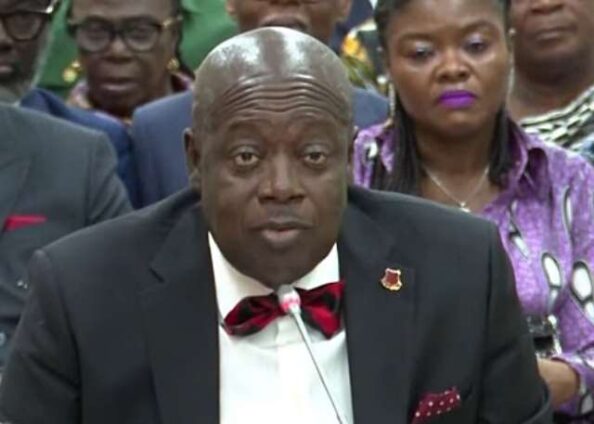
Supreme Court nominee Anthony Forson Jnr. presented a comprehensive set of views on critical legal and judicial issues during his appearance before Parliament’s Appointments Committee on Thursday, August 27, 2026. His remarks covered the role of artificial intelligence in legal practice, the ideal composition of the apex court, strategies for tackling case backlogs, and the constitutional validity of the Public Tribunals Act.
Mr. Forson strongly cautioned legal practitioners against becoming overly dependent on artificial intelligence (AI), emphasizing that the technology should strictly complement, rather than replace, human expertise and judgment. While acknowledging AI's potential to transform legal practice by accelerating research and improving efficiency, he warned of the risk of inaccurate or misleading information if used without a profound understanding of the law. He urged lawyers relying on AI tools to first cultivate robust legal principles, enabling them to critically assess generated information. “It is an aid, because AI can never replace the human being,” he stated, reiterating that human judgment, expertise, and responsibility remain indispensable despite AI's rapid advancements and growing application in professional services.
Addressing the structure of the Supreme Court, Mr. Forson expressed opposition to proposals for capping the number of justices at 19. He argued that the Court’s extensive jurisdiction and substantial workload render a fixed limit impractical, potentially creating significant challenges for the efficient administration of justice. His position, informed by his experience and participation in judicial reform discussions, highlighted that unless the country first reduces the range of matters falling under the Supreme Court’s purview, a cap should not be imposed. He recalled Justice Frimpong Manso’s concerns during an earlier constitutional review discussion regarding the difficulties a cap would present given the Court's wide-ranging jurisdictions. Mr. Forson also referenced the historical justifications for expanding the Supreme Court's membership, noting that its current composition struggled with workload, a consideration he believes remains relevant today.
To combat the persistent backlog of cases in Ghana’s courts, Anthony Forson Jnr. identified Information and Communication Technology (ICT) as a crucial tool. Drawing on his experience in digitalizing the operations of the Ghana Bar Association, he expressed 100% confidence in his ability to contribute to efforts to make justice delivery more efficient, provided the necessary resources are made available. He pledged to support Chief Justice Paul Baffoe-Bonnie’s initiatives in this regard. Furthermore, he backed proposals for implementing afternoon court sittings as an additional measure to expedite case disposal, acknowledging that such reforms might face resistance from legal practitioners.
Finally, Mr. Forson endorsed the recently passed Public Tribunals Act, stating that there should be no concerns about the legislation, provided Parliament enacted it in strict accordance with the 1992 Constitution. A private legal practitioner and former President of the Ghana Bar Association, he grounded his position in the supremacy of the 1992 Constitution, stressing Parliament’s obligation to ensure all legislation conforms to the country’s fundamental law. He clarified that the legislation does not introduce a concept alien to the Constitution, and his only concern would arise if Parliament failed to adhere to constitutional requirements in its enactment.