Global Shockwave: Venezuelan President Maduro Captured, Faces US Trial & Leadership Crisis
Venezuelan President Nicolás Maduro was captured by US forces in a pre-dawn raid and flown to the US to face charges. In his absence, the Supreme Tribunal of Justice has named Vice President Delcy Rodríguez as acting president, while Venezuela's streets see military deployment and the international community reacts with mixed responses.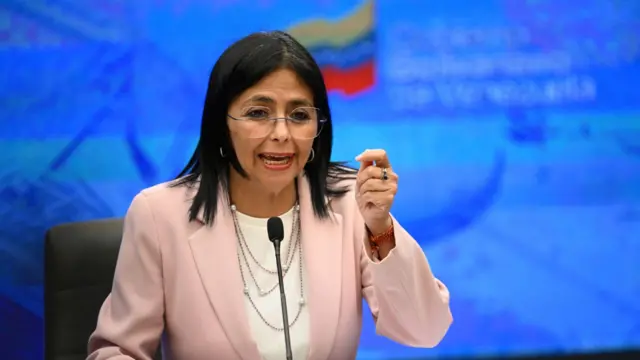
In a dramatic turn of events, Venezuelan President Nicolás Maduro and his wife, Cilia Flores, were captured during a pre-dawn raid by special United States forces on January 3, 2026. The surprise attack targeted their residence within Caracas' high-security Ft Tiuna military compound, culminating in their apprehension and immediate transport out of the country to the United States.
Following the extraordinary military strike, Venezuela's Supreme Tribunal of Justice (TSJ) swiftly intervened to ensure administrative continuity. The Constitutional Chamber of the TSJ, in a decision publicly announced by its president, Caryslia Beatriz Rodríguez, on state broadcaster Venezolana de Televisión (VTV), ordered Executive Vice President Delcy Rodríguez to assume the role of acting president. This measure was enacted "in light of the exceptional situation created by the kidnapping of Nicolás Maduro Moro," which the court deemed a "material and temporary impossibility" for him to exercise his functions. The TSJ cited "extraordinary circumstances and force majeure" – conditions not explicitly detailed in the Constitution but severe enough to threaten the stability of the state, national security, and governmental continuity – as the basis for this urgent and preventive protective measure.
The capture of President Maduro sparked a significant security response within Venezuela. Armed men were observed on the streets of Caracas, and videos circulating online depicted confrontations with vehicles, alongside the presence of tanks and heavy military equipment. Venezuela’s defense minister confirmed the nationwide deployment of the country’s armed forces, aiming to maintain order amid the rapidly unfolding crisis.
Meanwhile, US President Donald Trump confirmed the capture, stating that Maduro had been "captured and flown out of the country." Trump declared that the US government would oversee governance in Venezuela, including the management of its vast resources, notably one of the world’s largest oil reserves, until a "safe, proper and judicious" transition could be established. Maduro and Flores were detained in New York, where Maduro is being held at the Metropolitan Detention Center. He is scheduled for arraignment on Monday, January 5, at a federal court in Manhattan, facing federal drug-trafficking and related charges.
These charges build upon a 2020 indictment that previously accused Maduro and other senior Venezuelan figures of narco-terrorism conspiracy, cocaine importation conspiracy, and weapons-related offenses, including possession of machine guns. US Attorney General Pam Bondi emphasized that Maduro and his wife would "soon face the full wrath of American justice on American soil," though specifics of the prosecution's desired punishment were not disclosed. Under US federal law, drug offenses committed "as part of a continuing criminal enterprise" can carry the possibility of capital punishment. However, legal authorities note that death sentences for such crimes are exceedingly rare, with life imprisonment being a more probable outcome for Maduro, should he be convicted. President Trump drew parallels between the operation to apprehend Maduro and the 1989 US action in Panama that led to the arrest and subsequent trial of former leader Manuel Noriega.
The international community reacted with varied responses. Brazil's Foreign Ministry promptly released a statement formally recognizing Delcy Rodríguez as Venezuela's interim president. Conversely, China issued a strong condemnation of the US actions, calling for the immediate release of President Maduro and his wife. A Chinese Foreign Ministry spokesperson expressed "grave concern" over the "forcible seizure" and removal of Maduro, asserting that the US move constituted a "clear violation of international law, basic norms in international relations, and the purposes and principles of the UN Charter." China further urged the US to cease efforts to overthrow the Venezuelan government and to resolve disputes through dialogue and negotiation. The full scope of events on the ground in Venezuela continues to emerge as the situation develops.