Eastern Europe on Edge: Unidentified Object Crashes in Poland Amid Ukraine War Fallout
An unidentified object, later confirmed as a Russian cruise missile, landed in Poland during a massive Russian attack on western Ukraine, causing a 10-meter crater. This airspace violation sparked strong condemnation from Polish, Ukrainian, and European leaders, who collectively urged for bolstered air defense support for Ukraine to safeguard European security.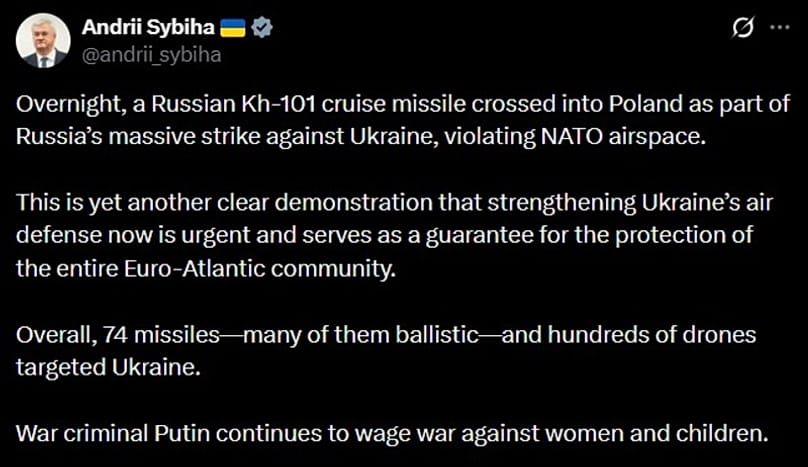
An unidentified object, later identified by Ukrainian authorities as a Russian cruise missile, landed deep inside Polish territory early Thursday morning. This incident occurred during a massive Russian barrage targeting western Ukraine, prompting immediate concern and condemnation from Polish, Ukrainian, and European leaders.
Polish Prime Minister Donald Tusk confirmed the violation of Polish airspace, stating on X, "During the Russian massive missile attack on western Ukraine, a violation of Polish airspace occurred." Polish authorities reported that the explosion caused by the object left behind a 10-meter wide crater. Residents of Tarnawa Kolonia reported hearing an explosion around 4 am local time, which shook their homes. Police responding to a field approximately two kilometers from residential areas discovered the crater and "debris from a non-identified object." An Mi-24 helicopter from the armed forces command also flew over the scene, reporting "the probable impact place of the object on unbuilt land." Fortunately, Polish authorities did not immediately report any casualties.
Ukrainian Foreign Minister Andrii Sybiha definitively identified the object as a Russian Kh-101 cruise missile. In a post on X, he stated, "Overnight, a Russian Kh-101 cruise missile crossed into Poland as part of Russia’s massive strike against Ukraine, violating NATO airspace." Sybiha emphasized that the missile was originally headed for Ukraine but missed its target. He leveraged the incident to call on Ukraine’s allies to significantly boost the country’s air defenses, asserting that a stronger Ukraine in the skies translates to a safer Europe. "This is yet another clear demonstration that strengthening Ukraine’s air defence now is urgent and serves as a guarantee for the protection of the entire Euro-Atlantic community," he added. Sybiha further detailed the scale of the Russian attack, noting it was one of the largest in a while, involving at least 74 missiles, many of them ballistic variants, and hundreds of Iranian-made Shahed strike drones.
European Council President Antonio Costa also condemned the violation of Polish airspace and territory, branding Russia as a threat to the entire continent. On X, Costa wrote, "During the attack, Polish airspace was also violated, underlining once again that Russia’s aggression is a threat to the security of Europe as a whole." Echoing Sybiha's sentiments, Costa called for the European Union to enhance its military support for Ukraine, enabling it to better defend itself and Europe against ongoing Russian aggression, which began with the Kremlin's invasion in February 2022. "We are stepping up our support to strengthen Ukraine’s air defence, including anti-missile and anti-drone capabilities. Europe will continue to stand united in the face of this aggression," Costa affirmed.
Ukraine has persistently appealed for more advanced air defense systems, particularly Patriot batteries and anti-missile capabilities, from allies such as the United States. Ukrainian President Volodymyr Zelenskyy reiterated these calls for more anti-ballistic missiles during his first meeting with the UK’s new Prime Minister Andy Burnham, who pledged to discuss the prospect further in the coming weeks.