Corruption Survives Because Entire Economies Quietly Depend On It
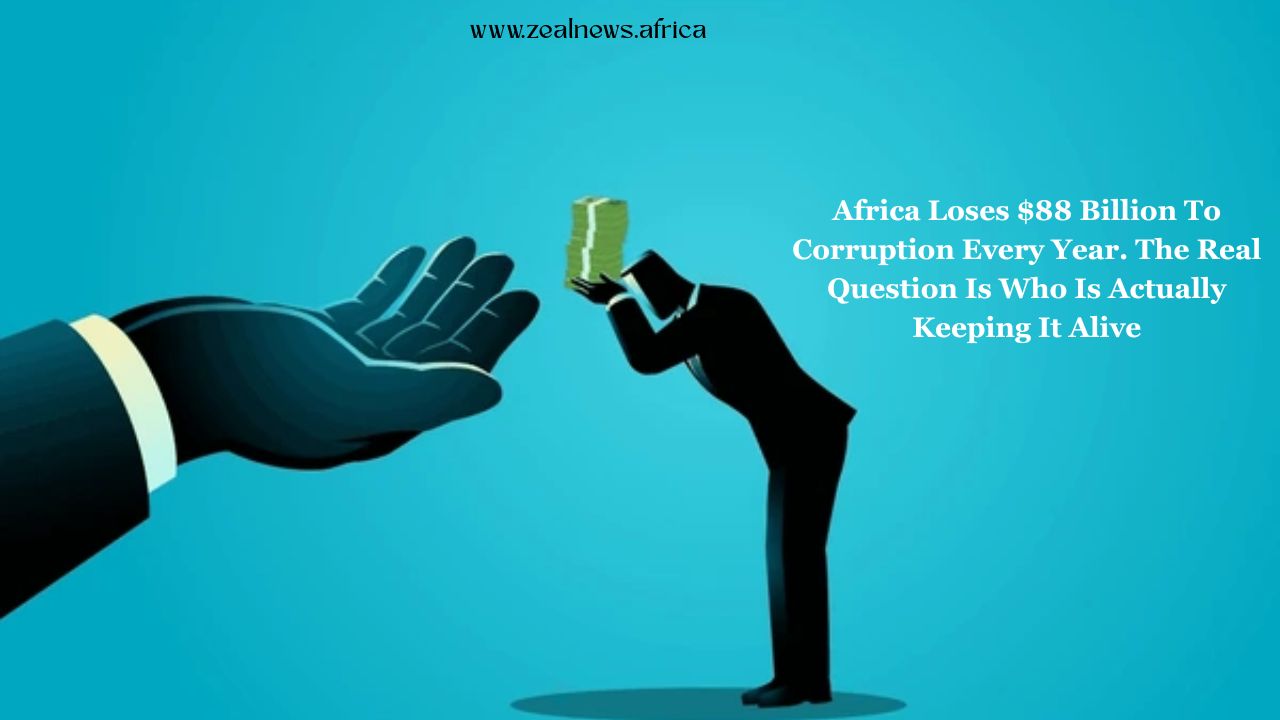
Africa loses $88 billion to corruption annually, but the real story is not just about governments. From Lagos to Accra to Johannesburg, entire economies, families, businesses, and survival systems are quietly built around it.
Kofi was not a bad man; that was what he always said to himself. He ran a small provisions shop in Accra, sold the usual things, soap, tin tomatoes, sachet water, the occasional cold drink if the light held long enough to keep the fridge running.
He paid his rent, sent his children to school, and went to church on Sundays, where the pastor preached about integrity, and the congregation said amen.
Then the city council officer came for the usual documentation and clearance exercise that everyone was aware of; it wasn't something new to Kofi.
He did not say bribe, nobody ever said bribe. He talked about permits, compliance, inspection schedules, and documentation. He came back three times, and on the third visit, he mentioned that the shop next door had sorted everything out and had not had any trouble since.
Kofi understood what the officer said fully without any need for explanation. He paid the officer, and he left without disturbing him again. For Kofi, he went back to selling tin tomatoes.
He did not report it. He did not think of himself as participating in corruption. He thought of himself as surviving and just escaping unwanted stress. That context matters more than any anti-corruption report on the continent will ever admit.
The System That Everyone Uses and Nobody Claims

The African Union, according to DW estimates, that Africa loses $88 billion to corruption annually, roughly 3.7 per cent of the continent's gross domestic product. Transparency International's 2023 Corruption Perceptions Index ranked Sub-Saharan Africa as the lowest-performing region globally, with an average score of 33 out of 100.
These numbers land in speeches, get cited in donor reports, and change very little at the end of the day.
What the numbers do not capture is the architecture underneath. The informal tax that a Lagos market trader pays a local agbero to keep his or her stall undisturbed. The speed fee a Nairobi driver hands over at a checkpoint to avoid spending three hours on the roadside.
The hospital porter in Kampala who moves a patient up a waiting list for the equivalent of two dollars because that patient's family gave him something, and the family in the next bed gave him nothing.
None of this is government policy. All of it is government behaviour, reproduced daily at the ground level by ordinary people in impossible positions.
The Young Man, The Mother, The Father

In Lagos, there is the boy who grows up fast, learning early that rules are negotiable and connection is a currency. He watches his uncle get a job, not because he was qualified, but because someone made a call.
He watches his neighbour's case at the local government office sit untouched for months until someone greased the right hand. By the time he is old enough to be in any position of leverage himself, a clerk, a gateman, a low-level official, the logic is already installed. This is how things work: he is not inventing anything, he is just part of a system.
In Accra, the young graduate polishes his CV and attaches it to emails that go nowhere. Then a family friend mentions someone who knows the hiring manager. He gets the interview and eventually gets the job; nobody calls it corruption.
They call it connections, others call it grace. The outcome is identical to what a bribe produces, access for the connected, nothing for the rest, but the language launders it clean.
In Johannesburg, the mother running a small catering business inflates her invoice to a corporate client by fifteen per cent. She has done this for two years, not because she is greedy, but because the corporate client takes ninety days to pay, and her suppliers want their money in thirty.
The inflation is her interest rate, self-administered. It is also technically fraud. She has a family to feed and a business to keep alive, and she does not have the luxury of ethical purity.

The father selling cooking gas at prices above the regulated rate is not a cartel. He is a man who bought the gas at inflated prices because the official supply chain is broken, and the black market is the only market that works.
He passes the cost on because he has no choice. The customer who pays it understands, and neither of them thinks of what they are doing as corruption. They think of it as a normal Wednesday.
The Government Is Also People

The politician who approves a fraudulent contract did not arrive in office from another planet. He grew up watching people survive by working around systems that did not work. He saw what desperation looked like on the faces of constituents and what gratitude looked like when someone with power used it to help someone without it.
He learned that loyalty, not competence, is what gets rewarded. He learned that the person who shares is protected and the person who refuses is isolated.
This does not excuse what he does with power. It explains how a culture of corruption reproduces itself without needing to recruit. The environment does the recruiting.
The African Development Bank notes that corruption thrives where institutions are weak, accountability is absent, and the cost of participating in corrupt behaviour is lower than the cost of refusing it.
That is not a description of government. That is a description of the conditions millions of ordinary Africans navigate every single day.
What Survives When Corruption Does

The uncomfortable truth is that corruption in Africa is not a parasite feeding on a healthy system. In many places, it is load-bearing. Remove it suddenly and entirely, and large portions of the informal economy, the part that employs the majority of working Africans, would stall before anything formal could replace it.
This is not an argument for keeping it. It is an argument for understanding what it is actually doing. The $88 billion figure represents what is stolen from public resources, from infrastructure, from health systems, from schools.
That theft is real, and its victims are real. But the conversation about corruption that begins and ends with government officials misses the ecosystem that sustains the government official, the shared logic, the normalised workarounds, the daily calculations of people who are not evil, just tired and trying to survive.
Kofi paid the council officer and went back to selling his wares. The officer went home and fed his children. Nobody filed an issue or reported anything. The system continued.
It always continues, because for enough people, in enough ways, it works, and until something better works instead, it will keep working.
That is the thing about corruption that the speeches never say. It survives because it is useful. Dismantling it means replacing every function it quietly performs, and that is a much harder problem than arresting the people at the top.