Business Anatomy Series(Part 7): Fan Milk
How much is Fan Milk worth, How does it operate, and Who started it all?
Imagine leaving the comfort of your cold, slow-paced, snow capped homeland to pursue a dream on a continent you’ve never lived. In a country perched directly on the equator, where the air is thick with heat and humidity, and the sun roasts from every angle.

Image Credit: Berlingske
Your pale complexion marks you as alien. You are surrounded by languages you do not speak, cultures you do not understand, and faces that quickly remind you that you are a foreigner.
It is the late 1950s, and across West Africa, a tide of anti-colonial sentiment is rising. Independence is the cry of the moment, and the presence of any foreign entrepreneur is, at best, met with suspicion.
Some would say you are adventurous. Others would say you are idealistic. Most would say you are utterly insane.
This was the reality faced by Erik Emborg, a Danish entrepreneur in Ghana who dared to dream differently. In doing so, he laid the foundation for what we now know as Fan Milk. His journey, however, was far from smooth.
The Birth of a Vision: Milk for a New Nation (1960)

Image Credit: Fan Milk Website
In 1960, Ghana had just become the first sub-Saharan African country to gain independence. It was a time of bold hopes and uncertain roads. Emborg, inspired by the region’s potential, teamed up with fellow Danish investors to launch the Ghana Milk Company.
Why they decided to name it the Ghana Milk Company is unclear, but it does raise suspicions of neo-colonial or monopolistic ambitions.
The plan was simple yet ambitious: provide pasteurized milk to institutions like schools and hospitals, a much-needed service.
But reality was unforgiving.
Imported tinned milk, cheaper and more familiar, dominated the market. Local preferences were misunderstood. The team had misread the business terrain, and by 1962, the Ghana Milk Company had collapsed into bankruptcy. For most, this would be the end of the story.
For Emborg, it was only the beginning.
A Local Spark and a New Beginning (1962)

Refusing to give up, Emborg bought out the other shareholders and leaned into the one thing he hadn’t done before: he listened to local voices. A Ghanaian employee suggested shifting focus from milk for institutions to cold treats for everyday people, such as ice cream, chocolate milk, and blocks of ice.
It was a game-changing insight.
In 1962, the company was reborn as Fan Milk Limited, and its products quickly began capturing the hearts of Ghanaians. Another key innovation came through distribution. Long John bicycles, large metal-framed bikes with insulated boxes, carried cold products through city streets and dusty roads.
In a country with few refrigerators, Fan Milk became more than just a treat. It became a part of daily life.
From a Struggle to a Staple: Regional Growth (1960s to 1990s)
The success in Ghana opened doors across West Africa. In 1961, Fan Milk expanded to Nigeria, setting up a production plant in Ibadan and a distribution hub in Lagos. The formula worked again: cold dairy products, distributed through bicycle vendors, tailored to local tastes.
By 1967, Fan Milk became the first foreign-invested company in Ghana to go public. In 1969, it officially transitioned into a public limited liability company, marking the start of its next chapter of growth.
Through the 1980s and 1990s, Fan Milk introduced product after product, including FanChoco, FanYogo, and FanIce. With smart packaging and efficient distribution, the company reached homes across Benin, Togo, and Burkina Faso. Fan Milk had become a true West African brand, loved and trusted across the region.
Navigating Change: Local Ownership and Global Partnerships

Image Credit: Charles Hansen-Quo of Google Photos
As West African governments pushed for more local control, Fan Milk evolved to match the moment. In Nigeria, local shareholders increased their stake. In Ghana, Fan Milk was listed on the Ghana Stock Exchange in 1991, making it a genuinely public company.
In 2013, the Abraaj Group, a global private equity firm, acquired a controlling stake. Not long after, global food giant Danone joined as a strategic partner.
With each change in ownership, Fan Milk gained new resources and expanded its reach, while staying committed to its roots in West African communities.
However, by 2019, Danone, a French multinational company, became the sole owner.
Building Livelihoods, One Vendor at a Time
Fan Milk’s success has never been just about products. It is also about people. In Ghana alone, the company directly employs over 1,000 staff and supports more than 10,000 indirect jobs.
These include the familiar faces we see every day—bicycle riders, push-cart sellers, and head-pan vendors—who bring cold refreshment into neighborhoods, schools, markets, and roadside corners. Behind them are approximately 1,000 independent agents who manage vendor networks and help keep this grassroots distribution model running.
This structure does more than move products. It provides dignity and income to thousands of families, especially in underserved communities. In a region where youth unemployment is high and economic opportunities can be limited, Fan Milk offers a chance, not just for a job, but for mobility, entrepreneurship, and a better life.
Across West Africa, the ripple effect is even larger. In countries like Nigeria, Côte d'Ivoire, Benin, Togo, and Burkina Faso, the company touches the lives of thousands more through its value chain. And in 2025, Fan Milk became one of the first multinational companies in West Africa to be certified as a B Corp™, recognizing its commitment to both social impact and environmental sustainability.
Financial Strength
Behind the social story is a business that is thriving. In the first quarter of 2025, Fan Milk Ghana posted a net profit of GH¢24.1 million, a remarkable 66 percent increase year-over-year, fueled by a 57 percent growth in revenue to GH¢242.2 million (roughly $20 million). Operating profit more than doubled to GH¢31.1 million. These gains came despite economic headwinds, including currency depreciation and rising input costs.
How did the company do it? Through a mix of automation, cost control, and strategic sourcing. Seventy-five percent of manufacturing processes are now automated, improving efficiency while reducing reliance on imports.
Fan Milk is also moving steadily toward 100 percent local sourcing of raw materials, a move that lowers foreign exchange risks and supports domestic agriculture.
In Nigeria, the company’s largest market, annual revenue in 2025 is estimated at $108 million, with thousands of employees supporting operations.
The overall valuation of the company has reached over GH¢400 million, which is billions of dollars.
A Brand That Delivers—Literally

Image Credit: Fan Milk Nigeria
The classic model of bicycle vendors is now being enhanced with new delivery initiatives like "FanDelivery", piloted in major cities. Urban households can now order their favorite products from home, expanding access and convenience.
The company’s strong brand loyalty, combined with an extensive grassroots distribution network, has helped it stay ahead of local competitors in a challenging and fast-changing market. Strategic pricing, smart promotions, and product mix optimization allow Fan Milk to meet consumers where they are, both economically and geographically.
As economic pressures fluctuate, Fan Milk continues to adapt—balancing affordability with innovation, while staying rooted in the communities that built its legacy.
A Legacy of Cold Joy in Hot Climates
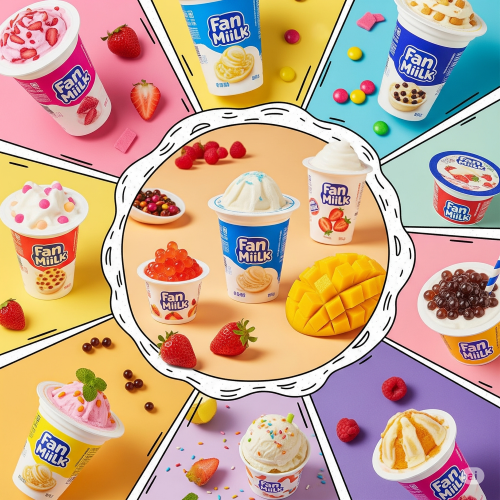
Today, Fan Milk is more than just a brand. It is a daily presence in the lives of millions across West Africa. From frozen yoghurt to fruit drinks, from street vendors on bicycles to supermarket freezers, Fan Milk continues to bring refreshment and delight.
What began as one man’s unlikely dream in the heat of post-independence Africa has grown into a company that employs thousands, supports small businesses, and refreshes millions of people every day.
And all of it started because one person, far from home, unfamiliar with the culture, and facing enormous odds, chose not to walk away when things fell apart.