AI War Drums Beat: Trump Admin Targets China's 'Exploitation' of US AI Tech
The Trump administration is escalating efforts to counter the alleged exploitation of U.S. artificial intelligence models by foreign entities, primarily China, through "model extraction attacks." This move comes as China narrows the AI gap with the U.S., prompting new legislative proposals and accusations from major American AI companies like OpenAI and Anthropic regarding the illicit distillation of their technologies.The Trump administration is vowing to crack down on foreign tech companies' exploitation of U.S. artificial intelligence models, singling out China at a time that country is narrowing the gap with the U.S. in the AI race.
In a Thursday memo, Michael Kratsios, the president's chief science and technology adviser, accused foreign entities “principally based in China” of engaging in deliberate, industrial-scale campaigns to “distill,” or extract capabilities from, leading AI systems made in the U.S. and “exploiting American expertise and innovation.”
The administration, Kratsios wrote, will work with American AI companies to identify such activities, build defenses and find ways to punish offenders.
The memo arrives at a time when China is challenging U.S. dominance in artificial intelligence, an area where the White House says the U.S. must prevail to set global standards and reap economic and military benefits.
But the U.S.-China gap in performance of top AI models has “effectively closed,” according to a recent report from Stanford University's Institute for Human-Centered AI.
In response to these allegations, Liu Pengyu, spokesperson for China’s embassy in Washington, voiced opposition to what he described as “the unjustified suppression of Chinese companies by the U.S.”
Pengyu asserted China's commitment to advancing scientific and technological progress through cooperation and healthy competition, while also emphasizing the country's dedication to protecting intellectual property rights.
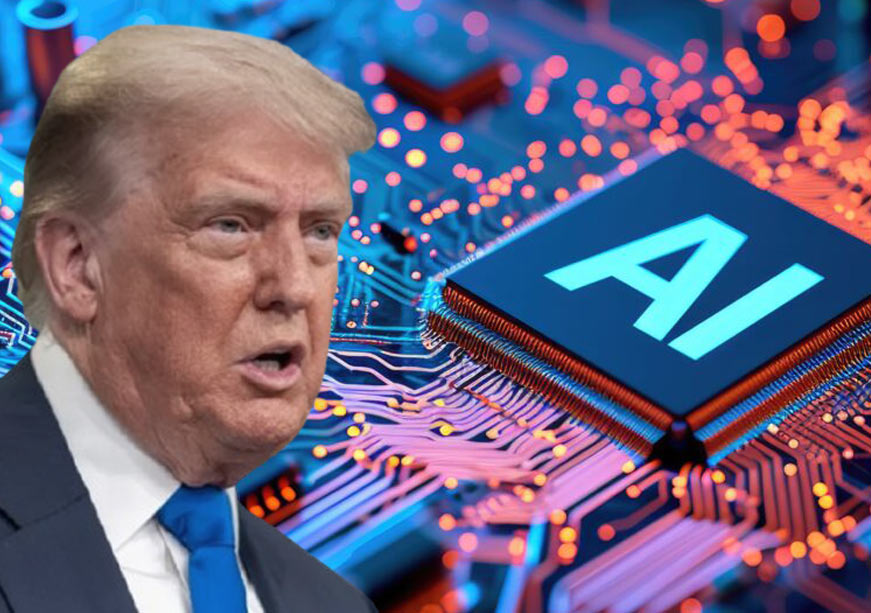
Further underscoring the severity of the issue, Kratsios’ memo coincided with the unanimous, bipartisan approval by the House Foreign Affairs Committee of a bill designed to establish a mechanism for identifying foreign actors who extract "key technical features" from closed-source, U.S.-owned AI models.
The bill proposes punitive measures, including sanctions, against these offenders.
Rep. Bill Huizenga, R-Mich., the bill’s sponsor, characterized "model extraction attacks" as "the latest frontier of Chinese economic coercion and theft of U.S. intellectual property," stressing the importance of preventing China from stealing transformative cyber capabilities derived from American AI models.
Specific instances of alleged exploitation have fueled these concerns. Last year, the Chinese startup DeepSeek drew attention in U.S. markets after releasing a large language model that rivaled U.S. AI giants in capability but at a significantly lower cost.
David Sacks, then an AI and crypto adviser to President Donald Trump, suggested that DeepSeek had copied U.S. models, stating there was "substantial evidence" that DeepSeek "distilled the knowledge out of OpenAI’s models."
OpenAI, the creator of ChatGPT, warned U.S. lawmakers that China could advance its AI by reusing American technology.
At the same time, Anthropic, which made Claude, accused companies like DeepSeek of copying their systems.
They said this was done using “distillation,” where a smaller AI learns from a more powerful one.
While this method can be normal, it becomes a problem when companies use it to gain advanced results faster and cheaper instead of creating their own.
However, the exchange of ideas goes both ways, but the U.S. startup Anysphere, known for Cursor, admitted its latest product used an open-source model from China’s Moonshot AI, the creator of Kimi.
In the end, AI development isn’t one-sided, countries are learning from each other and building on shared ideas.
Identifying and combating unauthorized distillation presents significant challenges. Kyle Chan, a fellow at The Brookings Institution and an expert on China’s technology development, likened the task to "looking for needles in an enormous haystack," given the vast volume of legitimate requests for data.

Chan suggested that enhanced information sharing and coordination among U.S. AI laboratories, facilitated by the federal government, could play a crucial role in strengthening anti-distillation efforts across the industry.
The ultimate trajectory of the proposed House bill remains uncertain, with Chan noting that President Trump might be hesitant to disrupt relations with Chinese President Xi Jinping ahead of a planned state visit to Beijing in mid-May.