African Union Sounds Alarm: Burundi Leads Charge Against Looming Water Crisis
Burundi's President Évariste Ndayishimiye has been elected the new AU Chairperson for 2026, succeeding Angola's President Lourenço amidst continental challenges. The 39th AU Summit prioritized water security as a strategic imperative, alongside calls for financial self-reliance and embracing technological advancements like AI, while still grappling with persistent conflicts across the continent.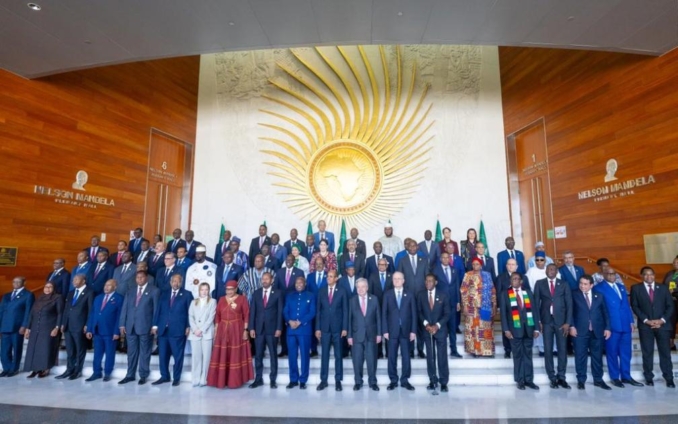
In a significant leadership transition at the 39th Ordinary Session of the African Union Assembly, President Évariste Ndayishimiye of the Republic of Burundi has been elected as the Chairperson of the African Union for 2026. President Ndayishimiye takes the helm from Angola’s President João Manuel Gonçalves Lourenço, inheriting a continent confronted by a resurgence of coups, declining external funding, and a pressing need for fundamental infrastructure development. The summit, convened at the AU headquarters in Ethiopia's capital, was officially launched under a critically important theme: "Assuring Sustainable Water Availability and Safe Sanitation Systems to Achieve the Goals of Agenda 2063."
This strategic pivot towards water security was underscored by outgoing Chair, President Lourenço, who declared the 2026 theme to be far more than just an environmental concern, but rather a "political, moral and strategic priority." With millions across Africa still lacking access to clean water, the African Union is strategically positioning water security as a foundational element for improving public health, ensuring food security, and fostering regional stability. H.E. Mahmoud Ali Youssouf, Chairperson of the AU Commission, further reinforced this perspective, characterizing water as a "collective good" that necessitates careful management to promote peace rather than exacerbate conflict, particularly in regions already grappling with geopolitical turbulence.
Accompanying Burundi's election to the chairmanship, the Assembly confirmed the new Bureau of the Heads of State and Government, which ensures a balanced regional representation. The structure of the 2026 Bureau is as follows: the Chair is held by the Republic of Burundi (representing Central Africa); Ghana assumes the role of First Vice (West Africa); Tanzania is the Second Vice (East Africa); the Third Vice position is yet to be confirmed (North Africa); and Angola serves as the Rapporteur (Southern Africa). Ghana's designation as the First Vice-Chair places the West African nation in a pivotal position within continental decision-making during a period when the region is confronting considerable security challenges, especially in the Sahel.
A recurring and urgent call throughout the summit was the imperative for Africa to move away from its dependency on external donors. Chairperson Youssouf articulated this bluntly, stating that "Institutional reform and financial self-reliance are now imperative as external funding declines." He strongly urged Member States to intensify their efforts in domestic resource mobilization to adequately fund the continent’s key industrialization and energy initiatives. Adding a forward-looking technological dimension to the discussions, Ethiopian Prime Minister Abiy Ahmed challenged the continent to transition from merely reacting to global events to actively shaping them. He highlighted Ethiopia’s significant investments in Artificial Intelligence (AI), including comprehensive plans for a dedicated AI university, as a potential blueprint for Africa to assert ownership over its technological future.
Despite the strong emphasis on development and future-oriented strategies, the persistent shadow of conflict loomed large over the proceedings, indicating that the goal of "Silencing the Guns" remains elusive. UN Secretary-General António Guterres, in a gesture of solidarity, advocated for a stronger UN-AU strategic partnership and reiterated the urgent necessity for UN Security Council reform, specifically championing permanent African representation. Reflecting on his tenure, President Lourenço acknowledged the progress made through the African Continental Free Trade Area (AfCFTA) but noted that the ongoing conflicts in Sudan, the Eastern Democratic Republic of Congo (DRC), and the Sahel constitute the most significant impediments to achieving the 2063 vision. He issued a firm warning against "legitimising coups through subsequent elections," reaffirming the AU's unequivocal zero-tolerance policy for unconstitutional changes of government. As the 39th Summit progresses, the central question remains whether the newly appointed leadership can effectively transform these high-level deliberations into "measurable commitments" that deliver tangible, positive results for the continent’s rapidly expanding youth population.