Why Africa's Biggest Telecom Companies Should Pay Attention to Huawei's Latest AI Framework
Huawei's latest AI framework offers African telecom giants like MTN, Airtel and Orange a roadmap to reduce customer churn, improve contact centers and accelerate AI-driven digital transformation.

Contact centers are where African telecom subscribers decide whether to stay or churn to a competitor and it happens in that thirty minutes they spend on hold after a failed mobile money transaction, or the multi-day email thread that never resolves a simple billing dispute.
That is the vulnerable point and it is where Africa's largest telecom operators are most exposed.
At DTW Ignite 2026 in Copenhagen, TM Forum and Huawei jointly released the IG1465 AI4Contact-Center: AI Transformation Whitepaper v2.0.0 during the event's AI and Data Masterclass. This was made known to the public on June 29, 2026 via a press release.
The document, developed through TM Forum's AI4Contact-Center Workstream, lays out a unified framework for what an AI-native contact center should look like. It shows how operators should measure their progress and what it costs not to move.
For telecom operators across Africa managing millions of subscribers on fragile legacy infrastructure, this whitepaper is that pressure test.
What the Whitepaper Actually Says
The whitepaper introduces the Contact Center Intelligence Maturity Model (CCIMM), a five-level framework spanning from basic rule-based automation (L1) to fully autonomous operations (L5).
Built on three pillars (technical foundation, business productivity and user experience), the CCIMM gives operators a structured roadmap to evaluate where they currently sit and quantify what each stage of AI adoption should deliver in measurable business outcomes.
The whitepaper argues that contact centers must be designed with intelligence as the structural core and should not be layered on top of existing systems as bolt-on plugins. This is a direct challenge to how most operators on the continent have approached AI so far.
It is a common phenomenon in the industry to purchase isolated AI tools for specific functions without integrating them into a coherent, data-sharing infrastructure.
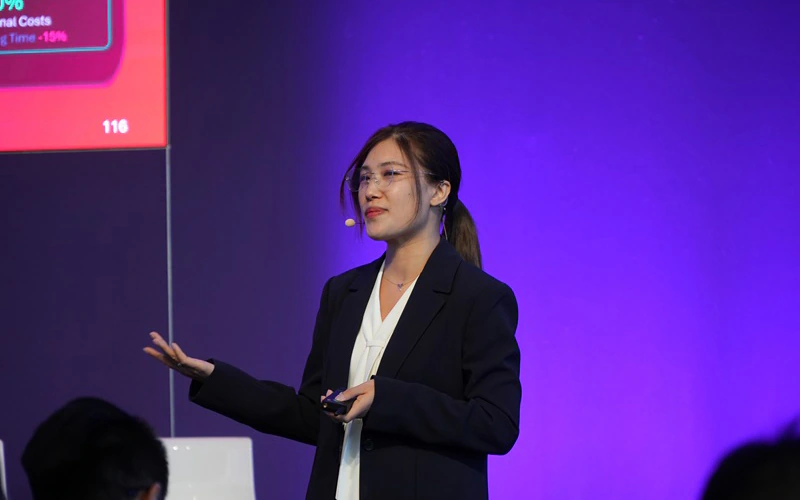
Judith Zhang, Huawei's Contact Center Standards Expert and Co-Chair of the TM Forum AI4Contact-Center Workstream, noted at the launch that voice agents with closed-loop service capabilities and strict compliance with business standard operating procedures are now ready for large-scale commercial deployment.

Africa's Contact Center Problem Is Already Expensive
The global telecom churn rate sat at 21.5% in 2025, one of the highest across major industries. In Africa's prepaid-dominant markets, where subscribers face minimal switching barriers, that figure moves even higher.
Research published in Scientific Reports in late 2025 found that the number of customer service calls a subscriber makes is among the strongest predictors of whether they will churn. The more a customer has to call, the more likely they are to leave.
AI-driven interventions, specifically predictive scoring, proactive outreach and personalized retention offers, have demonstrated a 10 to 25% reduction in voluntary churn in documented carrier deployments, with return on investment typically achieved within six to ten months of deployment.
A McKinsey analysis from early 2026 found that AI agents achieved a 50% reduction in cost per call while simultaneously improving customer satisfaction scores; these two outcomes rarely coexist in traditional service investment.
Latest Tech News
Decode Africa's Digital Transformation
From Startups to Fintech Hubs - We Cover It All.
African operators are not insulated from these dynamics. MTN Group, the continent's largest telecom operator by subscriber count with 301.3 million subscribers as of September 2025, generated service revenue of 160.37 billion rand in the first nine months of 2025.
Even a modest reduction in churn at that scale translates into hundreds of millions of rand in retained revenue.
Huawei's Existing Africa Relationships Make This Urgent
Huawei already has established relationships on the continent. At MWC Barcelona 2025, MTN Group and Huawei signed a strategic Memorandum of Understanding covering AI-driven network operations, fixed wireless broadband expansion, digital infrastructure development and data monetization.
The partnership explicitly targets a transition to Level 4 Autonomous Networks, deploying agentic networks capable of closed-loop optimization across planning, deployment and operations.
In February 2026, Axian Telecom, which operates across Tanzania, Madagascar, Comoros, Senegal and Togo, signed an MoU with Huawei in Shanghai focused on three pillars: digital connectivity, digital finance, and digital operations, with 5G, cloud and AI at the center.

In May 2026, Airtel Tanzania and Huawei met at the Huawei Mini Mobile World Congress in Tanzania to discuss AI-powered core networks, intelligent transmission systems and expanded network coverage.
At the Northern Africa Operations Transformation Forum in 2026, Huawei and African operators jointly launchedthe Northern Africa Digital Operation Transformation Pioneer Club 2.0, with TM Forum's Vice President present to note that AI is transforming operators from traffic pipes into intelligent platforms.
What the new AI4Contact-Center whitepaper does is provide the specific framework for what happens at the customer-facing layer of all those infrastructure investments. Building a Level 4 autonomous network while running a Level 1 contact center creates an internal contradiction where the network improves, but the customer relationship does not catch up.

What African Telecoms Should Take From This
The AI4Contact-Center whitepaper's most practical contribution is the ROI analysis embedded in its maturity model. African operators that have been hesitant to invest in AI-native contact center infrastructure now have a standardized framework from TM Forum to justify that investment internally.
The CCIMM provides evaluation metrics tied directly to business KPIs which bridges the gap between technical implementation and boardroom accountability.
MTN, Airtel, Orange, Axian and the operators building out AI partnerships with Huawei already have the infrastructure conversations underway. The question is whether the customer experience layer follows.
In markets where subscriber retention is structurally difficult and customer service interactions are the most frequent point of contact between operators and users, the contact center is a revenue function.
Treating it as one, with the same urgency being applied to network modernization, is what the CCIMM is designed to make measurable. African telecom leaders should not wait for a domestic competitor to demonstrate this first.