West Africa on High Alert: Leaders Call for Unified Strategy Amid Surging Terror Threats
West African leaders and experts convened in Accra to address escalating security threats, including terrorism and violent extremism, which increasingly impact the region. Vice President Opoku-Agyemang and President Mahama emphasized the critical need for coordinated regional and national responses that integrate security, development, and governance to counter these transnational challenges. Ministers Ablakwa and Mohammed-Mubarak highlighted alarming statistics and the socio-economic roots of the crisis, urging a fundamental shift towards collaborative action and robust intelligence sharing.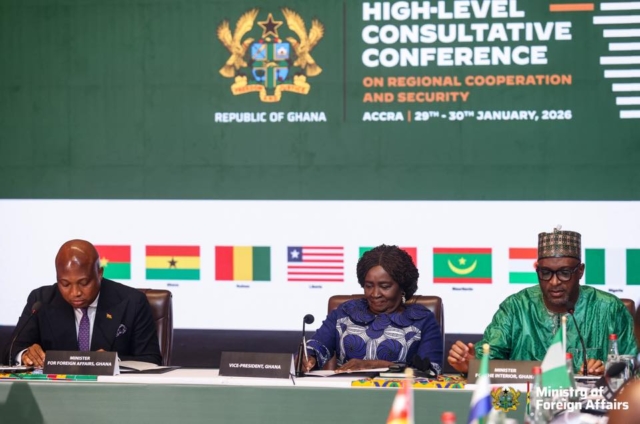
The West African sub-region and the Sahel face an unprecedented and complex security environment, marked by escalating threats that transcend national borders. This critical situation was the central focus of a High-Level Consultative Conference on Regional Cooperation and Security held in Accra, convened under the auspices of President John Mahama in late January 2026. Bringing together ministers, experts, intelligence chiefs, and senior security officials from numerous West African nations, including Burkina Faso, Ghana, Guinea, Liberia, Mali, Mauritania, Niger, Nigeria, Senegal, Sierra Leone, and Togo, alongside representatives from international and regional bodies like the African Union and United Nations Development Programme, the conference aimed to forge a coordinated regional response to these pervasive challenges.
Vice President Professor Jane Naana Opoku-Agyemang delivered the keynote address, underscoring the inadequacy of fragmented approaches against threats like violent extremism, terrorism, organised crime, cyber threats, and youth unemployment. She stressed the need for closer alignment between security strategies, foreign policy, and development agendas, advocating for integrated frameworks that prioritize crisis prevention over mere reaction. Echoing this sentiment, President John Dramani Mahama, speaking at a separate event, highlighted Ghana’s fragile security amid regional instability, urging a comprehensive national response that extends beyond traditional security forces to include citizens, communities, traditional authorities, and civil society. He emphasized that global developments, including the rise of non-state actors and asymmetric warfare, have reshaped security challenges, making national security a shared duty requiring vigilance and public cooperation.
Foreign Affairs Minister Samuel Okudzeto Ablakwa painted a stark picture of the crisis, revealing that West Africa and the Sahel now account for between 47 to 59 percent of all recorded global terrorist incidents, with an average of about 44 lives lost daily. He warned that the epicentre of global terrorism has shifted from the Middle East to this region, with terrorist attacks increasing by over 1,200 percent and the death toll by nearly 3,000 percent over the past 15 years. Minister Ablakwa stressed that these interconnected threats—ranging from extremism in the Sahel and piracy in the Gulf of Guinea to trafficking across porous borders—demand a move beyond episodic diplomacy towards a structured, multidimensional framework for sustained cooperation. He proposed four guiding principles for renewed cooperation: trust, resource mobilization from within the continent, integration of security, development, and governance, and foresight through credible, regionally owned early-warning systems.
Interior Minister Muntaka Mohammed-Mubarak further elaborated on the complexity, noting that extremist groups exploit governance gaps, inter-communal tensions, economic hardship, and environmental pressures to solidify their influence over civilian populations. He highlighted the growing lethality of attacks, including the use of drones, improvised explosive devices, and complex ambushes, and warned of serious spillover risks from the Sahel to coastal West African states like Ghana. Minister Mohammed-Mubarak argued that security responses must be embedded in comprehensive, regionally owned frameworks where development and security are mutually reinforcing, recognizing that terrorism thrives where poverty, unemployment, climate-induced resource scarcity, and weak governance converge.
National Security Coordinator COP Osman Abdul-Razak reinforced these concerns, emphasizing that isolated efforts are insufficient to effectively address transnational threats that claim thousands of lives across the region. He advocated for enhanced cooperation, trust-building, and robust intelligence-sharing mechanisms as essential pillars for any meaningful regional security architecture. The conference itself aimed to review the regional security situation, assess governance and socio-economic drivers of insecurity, examine existing cooperation frameworks, and contribute to a communiqué for an upcoming Heads of State Summit, underscoring the urgent need for frank and productive exchanges among participating intelligence chiefs. Collectively, these leaders underscored that only through strong political commitment, integrated strategies, and genuine regional collaboration can West Africa lay the foundations for lasting peace and shared prosperity, protecting its nations from the existential threats they now face.