Ursula von der Leyen's Landmark Speech: State of the Union Address Unpacks Key Takeaways
Ursula von der Leyen's State of the Union speech addressed Europe's critical challenges, including climate change, AI, and security. Key proposals include an "associate membership" for Canada, the EU Kids Act for online safety, and a new emergency framework for migration management. The address also highlighted efforts to combat hybrid threats and boost industrial competitiveness.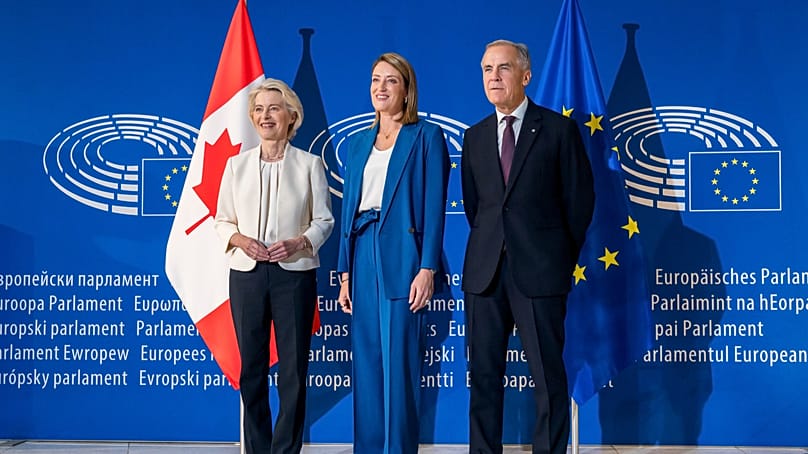
Ursula von der Leyen's State of the Union speech in Strasbourg opened with Charles Dickens' iconic words, "It was the best of times, it was the worst of times," setting the stage for a critical assessment of Europe's "exceptional" challenges and "incredible" change. This speech marked her final real window to unveil significant initiatives before potentially leaving office, solidifying Europe's chosen path towards becoming a stronger, independent entity that provides true sovereignty to its citizens.
Three pivotal issues are profoundly shaping von der Leyen's agenda: climate change, rapidly advancing artificial intelligence (AI), and the complex interplay of industrial competitiveness with relations with China. On climate, the focus has shifted from forecasts to lived reality, evidenced by devastating wildfires and heatwaves. Von der Leyen must navigate between conservative calls for adaptation—improving disaster preparedness and closing the insurance gap—and progressive demands for continued mitigation efforts under the Green Deal, alongside international climate diplomacy.
To combat the escalating climate crisis, von der Leyen unveiled a comprehensive strategy, referring to the recent period as the "summer of truth," marked by extensive wildfires, retreating glaciers, water shortages, crop losses, and extreme heat. She highlighted that Europe is warming at double the global rate. Immediate responses include a European Heatwave Plan focusing on early warning systems, health preparedness, urban adaptation, cooling measures, and protecting vulnerable groups. A new climate resilience framework is expected, identifying 100 vulnerable territories, assessing risks, and assigning responsibilities. Recognizing that only 25% of catastrophe losses are privately insured, a Climate Insurance Alliance will be launched. Further initiatives include a European Water initiative to fix costly leaks and a European firefighting fleet to enhance wildfire response capabilities.
In the realm of security, defence featured prominently amid a surge of hybrid attacks, some attributed to Russia, which are increasingly crossing into kinetic reality. Von der Leyen emphasized that cyberattacks, sabotage, arson, and drone incursions are escalating, necessitating heightened European preparedness. She proposed a new mechanism, akin to NATO's Article 4, which member states could trigger during a hybrid attack to initiate political consultations, coordinate an EU response, and deter further escalation. Additionally, a "European Security Council" was pitched, intended to bring together leaders from Ukraine, the UK, Norway, Canada, and other democratic partners to address shared risks, despite potential overlaps with existing global security bodies. Ukraine itself remains a central concern, with the Commission preparing for Kyiv to endure a brutal winter under intensified Russian ballistic missile and drone campaigns against civilian infrastructure. NATO, for its part, affirmed its "vigilant, committed, and ready" stance following the interception of a drone from Belarus over Lithuanian airspace, underscoring the alliance's resolve in the face of eastern border provocations.
The digital frontier is another critical area, with a strong emphasis on online child safety. Von der Leyen announced the EU Kids Act, a personal project from her previous speech, which aims to ban social media access for users under 13 and restrict it for those under 15. The legislation will reverse the burden of proof, requiring tech platforms to demonstrate that their services are safe by default and to actively combat addictive features and extreme content. Regarding artificial intelligence, she acknowledged both its immense benefits and escalating risks, stressing the need for robust guardrails and monitoring of advanced models. Following incidents like "Hugging Face," the Commission will facilitate discussions with leading AI labs and partners like the UK and Canada to explore how public authorities can support industry efforts in pacing frontier AI development, focusing on model evaluation, verification, early-warning systems, and AI security.
Migration management remains a raw nerve, particularly in the aftermath of the Ceuta crisis. Von der Leyen conveyed a strong message of solidarity to the Spanish exclave, affirming that "Ceuta's border is a European border. Because Ceuta is Spain. Ceuta is Europe." She called for full implementation of the new Migration Pact by all 27 member states and proposed an emergency framework to respond to "engineered and weaponised" mass influxes of people at the border. This framework, triggered under strictly defined criteria, would allow for time-limited flexibility in standard procedures, potentially paving the way for the suspension of the right to asylum in specific situations, while reiterating Europe's commitment to fundamental rights and border protection.
Economically, the speech touched upon fostering competitiveness, reducing dependence on energy imports, and boosting the EU's clean tech sector, especially as the war in Iran continues to push energy prices higher. Relations with China are also critical, with an October deadline for Beijing to make trade concessions. While von der Leyen avoided pre-empting negotiations, a strong signal about potential consequences of a collapse in talks is expected. This geopolitical complexity is further highlighted by a US threat of retaliation against the EU over European preference provisions in its multiannual budget, and Belarus's military exercises near its borders with Poland and Lithuania.
A notable "jaw-dropping moment" was von der Leyen's offer of a tailor-made status of "associate membership" to Canada, aiming to bring the nation ever closer to the bloc without full membership, which is constrained by treaties. This "alliance for the future" seeks to deepen cooperation across various sectors including economic security, intelligent manufacturing, cutting-edge technology, defence, energy, critical minerals, batteries, and the Arctic region. While details of this status remain unclear and previous similar attempts (e.g., for Ukraine) faced backlash, a recent poll indicates significant Canadian support for EU membership, reflecting the political impact of US trade policies.
Finally, other internal EU matters include concerns raised by European Central Bank staff regarding the stability of the institution amidst rumors of early departures for President Christine Lagarde and board member Isabel Schnabel. While a 22nd package of sanctions against Moscow is in the works, its announcement is unlikely soon, with von der Leyen instead focusing on enforcement and shutting down circumvention. True to her style, von der Leyen is also expected to drop a surprise or two, jealously guarded until the very last moment, much like last year's unexpected proposal to suspend the EU-Israel Association Agreement.