High Stakes: Wike's Fiery Standoff with APC Governors Fuels 2027 Election Drama
A political rift has intensified between FCT Minister Nyesom Wike and APC governors, moving beyond public support for President Tinubu's 2027 re-election to deeper battles for influence. This disagreement is fueled by succession politics, control of party structures, and strategic positioning for future power. The conflict highlights evolving alliances that will shape Nigeria's political landscape leading up to and beyond the next general election.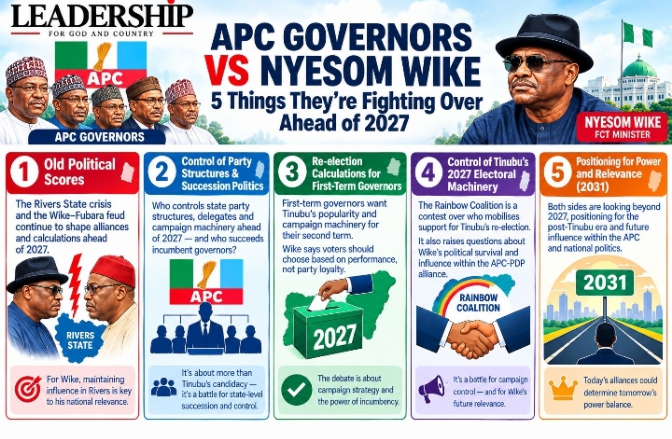
A significant political disagreement has emerged between the Minister of the Federal Capital Territory (FCT), Nyesom Wike, and governors elected under the All Progressives Congress (APC) platform. While both factions publicly endorse President Bola Tinubu’s re-election bid in 2027, the dispute extends beyond mere public exchanges, revealing deeper struggles for political influence, control over party structures, succession plans, and the management of the ruling party’s electoral machinery in anticipation of the next general election.
The growing rift is primarily driven by five major issues. Firstly, it involves the settling of old political scores, particularly the ongoing political battle in Rivers State between Wike and Governor Siminalayi Fubara. Despite a reported settlement, the underlying tensions persist, with Rivers State serving as a crucial backdrop for Wike’s political calculations and his efforts to maintain a strong political structure. Political observers link this renewed confrontation with APC governors to the unresolved Rivers political crisis, where the control of the state's political future remains fiercely contested, central to Wike's national relevance.
Secondly, the disagreement revolves around the control of party structures and succession politics. Ahead of the 2027 elections, second-term APC governors are strategically positioning their allies for succession. This involves asserting control over state party executives, delegates, and campaign structures, which are vital in determining gubernatorial candidates. Wike challenges the notion that support for President Tinubu automatically grants governors absolute control over every election within their states, arguing against their desire to leverage the APC’s presidential campaign to bolster their preferred successors and legislative candidates.
Thirdly, the dispute encompasses the re-election calculations for first-term governors. For APC governors elected in 2023, securing a second term in 2027 is paramount. They perceive President Tinubu’s popularity and campaign machinery as a significant advantage for their own re-election campaigns, advocating for a unified party message from the presidency down to state-level elections. Wike, however, contends that governors should earn support based on their performance and local political realities, asserting that voters can differentiate their support between the presidency and gubernatorial or legislative elections.
Fourthly, the contention also involves the control of Tinubu’s 2027 electoral machinery and Wike’s political survival. Wike's 'Rainbow Coalition' is envisioned as a cross-party political arrangement designed to attract supporters from various political parties for Tinubu’s re-election, operating separately from the APC’s official campaign structure and allowing participating parties to field candidates in other elections. The APC Governors’ Forum, conversely, opposes any arrangement that could weaken APC candidates or establish parallel campaign structures. For Wike, remaining a key ally of Tinubu while retaining influence within the PDP is a crucial strategy for his political future and unique positioning in Nigeria’s political landscape leading up to 2027.
Finally, the current dispute is also seen as positioning for power and relevance ahead of the 2031 political transition. Several governors will complete their constitutional terms before 2031, prompting them to build alliances for future roles within the APC and national politics. Wike is similarly focused on preserving his national political influence through strategic alliances centered on Tinubu’s presidency, while maintaining his identity within the PDP. Both camps are looking beyond the immediate 2027 election to the future balance of power after Tinubu’s second term.
Ultimately, this public debate, while seemingly focused on Wike’s Rainbow Coalition, signifies much more than a single political alliance. It integrates unresolved rivalries in Rivers State, intense struggles over party control and succession, divergent campaign strategies for 2027, and a broader competition over who will wield the most significant political influence within and around President Tinubu’s political coalition. This emerging battle indicates that the road to the 2027 elections is already actively shaping alliances and rivalries that are poised to define Nigerian politics well beyond the presidential contest.