Unveiled: Who Made the Coveted All-NBA Playoff First and Second Teams!
In a hypothetical look at the 2026 NBA postseason, new All-Playoffs teams and a Playoffs MVP award highlight top performers across the entire tournament. Jalen Brunson of the New York Knicks is crowned Playoffs MVP, leading a First Team featuring stars like Victor Wembanyama and Shai Gilgeous-Alexander for their exceptional contributions.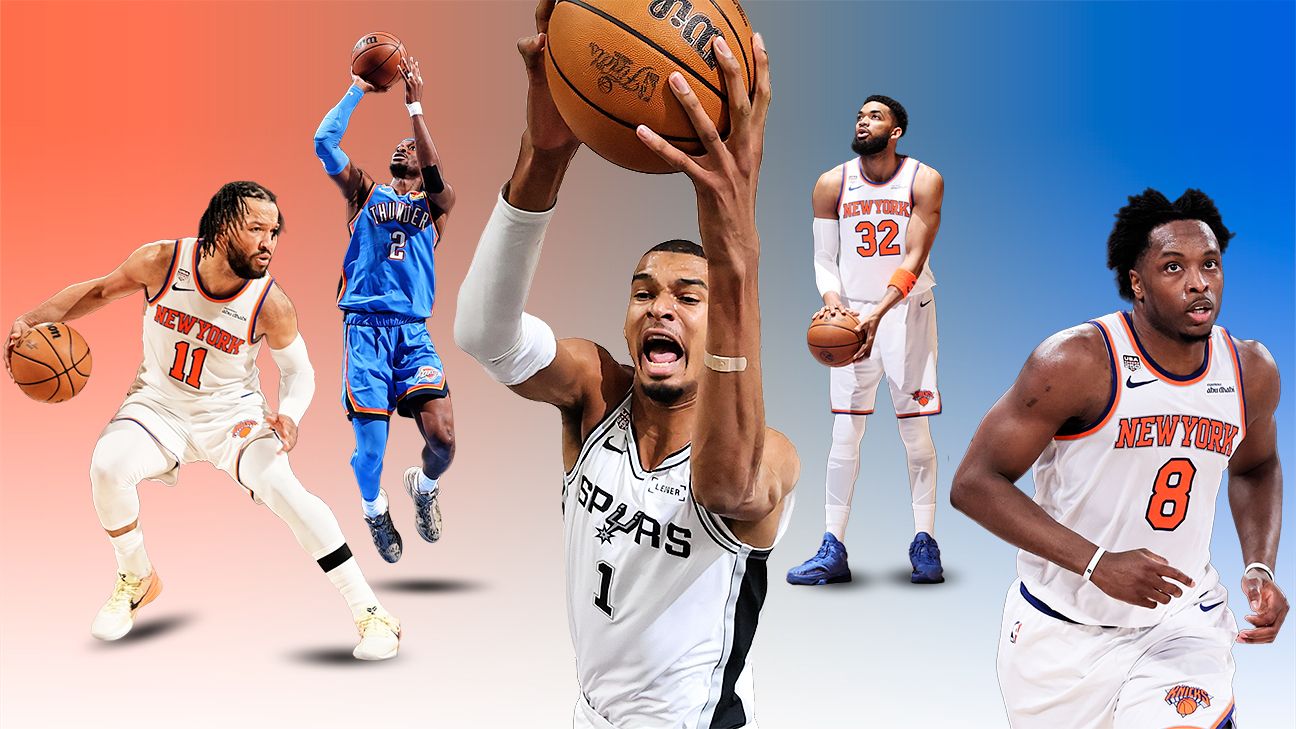
The NBA's expansion of awards in recent years, including Clutch Player of the Year and conference finals MVP, still leaves a gap: a singular honor for the entire postseason. To address this, hypothetical 2026 All-Playoffs first and second teams have been awarded, recognizing the 10 best players since the playoffs began. Additionally, the 2026 Playoffs MVP Award highlights the single most valuable postseason performer. These honors consider both the quality and quantity of play, naturally rewarding players whose teams advanced further and accrued more value throughout the tournament. This approach mirrors the tournament format logic, as seen in the 2024 Olympics FIBA "All-Star Five" teams, which featured players from both final four teams and quarterfinalists.
First Team:
Jalen Brunson, New York Knicks (MVP): Brunson secured the overall Playoffs MVP, adding to his Finals and conference finals MVP awards. The underdog champion became the 13th player since 1984 to average at least 28 points for a title winner, leading the 2025-26 playoff field with 28.4 PPG. His legendary 45-point performance in the Finals clincher cemented his status. Brunson was particularly effective in clutch moments, scoring 38 clutch points, while the rest of the Knicks combined for 35.
Victor Wembanyama, San Antonio Spurs: In his debut postseason, the 22-year-old Wembanyama showcased immense talent, eliminating the defending champion Oklahoma City Thunder in Game 7, winning conference finals MVP, and reaching the Finals. He led the playoff field in advanced statistics like ESPN's net points and value over replacement player. Despite growing fatigued in later rounds, struggling with clutch scoring (outside Game 1 of the conference finals), and a potential suspension due to flagrant foul points, Wembanyama averaged 23.8 points, 10.9 rebounds, and 3.5 blocks. His arrival as a central figure in the league, alongside the Knicks' title, defined the 2025-26 playoffs.
Karl-Anthony Towns, New York Knicks: The Knicks' success dramatically improved after Game 3 of their first-round series when Towns was given more responsibility, initiating a dominant stretch. While his 15.9 PPG were his lowest since his first Timberwolves postseason, Towns' importance was evident in his on/off differential, which was the largest on the championship roster. The Knicks were exceptionally dominant with him on the court and merely decent without him, leading to Towns ranking second in total playoff net points, behind only Wembanyama.
OG Anunoby, New York Knicks: Despite missing two second-round games due to injury, Anunoby's postseason numbers were exceptional. Offensively, he contributed 20.1 PPG on 56% shooting, including an outstanding 49% from beyond the arc. He ranks first in 3-point accuracy among 94 NBA players with at least 75 playoff 3-point attempts who won a championship. Defensively, Anunoby effectively guarded All-Star wings and guards, averaging 1.5 steals and 1.1 blocks. His tip-in to complete the Knicks' record-setting 29-point comeback in Game 4 of the Finals is considered a defining moment of their triumph, making up for his missed postseason appearance during his first ring in Toronto.
Shai Gilgeous-Alexander, Oklahoma City Thunder: The back-to-back regular-season MVP was an easy choice for this honor despite not meeting his usual high standard in most of his team's conference finals loss to the Spurs. Gilgeous-Alexander dominated the first two rounds, sweeping the Phoenix Suns and Los Angeles Lakers. He delivered in Game 7 of the conference finals with 35 points and nine assists on 12-for-21 shooting in a losing effort. He ranked third among all players this postseason in points (27.6) and assists (7.9) per game, bringing his team within one win of the Finals.
Second Team:
Stephon Castle, San Antonio Spurs: In his rookie postseason, Castle averaged 18.2 points and 6.1 assists, serving as the Spurs' primary defender on elite guards like Brunson, Gilgeous-Alexander, Julius Randle, and Deni Avdija. While he battled turnover issues and inconsistent shooting, his two-way contributions were vital to San Antonio's Finals run. He out-performed teammate Dylan Harper in minutes, points, and assists this postseason.
Mikal Bridges, New York Knicks: Early in the postseason, Bridges' inclusion on an All-Playoffs team seemed unlikely; he averaged just 7.2 points, 1.4 rebounds, and 1.4 assists on 44% shooting through five games against Atlanta. However, Knicks coach Mike Brown maintained Bridges in the starting lineup, and Bridges rediscovered his form. He caught fire in the closeout game in Atlanta, then averaged 18.7 points, 4.0 rebounds, and 3.1 assists on 63% shooting over the next nine games before a slight dip in the Finals.
Alex Caruso, Oklahoma City Thunder: Caruso proved to be the ultimate role player, demonstrating a significant impact with a plus-16.4 net rating on court compared to a minus-4.7 without him, a 21.1-point swing. He defended a wide range of players, from Wembanyama to Castle to James, and shot 47% from 3-point range. Against the Spurs in the conference finals, Caruso's 50% (20-for-40) 3-point marksmanship forced the Spurs to alter their defensive strategies, and his 14.9 PPG in that series marked a career high for any playoff series.
Jarrett Allen, Cleveland Cavaliers: Allen earned this spot over frontcourt partner Evan Mobley, representing a Cavaliers squad that reached the conference finals. Allen performed his best in critical moments, delivering 22 points and 19 rebounds in a Game 7 win over the Toronto Raptors, and 23 points and seven boards in a Game 7 win over the Detroit Pistons. Furthermore, the Cavaliers had a plus-6.8 net rating in the playoffs when Allen played without Mobley, versus a minus-9.0 net rating when Mobley played without Allen, per databallr.
Jaden McDaniels, Minnesota Timberwolves: Few candidates emerged from teams eliminated before the conference finals. While Cade Cunningham was considered for his 28.1 PPG (second only to Brunson) for Detroit, his struggles in key losses and high turnover rate prevented his selection. The Timberwolves, however, impressed with an upset over the Nuggets and a respectable 4-2 loss to the Spurs, despite significant injuries including Anthony Edwards. McDaniels was a defensive stalwart throughout their run, frustrating star point guards Jamal Murray (who averaged significantly fewer points against McDaniels) and De'Aaron Fox. Despite shooting only 24% from three, McDaniels boosted his scoring when needed due to injuries, highlighted by a 32-point performance in their closeout win over Denver, securing his spot on the 2026 All-Playoffs team.