Trump's 'Board of Peace' Debacle: Logo Scandal, Canada Withdrawal, and European Rejection
Donald Trump launched his controversial "Board of Peace" at the World Economic Forum, featuring a gold logo resembling the UN emblem but focused on North America. Initially aimed at Gaza, its mandate expanded to global conflict resolution with a $1 billion membership fee and Trump as chairman for life. While some nations joined, many European allies, including Canada, declined due to concerns over its scope and financial demands.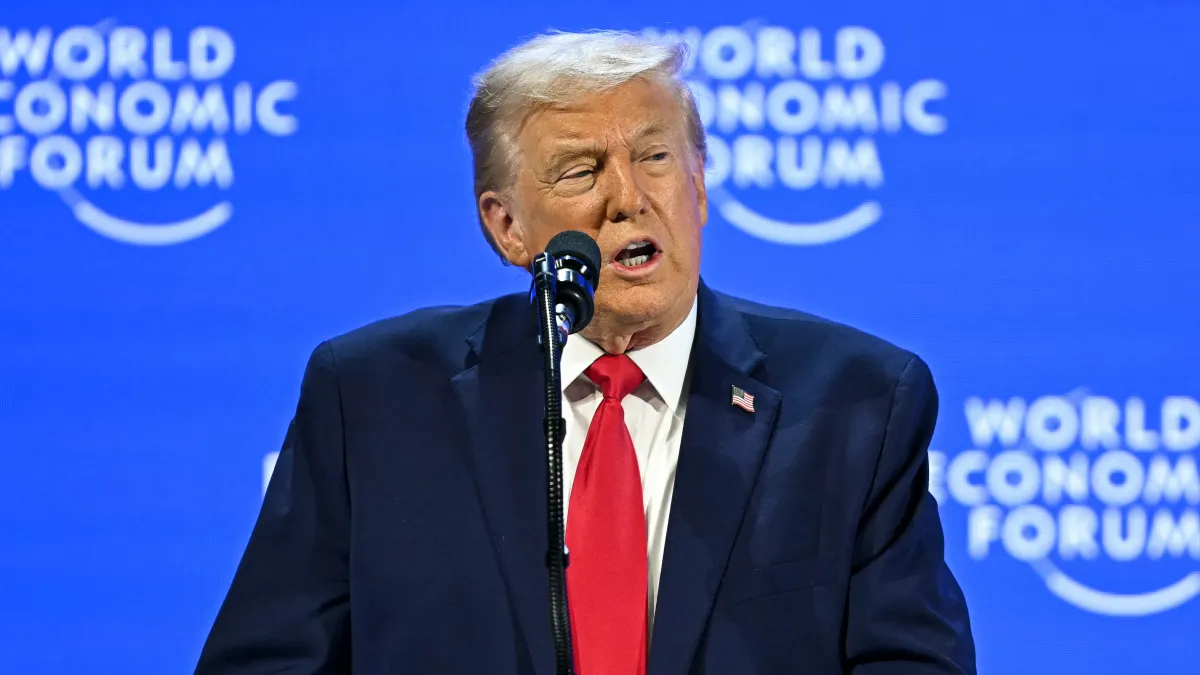
Donald Trump's recently launched "Board of Peace" (BoP) initiative, unveiled at the World Economic Forum in Davos, has quickly become a focal point of international discussion and controversy. The new global body, intended by Trump to resolve international conflicts and reshape the postwar global order, has drawn particular attention due to its emblem and ambitious scope.
A striking resemblance has been noted between the BoP's new gold-colored logo and the United Nations emblem. Both feature a globe flanked by olive branches. However, Trump's version is distinct: it is entirely in gold, an aesthetic consistent with his personal style, and notably, its globe depicts only North America and parts of South America, unlike the UN's which is centered on the North Pole to show the whole world.
This US-centric imagery, coupled with the lavish gold treatment, led social media users and critics to suggest it symbolized a US-led American region, potentially implying US protection or even a desire to sideline the UN. Trump's well-documented affinity for gold, evident in his Oval Office renovations, gold-themed products, and gifts from foreign leaders, reinforces this association.
The initiative's mandate has expanded significantly since its initial conception. First endorsed in November by the UN Security Council, the BoP was initially understood to focus on brokering a ceasefire and overseeing reconstruction in Gaza. However, Trump has since positioned it as a broader global body tasked with resolving international conflicts of all types, with himself as chairman for life, possessing extensive executive powers including the ability to veto decisions and remove members.
The board's 11-page charter reportedly makes no specific mention of Gaza, underscoring this expanded ambition.
Membership in the Board of Peace requires countries to pay a $1 billion fee to become a permanent member. While Trump claimed that "every country" wants to join, and a senior administration official stated around 35 nations had agreed, many significant US allies and European countries have either declined or expressed concerns.
Countries that have agreed to join include Middle East allies such as Israel, Saudi Arabia, the United Arab Emirates, Bahrain, Jordan, Qatar, and Egypt, along with NATO members Turkey and Hungary, Armenia, Azerbaijan, Morocco, Pakistan, Indonesia, Kosovo, Uzbekistan, Kazakhstan, Paraguay, and Vietnam. Belarusian President Alexander Lukashenko also accepted an invitation.
Conversely, several European nations, including Norway, Sweden, France, Italy, and the UK, have declined participation, with Greece's Prime Minister Kyriakos Mitsotakis stating that the initiative "goes way beyond UN Security Council mandate" and creates a parallel structure. Concerns were also raised about the disproportionate powers granted to Trump and the invitation of leaders like Russia's President Vladimir Putin. Trump, however, asserted that the board would "work with" the UN to end global conflict, acknowledging the UN's "tremendous potential" while suggesting it had not been fully utilized.
Canada initially accepted the invitation in principle, but its finance minister, François-Philippe Champagne, later stated that Canada did not plan to pay the $1 billion fee. Canadian Prime Minister Mark Carney also criticized Trump's aggressive behavior, describing a "rupture" in the previous "rules-based" world order.
In response, Trump publicly withdrew Canada's invitation, telling Carney, "Canada lives because of the United States. Remember that, Mark, the next time you make your statements." Carney retorted, "Canada thrives because we are Canadian." This exchange highlighted the diplomatic tensions surrounding the BoP.