Top 10 Exoplanets: Exploring the Possibilities of Life Beyond Earth
Scientists have identified thousands of exoplanets beyond our solar system. Check out the top 10 exoplanets believed could hold clues to life beyond Earth and the future of space discovery.
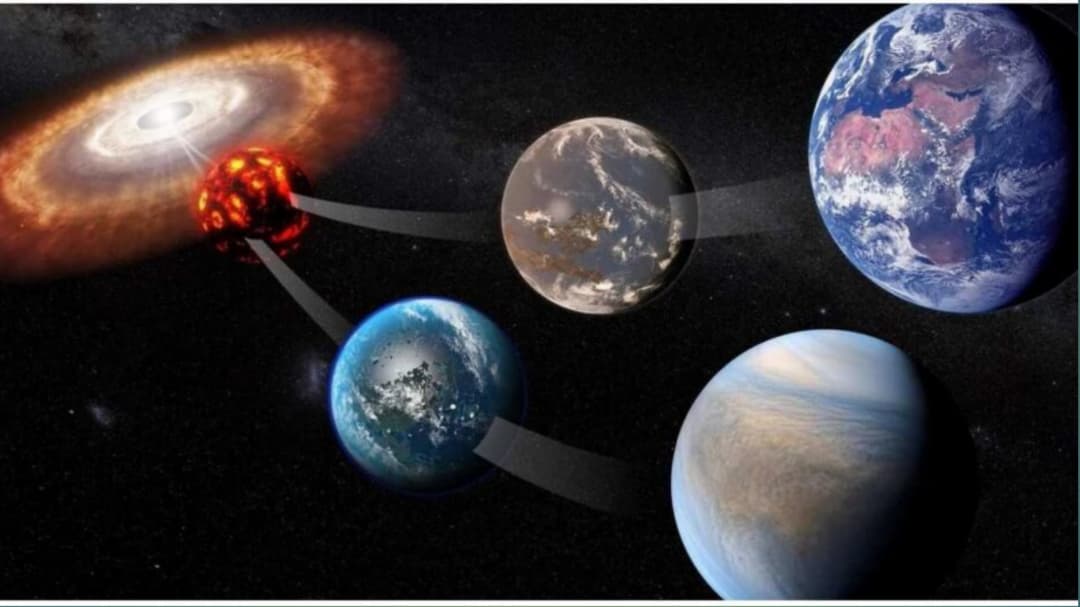
Exoplanets are planets that orbit stars outside the Sun’s system.
With advanced telescopes and improved detection methods, these planets that may possess the essential ingredients for life: water, stable temperatures, and protective atmospheres, are now being identified.
Missions such as the Kepler Space Telescope and the James Webb Space Telescope have transformed the study of distant worlds.
Rather than simply asking whether planets exist beyond our solar system, scientists are now asking a deeper question. Could any of them support life?
Below are ten of the most intriguing exoplanets currently shaping the conversation.
1. Proxima Centauri b
Located about 4.2 light-years away, Proxima Centauri b is the closest known exoplanet to Earth. It orbits a red dwarf star within the habitable zone, making it one of the most studied candidates. Scientists are still unsure whether strong stellar radiation has stripped away its atmosphere, which would affect its ability to support life.
2. TRAPPIST-1e
Part of a remarkable seven-planet system discovered in 2017, TRAPPIST-1e is Earth-sized and likely rocky. Its position within the habitable zone and potential for liquid water make it one of the strongest contenders for habitability among known exoplanets.
3. Kepler-452b
Often described as an “Earth cousin,” Kepler-452b orbits a Sun-like star and is about 60 percent larger than Earth. Its longer orbital period and location within the habitable zone suggest it may have conditions suitable for liquid water, though its true surface environment remains unknown.
4. LHS 1140 b
This dense, rocky planet lies about 40 light-years away and may possess a thick atmosphere. Observations suggest it could have oceans or ice-covered surfaces, making it a prime target for atmospheric studies using advanced telescopes.
5. K2-18b
K2-18b has attracted significant scientific interest because water vapor has been detected in its atmosphere. Located roughly 120 light-years away, it is larger than Earth but may host conditions that allow liquid water beneath its atmospheric layers.
6. Kepler-186f
Kepler-186f was the first Earth-sized planet discovered within a star’s habitable zone. Its discovery marked a major milestone in exoplanet research, proving that potentially habitable rocky planets may be common throughout the galaxy.
7. TOI 700 d
Discovered by TESS, TOI 700 d is another Earth-sized planet located in a stable habitable zone. Scientists consider it important because its host star is relatively quiet compared to other red dwarfs, increasing the chances of atmospheric stability.
8. Gliese 667 Cc
Orbiting within a triple-star system, Gliese 667 Cc receives a similar amount of energy from its star as Earth receives from the Sun. Its rocky nature and favorable temperature estimates place it among the most intriguing candidates for further observation.
9. WASP-96b
Unlike many rocky candidates, WASP-96b is a gas giant. Although it is unlikely to host life itself, it has provided valuable insights into atmospheric chemistry. Observations by the James Webb Space Telescope revealed detailed water signatures, helping scientists refine techniques used to analyze potentially habitable worlds.
10. HD 209458 b
Known informally as “Osiris,” this planet was the first exoplanet observed with a detectable atmosphere. While it is far too hot for life, its discovery helped scientists understand atmospheric escape and planetary evolution, paving the way for modern habitability studies.
Challenges in Finding Life Beyond Earth

Despite exciting discoveries, confirming life on another planet remains extremely difficult.
The vast distances involved mean spacecraft cannot yet travel to these worlds. Instead, scientists rely on indirect evidence gathered through light analysis and computer modeling.
Another challenge is interpretation. Chemical signals that appear biological may also result from volcanic or atmospheric processes. Multiple lines of evidence must therefore be gathered before suggesting the presence of life.

Technological limitations also play a role. Even the most powerful telescopes can only observe faint signals from distant stars. However, rapid improvements in space observation technology continue to expand what scientists can detect.
A New Era of Cosmic Discovery

The search for habitable exoplanets represents one of the most exciting scientific pursuits of the modern era.
Each discovery expands understanding of how planets form and how common Earth-like environments may be across the galaxy.
Future missions and next-generation telescopes are expected to analyze planetary atmospheres with unprecedented precision.
As technology advances, scientists may one day identify unmistakable signs of biology beyond Earth.
Until then, these ten exoplanets serve as reminders that the universe is far larger and more complex than once imagined and that the possibility of life beyond Earth remains an open and fascinating question.