Tesla's Cybercab Shocker: Autonomous Taxi Reportedly Hides Manual Controls!
The Tesla Cybercab, launched without physical controls, surprisingly features a hidden virtual joystick for manual operation. Discovered by a passenger, this interface suggests an engineering or service mode, allowing staff to maneuver the autonomous vehicle, particularly for tasks like charging, despite its self-driving design.
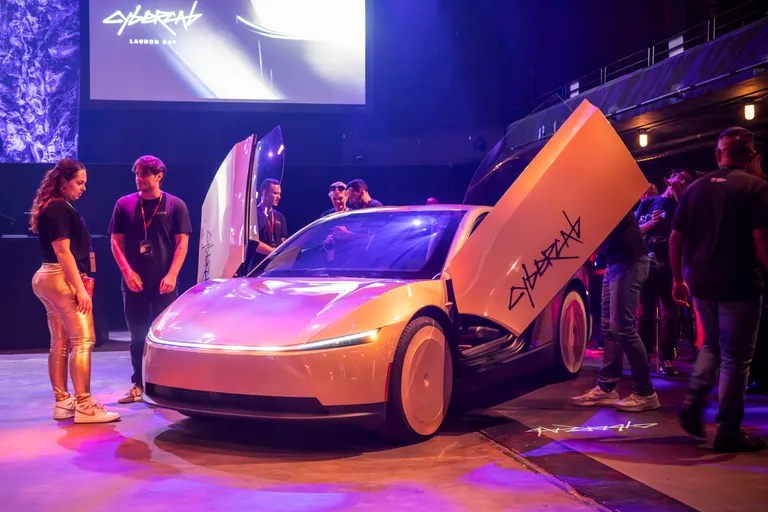
A highly anticipated autonomous vehicle, ‘The Tesla Cybercab,’ has recently debuted in Austin, Texas, making headlines for its radical design that completely omits traditional manual controls like a steering wheel and pedals.
It was engineered to operate solely through an advanced network of cameras and sensors, the Cybercab leverages technology akin to Tesla's Full Self-Driving (Supervised) system, offering a glimpse into the future of urban mobility where human intervention is seemingly obsolete.
However, a surprising discovery by a passenger has revealed an intriguing contradiction to this fully autonomous vision.
During a ride in Austin, passenger Matthew Skrzypczack encountered an unexpected virtual joystick displayed on the Cybercab’s central screen.
This digital interface appeared to provide an option for manual vehicle operation, despite the vehicle's publicized lack of physical controls.
Skrzypczack, who shared his experience on X, noted, “When I got in the vehicle, the display was in a different configuration with a virtual joystick for manual driving. I have a feeling I wasn’t supposed to see this… but I tried to manually drive the vehicle anyway!”
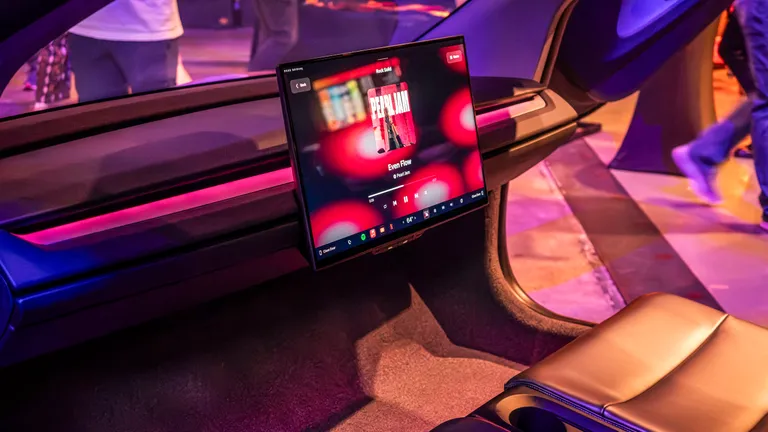
This discovery immediately raised questions about the vehicle's true operational capabilities and the extent of its autonomy.
Upon attempting to use the virtual joystick, Skrzypczack observed the screen prompt him to "Press and hold joystick" and then "Swipe up or down to shift gears."
Despite his efforts, the Cybercab remained stationary, and he was unable to engage any gears or initiate movement.
His attempts to manually control the vehicle were unsuccessful, leading him to contact Tesla support for assistance.
The presence of such a manual control option, even if virtual and seemingly inaccessible to passengers, suggests a hidden layer of functionality within the Cybercab's system.
While Tesla has not officially commented on this finding, speculation suggests that the virtual joystick likely functions as part of an engineering or service mode.
This mode would be intended exclusively for Tesla employees or Cybercab technicians, allowing them to perform specific tasks such as diagnostic checks or low-speed maneuvering.
It is plausible that the joystick is designed to control the vehicle only at minimal speeds, facilitating precise positioning within a Cybercab facility or enabling strategic alignment for charging purposes.
Latest Tech News
Decode Africa's Digital Transformation
From Startups to Fintech Hubs - We Cover It All.
The video footage also showed frozen camera views pointing towards Tesla Superchargers, further hinting at the vehicle's previous operation in a service-oriented capacity for charging.
Reinforcing this theory, another observation shared on X by user @Serenity_Now247 depicted a Cybercab being manually moved by a Tesla employee.
The video captured an instance where the employee initially parked the vehicle slightly out of reach of a Supercharger cable. After a brief period, the employee manually adjusted the Cybercab's position to enable it to connect for charging.
This real-world application of manual repositioning by staff underscores the practical necessity of such controls, even in a vehicle designed for full autonomy, ensuring operational efficiency and maintenance readiness.
Thus, while the Cybercab is presented as a fully autonomous marvel, it appears that "secret" manual controls, albeit virtual and reserved for specific personnel, are integral to its deployment and servicing.