Tensions Rise as #FreeNnamdiKanu Protests Erupt Across Abuja and Abia Amid Political Firestorm
Protests demanding Nnamdi Kanu’s release grip Abuja and Umuahia, disrupting activities and sparking political tension. Government, activists, and analysts clash over justice, security, and clemency.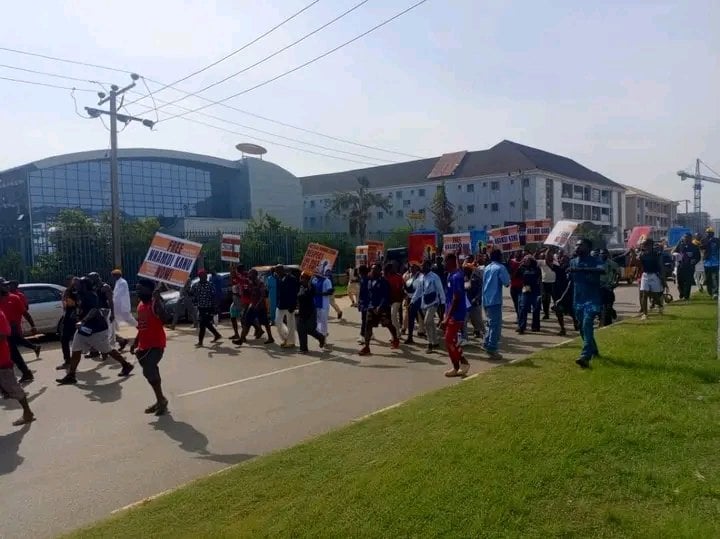
Massive #FreeNnamdiKanu protests erupted across Nigeria’s Federal Capital Territory (FCT) Abuja and parts of Abia State, particularly Umuahia, on Monday, October 20, demanding the release of Nnamdi Kanu, leader of the proscribed Indigenous People of Biafra (IPOB). The demonstrations, led by Omoyele Sowore, a prominent human rights activist caused widespread disruption to business operations and movement in key areas, including Unity Fountain, Federal Secretariat, and several commercial centers. Ministries, agencies, and banks were forced to shut down due to security concerns, while many civil servants and traders reported financial losses.
A similar shutdown gripped Umuahia, Kanu’s hometown, where residents deserted markets, shops, and streets in solidarity.
Kanu has been in the Department of State Services (DSS) custody since his re-arrest in June 2021, facing a seven-count charge of terrorism and treasonable felony. Initially arrested in 2015 and released on bail in 2017, he reportedly fled following a military raid on his home. Despite a 2022 Court of Appeal judgment ordering his release, the government has yet to comply. Recently, his “no case submission” was dismissed, and the Nigerian Medical Association (NMA) certified him fit to stand trial, with proceedings set to resume on October 23.
The protests drew sharp criticism from the All Progressives Congress (APC) and the Presidency, which branded them as politically motivated. APC’s Lagos spokesperson, Seye Oladejo, described the demonstrations as “reckless” and an “act of desperation” allegedly sponsored by opposition figures such as Atiku Abubakar and some South-East politicians. Similarly, Presidential Adviser Sunday Dare warned that street protests should not be used to influence judicial processes, calling them “counterproductive and inimical to the rule of law.”
Civil society group Nigeria First Project Initiative echoed this sentiment, warning that politically charged protests could endanger national security. The group cited Kanu’s 2017 bail violation, expressing fears he might attempt to flee again if released.
In contrast, Sowore condemned the police crackdown on what he called peaceful demonstrations, asserting that protesters maintained a nonviolent stance. He accused law enforcement of using tear gas, rubber bullets, and even live ammunition at protest sites in Utako, Gudu, Apo, and the FCT Police Command. Several protesters, including journalists and Kanu’s lawyer, Aloy Ejimakor, were arrested. Security agencies such as the Department of State Services (DSS), Guards Brigade, and NSCDC fortified major parts of the city, causing massive gridlock and restricting access to the Federal Secretariat and Presidential Villa.
Presidential spokesperson Bayo Onanuga accused Ejimakor of unprofessional conduct for “abandoning legal duty for street activism,” calling for disciplinary action. Meanwhile, Dan Iwuanyanwu, National Chairman of the Zenith Labour Party (ZLP), alleged that powerful South-East politicians and business figures were quietly supporting Kanu’s detention, fearing his release could end their political influence due to his widespread popularity.
Political analyst Reuben Abati drew global parallels between the #FreeNnamdiKanu protests and other youth-led movements in countries like Nepal, Madagascar, and Morocco, noting that such activism often grows out of frustration with governance and inequality. He denounced state brutality and argued that peaceful protest is a constitutional right, while criticizing the government’s fear-driven response. Abati also highlighted the irony of Sowore, a Yoruba activist, leading a cause centered on Igbo self-determination, exposing deep contradictions within Nigeria’s ethnic politics.
Legal experts continue to question the legality and morality of Kanu’s prolonged detention. Professor Okoh Akubo (SAN) described the case as “constitutionally troubling,” while Professor Eno Cyprain called for Kanu’s immediate and unconditional release, with possible restrictions on inflammatory speech. Emmanuel Onwubiko of HURIWA condemned the government’s stance as “collective punishment,” while security analyst Dr. Kabiru Adamu labeled the decade-long trial a national disaster, urging a political resolution involving northern and southeastern stakeholders.
Adamu further warned that the government’s hardline approach risked turning Kanu into a martyr, noting that the ongoing case has become both symbolic and polarizing. Many Nigerians have questioned whether President Bola Tinubu will consider presidential clemency, especially after granting pardons to 175 prisoners, including convicted murderers and drug traffickers. Analysts speculate that any decision on Kanu’s fate might be strategically delayed until the 2027 general elections to serve political ends.