Tanzania's Shadowy Inauguration: Suluhu Sworn Amidst Scrutiny and Missing Crowds
Tanzanian President Samia Suluhu Hassan's second term inauguration on November 3, 2025, was overshadowed by a deeply controversial election marred by violence, opposition suppression, and international criticism. Zambian President Hakainde Hichilema faced backlash for attending, accused of "selective morality" given the widespread concerns over democratic integrity. The aftermath saw a crackdown on information and reports of numerous casualties.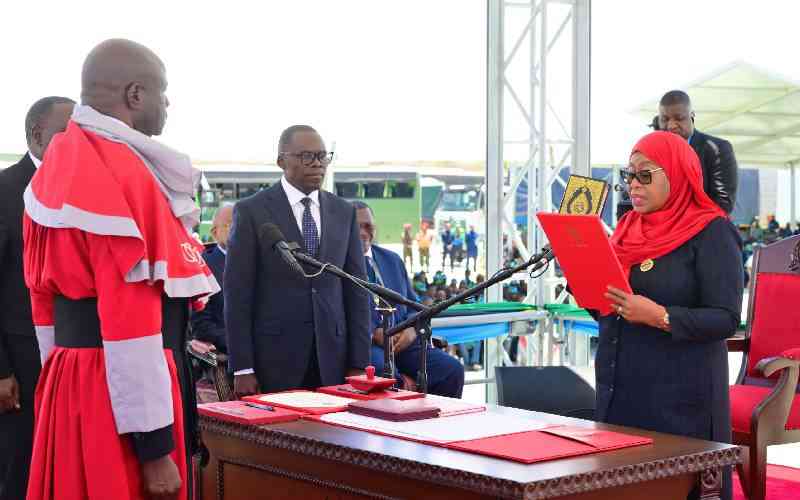
Tanzanian President Samia Suluhu Hassan was inaugurated for her second term on November 3, 2025, in a ceremony held in Dodoma. This event marked a stark contrast to the celebratory atmosphere of her first swearing-in four years earlier, as the recent election was marred by widespread controversy, allegations of fraud, and significant violence. The inauguration itself was a subdued affair, taking place at a military parade ground rather than a public stadium. It was closed to the public but broadcast live on state television. President Hassan was declared the winner with 98% of the vote, facing minimal opposition due to key rival candidates being either imprisoned or barred from participating.
The election process leading to President Hassan's second term drew severe criticism from various quarters. Reports highlighted the unlawful imprisonment of prominent opposition leaders, including Tundu Lissu—who faced treason charges and Luhaga Mpina of the ACT-Wazalendo party, who was excluded on legal technicalities. The deliberate exclusion of political contenders, coupled with allegations of hundreds of protesters killed in the aftermath, cast a significant shadow over the polls' legitimacy. International observers, including the Southern African Development Community (SADC), issued a strong statement highlighting concerns about transparency and the violent aftermath. SADC noted that in most areas, "voters could not express their democratic will" and pointed to restrictions on the opposition and suspected ballot stuffing.
The election's aftermath plunged Tanzania into further turmoil. A nationwide internet shutdown—implemented from election day and lasting several days, severely restricted information flow, making it difficult to verify the scale of violence and death toll. Opposition parties, such as Chadema, reported "no less than 800" deaths, while a diplomatic source suggested at least 500 fatalities. The UN human rights office reported credible evidence of at least 10 deaths in three cities. Personal accounts painted a grim picture: a woman, Mama Kassim, reported her two sons missing since election day, unable to ascertain their fate; another Tanzanian described being stranded due to lack of transport and money, with his children going hungry. The unrest also led to prices for essentials like food and fuel doubling or tripling, with schools and colleges closing and public transport halting in many areas.
In her inauguration speech, President Hassan acknowledged the violence that had resulted in "loss of lives and destruction of public property," describing it as a "blot on Tanzania's image." She thanked the electoral commission for their "unquestionable efficiency" in running the elections and ordered authorities to ensure people's lives returned to normal. Curiously, she stated it was "not surprising" that some arrested individuals were not Tanzanians, implying foreign involvement and announcing ongoing investigations by security agencies. Police spokesman David Misime echoed this, blaming motorbike operators and foreign nationals for violent demonstrations and vandalism, while urging citizens to report suspicious foreigners.
The situation in Tanzania garnered significant international concern. Pope Leo XIV called for prayers, lamenting the post-election violence and "numerous victims." EU foreign affairs chief Kaja Kallas urged Tanzanian authorities to exercise restraint to preserve lives, and UN Secretary-General António Guterres expressed deep concern over reports of deaths and injuries. Domestically, the Chadema party vehemently rejected the results, stating they had "no basis in reality" and calling for a fresh election, arguing no genuine vote took place despite electoral authorities claiming an 87% turnout.
The inauguration also sparked diplomatic controversy, particularly regarding the attendance of Zambian President Hakainde Hichilema. Citizens First (CF) leader Harry Kalaba strongly criticized Hichilema's decision, citing it as a contradiction to his previous stance on democracy and regional governance. Kalaba highlighted Hichilema's refusal to attend Zimbabwean President Emmerson Mnangagwa’s inauguration in 2023 due to concerns over election conduct, even though those elections were acknowledged by SADC and the AU. Kalaba questioned how Hichilema could justify attending Hassan's inauguration, given the unlawful imprisonment of opposition leaders, exclusion of contenders, and reported killings in Tanzania. He accused Hichilema of "selective morality" driven by personal alliances rather than democratic principles, warning that this inconsistency risked isolating Zambia diplomatically and weakening its moral voice in SADC.
Historically, Tanzania's political landscape has been dominated by the ruling Chama Cha Mapinduzi (CCM) party and its predecessor, Tanu, which have never lost an election since independence. Ahead of the contested vote, human rights organizations like Amnesty International condemned what they termed a "wave of terror," citing enforced disappearances, torture, and extrajudicial killings of opposition figures, claims the government rejected while asserting the election would be free and fair. President Samia Suluhu Hassan's rise to power in 2021 made her Tanzania's first female president, following the death of President John Magufuli.