Super Falcons Heartbreak: Nigeria Misses Women's World Cup After Do-or-Die Showdown
In a critical 2027 FIFA Women's World Cup play-off, South Africa's Banyana Banyana defeated Nigeria's Super Falcons 2-1 in Casablanca, ending Nigeria's long-standing record of World Cup appearances. The match, born from unexpected WAFCON quarter-final exits for both African giants, saw Thembi Kgatlana and Refiloe Jane score for South Africa, securing their path to the Inter-Confederation Play-Off Tournament.
In a high-stakes CAF play-off that neither team had anticipated, the Super Falcons of Nigeria and Banyana Banyana of South Africa clashed with their 2027 FIFA Women’s World Cup hopes on the line.
These two African football powerhouses were originally expected to be preparing for the WAFCON semi-finals and automatic World Cup qualification in Brazil.
However, both unexpectedly suffered quarter-final defeats – Nigeria losing 1-0 to Cameroon and South Africa falling 2-1 to hosts Morocco – forcing them into this arduous play-off pathway to keep their global ambitions alive.
The stakes for the match, held at the Moulay Rachid Stadium in Casablanca, were immense: the winner would advance to FIFA’s six-team Inter-Confederation Play-Off Tournament, where three World Cup places would ultimately be available.
Victory would not guarantee a direct ticket to Brazil but would preserve the dream. Conversely, the loser faced immediate elimination from World Cup qualification, a particularly heavy blow for Nigeria, who held the proud record of appearing at every edition of the Women’s World Cup since its inception in 1991.
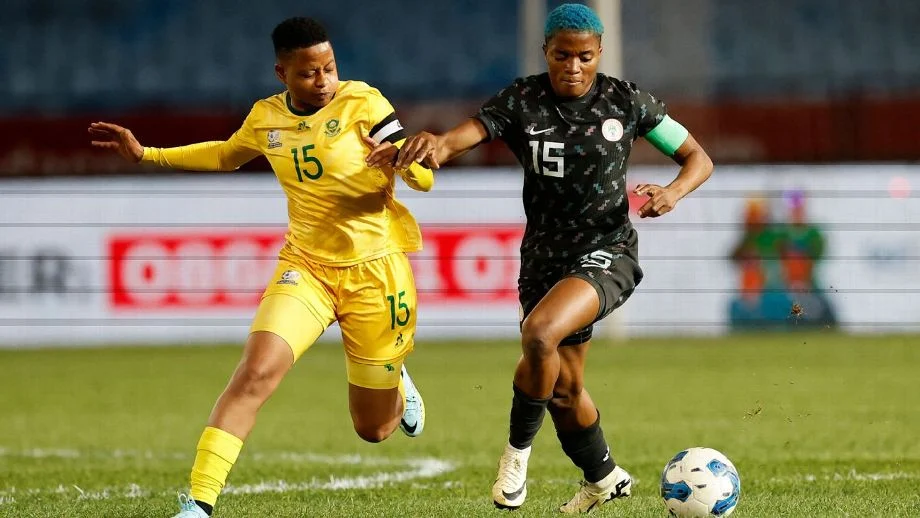
For the Super Falcons, the lead-up to the play-off was a period of intense recovery from a painful WAFCON campaign.
They entered Morocco as the defending champions and the continent’s most decorated women’s national team with 10 WAFCON titles, Nigeria’s tournament began disastrously with a 3-2 defeat to debutants Malawi.
They rebounded with victories over Zambia (1-0) and Egypt (6-2) to reach the quarter-finals, only to be undone by Maéva Nyadjou’s free-kick against Cameroon.
Coach Justin Madugu accepted responsibility for the disappointment but emphasized the "second opportunity" this play-off presented.
The Captain, Rasheedat Ajibade urged her teammates to channel their frustration into the upcoming contest, putting the Cameroon defeat behind them.
South Africa’s Banyana Banyana arrived with their own set of scars. As the 2022 WAFCON champions and strong contenders for the current title, their quarter-final loss to Morocco (2-1) was a bitter pill.
Their group-stage performance was also turbulent, starting with a shock 2-1 defeat to Tanzania, followed by a 2-2 draw with Côte d’Ivoire, and a 1-0 victory over Burkina Faso to narrowly secure a quarter-final spot.
Head coach, Desiree Ellis faced the challenge of quickly motivating her experienced squad, including key players like Thembi Kgatlana, Andile Dhlamini, and Linda Motlhalo, for another high-pressure assignment, with defender Karabo Dhlamini stressing the need to focus on the remaining opportunity.
This encounter also rekindled one of African women’s football’s most enduring rivalries.
Historically, Nigeria boasted a superior record, having won 15 of their more than 23 meetings across WAFCON, qualifiers, and friendlies.
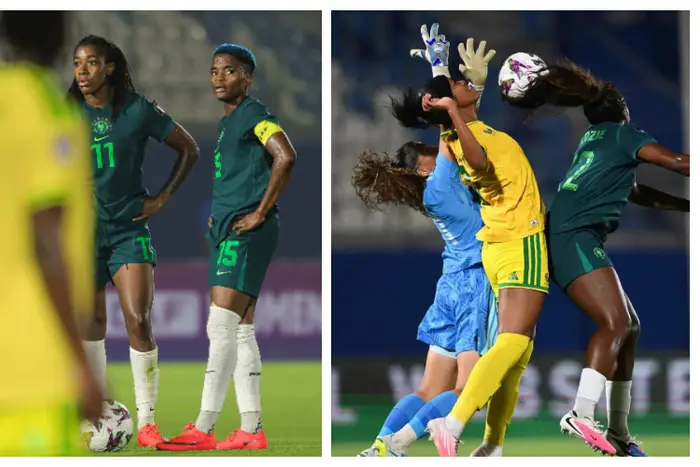
However, South Africa had significantly narrowed the gap in recent years, notably defeating Nigeria 2-1 in the opening match of the 2022 WAFCON en route to winning their first continental title.
Nigeria later exacted revenge in the qualification race for the 2024 Paris Olympics, securing a 1-0 aggregate victory over two legs.
These results underscored the evolving balance between the traditional powerhouse and the emerging contenders, highlighting that pedigree alone would not dictate the outcome in Casablanca.
The highly anticipated clash ultimately saw South Africa’s Banyana Banyana triumph over Nigeria’s Super Falcons with a 2-1 victory in Casablanca, definitively extinguishing Nigeria’s hopes of qualifying for the 2027 FIFA Women’s World Cup.

After a goalless first half, Thembi Kgatlana broke the deadlock for South Africa in the 56th minute.
As Captain Refiloe Jane then doubled Banyana Banyana’s advantage in the 77th minute, asserting their dominance.
Despite a late lifeline for the Super Falcons when Christy Ucheibe converted a penalty in stoppage time, and Refiloe Jane being sent off moments before the goal, Nigeria could not find an equalizer, sealing their fate.
This defeat marked a difficult period for Nigeria, ending their remarkable record of appearing at every Women's World Cup.
For South Africa, the victory represented a strong recovery from their own WAFCON disappointment and secured their progression to the Inter-Confederation Play-Off Tournament, alongside Ghana’s Black Queens, who also advanced after defeating Côte d’Ivoire 2-1 in their respective play-off tie.
The match served as a stark reminder that in high-stakes football, history counts for little, and only performance under pressure determines who survives.