Shockwaves in Europe: Hungarian Parliament Ousts President Tamás Sulyok
The Hungarian Parliament has adopted the 17th constitutional amendment, paving the way for the removal of President Tamás Sulyok. This move, supported by 139 votes, has sparked strong debate, with Prime Minister Péter Magyar criticizing the current constitution and Fidesz boycotting the vote and announcing its parliamentary leader's resignation amidst accusations of undermining democracy.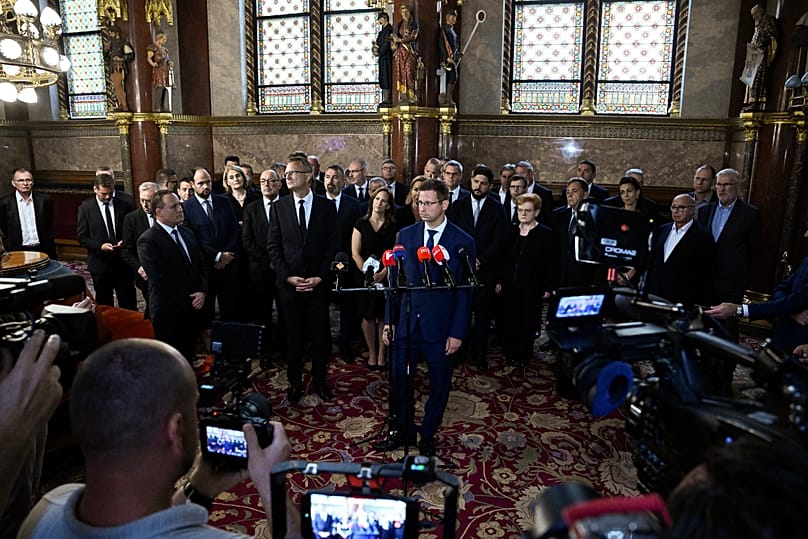
The Hungarian Parliament has adopted the 17th amendment to the constitution, a significant move enabling the removal of the current President of the Republic, Tamás Sulyok. The vote saw 139 MPs in favour and 6 against, with 54 abstaining. This constitutional change is primarily aimed at ousting President Sulyok but also establishes a precedent for similar presidential removals in the future. Upon the amendment's entry into force, Sulyok's mandate will conclude, after which Parliament will elect a new head of state to serve until a new constitution is implemented, for a term not exceeding five years.
Prime Minister Péter Magyar, in a powerful speech preceding the vote, condemned the Fidesz-drafted constitution, labeling it "the founding document of the Hungarian Cosa Nostra built by Fidesz–KDNP." He asserted that under the Orbán governments, all state functions had been subjugated to the will and political survival of one individual. Magyar recounted numerous instances where the constitution was purportedly not defended, notably citing former chief prosecutor Péter Polt's failure to investigate substantial financial irregularities at the MNB (central bank). He stressed the constitutional duty to protect the nation from external threats, citizens from arbitrary power, common property from plunder, electoral freedom, children from abuse, and state institutions from partisan manipulation. Magyar justified Sulyok's removal by listing his silences on critical issues, including alleged police and secret-service surveillance against Tisza Party IT experts on fabricated charges. He argued Sulyok should have defended constitutionalism when its foundations, particularly the role of secret services, were threatened.
In protest, the Fidesz and KDNP parliamentary groups boycotted both the detailed debate and the final vote on the amendment. Fidesz MP Miklós Panyi announced their refusal to "take part in dismantling democracy." On the day of the vote, July 13, neither the Fidesz-KDNP MPs nor President Tamás Sulyok were present in the chamber.
Gergely Gulyás, the outgoing leader of the Fidesz parliamentary group, announced his resignation at a press conference held just before the vote. He criticized the "unprecedented" removal of the head of state and the "violent approach," stating that "from now on there is a political contest in Hungary in which at least half of MPs are excluded from competing." The entire Fidesz group attended his briefing. In a related development, Fidesz organized a demonstration under the slogan 'Stop arbitrary rule!' outside the Sándor Palace, the presidential residence, last Thursday.
President Sulyok has five days to sign the constitutional amendment. Should he refuse, Parliament is prepared to initiate removal proceedings, rendering him unable to exercise his powers, with the Speaker of Parliament then authorized to sign the law. Sulyok has previously voiced constitutional concerns regarding his removal, appealing to both the Constitutional Court and the Venice Commission. The amendment, drafted by Justice Minister Márta Görög, aims to secure the essential institutional conditions for the state's lawful operation until a new constitution is enacted, thereby establishing the groundwork for restoring constitutional democracy. Key provisions include a 12-year (three-term) limit for MPs, the termination of the current president's mandate, a 70-year age limit for constitutional judges, and the right for judges to initiate the recall of the presidents of the Curia and the National Judicial Office.
Before the vote, Prime Minister Magyar used his Facebook page to declare that "on the basis of the democratic mandate of the Hungarian people, the replacement of Orbán's political puppets can begin." He asserted that the president's role does not allow for a content review of a constitutional amendment, only a referral to the Constitutional Court for prior review on public-law grounds of invalidity, which he argued do not exist in this case. Magyar further alleged that Fidesz intervened mid-week, instructing Sulyok not to sign, thereby "defying the constitution" and blocking the "breaking of the Orbán mafia." He also claimed that Gergely Gulyás had pre-written a submission for Sulyok to file with the Constitutional Court, with Péter Polt, described as Viktor Orbán's "long-time henchman," allegedly waiting to bury the case. Magyar issued a stern warning to all involved in this "dark, unconstitutional manoeuvre" that they would face future responsibility.
Health Minister Zsolt Hegedűs explained Sulyok's impending departure on social media, attributing it to his "silence." Hegedűs argued that over the past sixteen years, a "deep state" had been constructed to perpetuate the influence of the "old order" through long mandates, two-thirds rules, entrenched office-holders, and publicly funded power centres, even after an electoral defeat. He criticized those who failed to defend constitutionalism, human dignity, and national unity, citing instances where Hungarian citizens were dehumanized, and judges, journalists, and activists were stigmatized. Hegedűs concluded that Sulyok's failure to speak up for politically attacked judges, journalists, activists, artists, and abused children, and to "draw a line in front of power," constituted a betrayal of the president's most important moral duty.