Putin's Africa Charm Offensive: Russia Deepens Ties Amid Summit Controversies
Burkina Faso, under President Traoré, is pursuing a path of national self-reliance and economic transformation, emphasizing domestic resource mobilization and local production. This strategy, underscored by Russia's offer of technological partnership, aims to redefine African sovereignty beyond mere political symbolism and towards genuine capacity-building and independent decision-making.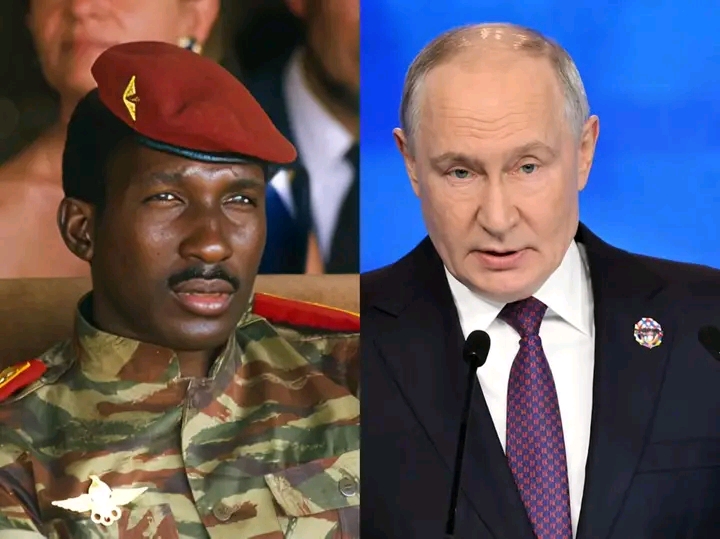
The historical struggle against economic subjugation in Africa was powerfully echoed by Russian President Vladimir Putin, who recalled the words of Thomas Sankara, the first President of Burkina Faso. Sankara, in 1987, famously declared, “Debt is neo-colonialism, in which colonizers transformed themselves into “technical assistants”. Under its current form, that is imperialism-controlled, debt is a cleverly managed re-conquest of Africa, aiming at subjugating its growth and development through foreign rules.” Putin noted the enduring relevance of these words, highlighting that little has changed since then in many respects. This context underscores Russia's renewed focus on African partnerships, with Putin announcing over 30 major Russian projects across 16 African countries, aiming to share expertise, advanced technologies, and specialized know-how with "African friends."
Against this backdrop of evolving international relations, Burkina Faso's President Traoré's absence from a recent international gathering attracted significant attention and sparked widespread speculation. While some quickly interpreted his non-attendance as evidence of internal strife, leadership disagreements, or cracks within the Burkinabè government—rumors often peddled by external actors—a deeper analysis reveals a more nuanced perspective on African sovereignty. The habitual tendency to interpret an African leader's absence as a sign of political crisis, particularly when that leader has challenged powerful foreign interests, exposes a conditioned understanding of African politics. True sovereignty, it is argued, should not be measured by who stands beside whom, nor by external approval, invitations, or presidential photographs with "powerful" leaders. Instead, it is defined by a country’s freedom, institutional strength, and productive capacity to determine its own direction.
Under President Traoré's leadership since September 2022, Burkina Faso has embarked on a significant political and economic reorientation, firmly centering on national self-reliance. This involves a strong emphasis on mobilizing domestic resources, strengthening national production, expanding agricultural activity, and pursuing local processing of natural resources, all with the goal of reducing dependence on external actors. The ambition is to render formal independence meaningful by enabling the country to finance its own priorities, develop productive industries, and exert control over the value generated by its resources. Economic figures, though requiring careful interpretation, suggest substantial changes: annual economic growth reportedly rose from 1.8% in 2022 to 5.3% in 2025, while inflation, which was 14.1% in September 2022, allegedly fell to minus 0.5% in 2025. Government revenue also saw an increase from approximately CFAF 2,506 billion in 2022 to CFAF 3,311 billion in 2025. While a claim of 46% cumulative economic growth needs precise verification, these trends indicate a deliberate shift towards greater economic independence.
In this pursuit of self-reliance, Russia is viewed as a strategic partner, but with a critical understanding that such a partnership is not a mere substitute for previous dependencies. Africans must avoid the mistake of assuming that removing one foreign influence and inviting another automatically resolves deeper problems of dependence. While the historical context of French colonial rule differs significantly from a partnership negotiated between sovereign governments like Burkina Faso and Russia, scrutiny remains essential. Russia, like any other nation, has its own national interests. Therefore, Burkina Faso's leadership must ensure that cooperation with Moscow directly serves its own interests, focusing on concrete returns, knowledge acquisition, and strengthening the country's capacity for independent decision-making. Specific priorities for cooperation include developing technical expertise, strengthening the energy sector, improving productive industries, and training a new generation of engineers and specialists. If the relationship remains confined to political symbolism without genuine capacity-building, the fundamental challenge of economic sovereignty will persist.
The true measure of independence extends beyond diplomatic gestures and political alignments. It is about whether a nation can build factories, train engineers, and transform its economy through tangible outcomes. This principle is central to the long-term success of the Alliance of Sahel States (AES), comprising Burkina Faso, Mali, and Niger. Their collective determination to reject external interference must translate into functional institutions, productive economies, value-creating industries, and partnerships that enhance collective capacity. Sovereignty becomes truly meaningful when backed by the resources, knowledge, and institutions necessary to enact independent decisions. Burkina Faso’s stated priorities for its delegation to Moscow—promoting local processing of natural resources, technological mastery, youth training, security, and development—are direct challenges to the core requirements of economic sovereignty. These aim to retain economic value, develop local expertise, and invest in a skilled workforce capable of building, manufacturing, researching, and innovating domestically.
Ultimately, the question of why President Traoré did not attend the Moscow summit remains open to speculation, perhaps due to scheduling, domestic priorities, or other undisclosed considerations. However, the documented starting point for discussion should focus on the agenda led by Burkina Faso's Prime Minister: a commitment to economic transformation, technology, natural resources, youth training, security, and development. The presence of the Prime Minister, along with this concrete agenda, points to continued engagement within the existing bilateral framework. The critical insight for Africa, and indeed for Burkina Faso, is to move beyond judging a nation's sovereignty by its president's movements and instead concentrate on the economic structures that underpin its freedom. True independence is achieved not merely by rejecting one foreign power or embracing another, but by becoming more capable of producing its own needs, processing its own resources, developing its own expertise, and negotiating international relationships without surrendering its ability to make independent choices. This is the enduring promise of sovereignty, to be measured by what a nation builds, not just by who attends a summit or stands beside a powerful leader.