Political Earthquake: Governor Mutai Fights For Survival Amid Impeachment Storm
Kericho Governor Erick Mutai narrowly survived an impeachment bid in the Senate after a crucial vote terminated the proceedings. The contentious trial was dominated by disputes over the integrity of the electronic voting system used by the County Assembly, despite an independent ICT Authority report finding it "foolproof." Governor Mutai also successfully defended himself against various corruption and nepotism allegations.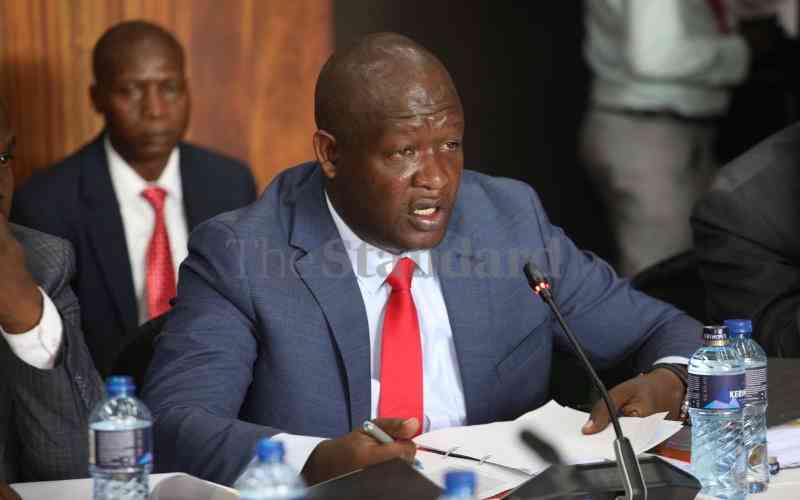
The impeachment proceedings against Kericho Governor Erick Mutai, initiated by Sigowet MCA Kiprotich Rogony, culminated in a significant debate in the Senate over the integrity of the electronic voting system used by the County Assembly. Governor Mutai’s defence team, led by lawyer Katwa Kigen, immediately challenged the credibility of the voting process, asserting it was “riddled with irregularities” and therefore unreliable for the Senate to consider. Kigen highlighted that Members of the County Assembly (MCAs) received login credentials via SMS, using only their ID and payroll numbers without secure passwords, which made the system highly susceptible to impersonation and manipulation.
During cross-examination, Sigowet MCA Kiprotich Rogony faced accusations of logging in and voting on behalf of a colleague. Rogony vehemently denied these allegations, including a clip presented in the Senate that insinuated he was offered Sh200,000 and promised foreign trips in exchange for swearing an affidavit. He countered, stating, “It is not true. The clip played here is not my voice. The person in that recording sounded drunk. I am not drunk; I don’t even drink; I’m a Seventh Day Adventist.” The governor’s legal team further raised concerns about voter bribery, referencing an audio clip where an MCA was allegedly offered money and trips. Some senators, perturbed by these revelations, suggested recalling Kericho MCAs to conduct a fresh vote to resolve the matter.
The second day of impeachment proceedings saw intense scrutiny of the technological systems employed during the impeachment vote. Both Senators and the Governor’s defence team questioned the credibility of the online voting system following revelations that unauthorized persons might have accessed it. Concerns mounted over the use of payroll and ID numbers as passwords, a method that could severely compromise the process's integrity. Evidence presented by the defence indicated alarming discrepancies: three MCAs allegedly voted more than once, and one Internet Protocol (IP) address was used to cast nine votes. The defence further highlighted that the online link-based voting was entirely dependent on internet-enabled mobile phones, yet during the County Assembly proceedings on August 15, 2025, the Speaker and Clerk reportedly failed to verify internet access and devices for all eligible MCAs. This led to serious concerns, especially as some of the 18 MCAs who opposed the impeachment, despite lacking internet connectivity, were allegedly recorded as having participated. The defence sought to terminate the trial, arguing the required threshold of 32 out of 47 MCAs was not met if these four disputed votes were excluded.
Alfred Korir, the Head of ICT at Kericho County Assembly and the expert witness, underwent rigorous cross-examination by Senators. They sought clarification on the use of such a “porous” system, the exact number of affirmative votes (whether 28 or 33), and the lack of prior system testing. Senator Enock Wambua questioned how one person could log in twice simultaneously and vote seconds apart, while Senator Veronica Maina asked if anyone with an MCA’s payroll and ID information could access the system, to which Korir confirmed its possibility. Deputy Speaker Kathuri Murungi pressed why a manual system wasn't used if the electronic one was unreliable. Senator Moses Kajwang' urged Korir to extract login logs in the presence of witnesses, and Senator Bonny Khalwale challenged the reliance on a known flawed system. Senator Karungo Thang’wa sarcastically remarked on the “proxy voting system” evidenced by one IP address voting nine times. Korir, in response, explained that the chamber’s Wi-Fi used a static IP address, which could be picked up by multiple devices, and admitted he could not confirm if the four contesting MCAs personally voted without their direct testimony.
In light of these serious doubts, Senate Speaker Amason Kingi intervened, directing the Office of the Clerk to contact the Information and Communication Technology (ICT) Authority of Kenya. The Authority was tasked with deploying two independent ICT experts to assist the Senate, collaborating with the County Assembly’s ICT head, the Governor’s ICT expert, and representatives from both sides. Their mandate was to prepare a “brief and concise” report by 6:00 p.m. on Thursday, August 28, 2025, addressing critical questions: whether an electronic voting process occurred, if the number of MCAs who voted was verifiable, if proxy voting was possible, the exact number of affirmative votes, and any evidence of multiple voting or system compromise. The Senate’s final vote on the impeachment was to be informed by this crucial report.
Concurrently with the debate over the voting system, Governor Mutai defended himself against numerous corruption allegations. Regarding claims of misappropriating Sh351 million from the National Agricultural Value Chain Development Programme (NAVCDP), Mutai dismissed the figure as “erroneous and sensational,” stating the actual amount for disbursement was approximately Sh281 million. He clarified that NAVCDP and World Bank funds are donor-controlled, regulated, and audited, implemented by third parties who had not raised any complaints, thus asserting that “no funds have been misappropriated or lost as alleged.” Mutai also denied involvement in the alleged Sh14.9 million procurement of goods, including soya beans and sunflower seeds, which were reportedly not delivered. He maintained that all items were delivered prior to payment, with supporting documentation readily available. On accusations of skewed, uncompetitive, and nepotistic appointments, Mutai firmly stated that “The authority to hire personnel...rests solely with the County Public Service Board.” He denied personally hiring Victor Mutai or confirming Chepkirui Mercy, explaining that Ms. Chepkirui was offered a three-year contract on June 3, 2025, based on a transparent recruitment process by the Department of Health with the Board's full endorsement. He concluded that “the impeachment motion and its grounds are false, brought in bad faith, and driven by ulterior motives unrelated to public welfare.”
On the third day of hearings, Friday, August 29, 2025, the Senate received the eagerly anticipated report from the Information and Communication Technology Authority. This report delivered a major blow to the Governor's defence regarding the voting system's integrity, finding the system “foolproof” and giving it a “clean bill of health.” It confirmed that an electronic voting process indeed took place, with 33 MCAs voting in favour of the ouster motion, directly disputing earlier claims of interference from 18 MCAs. The report explicitly stated, “The number of MCAs who voted in the motion were 33 MCAs as extracted from the voting module logs,” and added, “You cannot vote for any other person/MCA with the link provided.” Furthermore, it found “no evidence of multiple voting neither is there evidence of other compromise of the voting system and/or any impropriety in the voting system and process.” The report detailed that the system was an in-house developed, off-premise, out-of-country hosted system managed by Alfred Kimutai Korir, and went into production on August 12, 2025. Despite these findings, the Governor's defence continued to argue the system's vulnerability, reiterating the lack of prior audit or verification of internet access for MCAs.
A section of the 18 MCAs who opposed the impeachment motion appeared before the Senate, shedding light on their non-participation and distrust. They claimed that despite lacking internet access on the day, they were allegedly recorded as having participated, and that their abstentions were not captured. They corroborated video evidence showing the Speaker opting for an electronic system over manual voting despite their contestations and prior rumours of the system being compromised and its rushed implementation. Nominated MCA Irene Chebet stated, “I did not vote because I did not want to partake in an exercise that was going to be shambolic…In a few minutes to voting, that is when we were told of electronic voting, something we have never used before.” Nominated MCA Bavina Chepkirui Serem recounted abstaining and an attempt to declare her seat vacant, citing social media posts by pro-impeachment members claiming to already have 33 votes. The prosecution team, led by Elisha Ongoya, countered that electronic voting was provided for by County Assembly standing orders, approved by MCAs like Irene and Bavina. Advocate Elias Mutuma challenged Kapkatet MCA Amos Bii’s claim of lacking an internet-connected device while being active on numerous WhatsApp groups, prompting Bii to explain he had two phones, with his PA operating one. Senator Seki Lenku further questioned if Bii's PA had voted on his behalf, which Bii denied.
As the Senate moved towards a vote, various senators voiced their perspectives. Kakamega Senator Bonni Khalwale moved the motion for the ascertainment of the threshold, urging senators to decide carefully. Narok Senator Ledama Ole Kina advocated for recognizing the ICT Authority's findings and proceeding with the impeachment. However, the tide turned towards the Governor's defence. Tana River Senator Danson Mungatana argued that the standard for issues of threshold should be “beyond a reasonable doubt,” similar to criminal cases, stating, “you’d rather acquit ten suspects if in doubt than convict one unfairly.” Nyamira Senator Okong’o Mogeni echoed this, expressing his inability to understand the electronic system used. Kericho Senator Aaron Cheruiyot, however, passionately argued that the residents of Kericho deserved justice and hinted at future attempts to oust Governor Mutai if he escaped the Senate's decision.
In a late-night session, the Senate ultimately voted to stop the impeachment proceedings against Governor Mutai. The final count revealed 26 Senators voted to save him, 16 voted for impeachment, and one abstained. Speaker Amason Kingi, in his ruling, declared that the result of the division indicated the motion had been “negative,” thus terminating the impeachment hearing. Despite the outcome, Kericho Senator Aaron Cheruiyot vowed, “We will get justice by any means necessary,” implying that the fight for accountability would continue outside the Senate. Following his reprieve, Governor Mutai reiterated his earlier comprehensive defence against all corruption allegations, emphasizing the donor-controlled nature of NAVCDP funds, the delivery of all procured goods before payment, and the transparent, merit-based hiring practices of the County Public Service Board, concluding that the motion against him was “false, brought in bad faith, and driven by ulterior motives.”