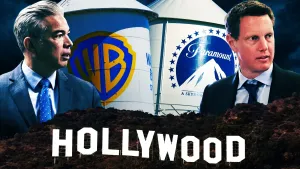
Paramount-Warner Bros. Merger Saga: Judge Clears Path, Industry Leader Backs Deal

A federal judge dismissed a consumer lawsuit against the $111 billion Paramount-Warner Bros. merger, citing a lack of standing, though the plaintiffs can refile. While major antitrust trials from state attorneys general and the Writers Guild of America are slated for 2027, the merger has gained crucial support from major cinema chains like Regal and AMC, bolstered by Paramount-Skydance CEO David Ellison's commitments to theatrical releases and his defense against claims of potential CNN bias.
Precious Eseaye
Precious EseayeMovies3 hours ago4 minute read
Paramount-Warner Bros. Merger Saga: Judge Clears Path, Industry Leader Backs Deal

The proposed $111 billion merger between entertainment giants Paramount and Warner Bros. Discovery continues to navigate a complex legal and industry landscape, marked by both judicial challenges and significant support from key players. A recent development saw a federal judge dismiss a consumer lawsuit aimed at blocking the merger, though the plaintiffs have been granted an opportunity to revise and refile their complaint.

U.S. Judge Araceli Martínez-Olguín ruled that the initial lawsuit, brought by three current and two prospective Paramount+ subscribers, lacked sufficient standing. Furthermore, the plaintiffs failed to establish "cognizable" economic fallout that would warrant antitrust intervention. Judge Martínez-Olguín noted the complaint's reliance on "boilerplate assertion[s] of competitive harms, such as ‘lower quality and variety’ and ‘decreased consumer choice,’" without providing plausible facts to demonstrate how such harms have materialized or would materialize. She further clarified that the plaintiffs' standing theory amounted to little more than the assertion that as consumers of television and movies, they would be injured by a merger between entertainment companies.

Despite this dismissal, the merger faces more formidable legal hurdles. Judge Martínez-Olguín will also oversee separate antitrust cases filed by a coalition of 12 state attorneys general and the Writers Guild of America. Both groups contend that the Paramount-Warner Bros. merger would inflict irreparable harm upon the broader entertainment industry. These significant antitrust trials are officially scheduled to commence on March 2, 2027, and run for 12 days, concluding on March 19, 2027. This schedule came after Paramount's request for a November trial date was denied in favor of the March timeline requested by the states and WGA. Paramount is eager to finalize the deal sooner due to a substantial "ticking fee" of $7 million per day, payable to Warner Bros. Discovery, for every day the deal remains in limbo past October 1.

Amidst these legal challenges, Paramount-Skydance CEO David Ellison has publicly defended the merger and addressed concerns. In a New York Times op-ed, Ellison controversially posited that the underlying reason for the state attorneys general's opposition is not consolidation, but rather a concern over his potential control of CNN following the acquisition of Warner Bros. Discovery. Ellison's historical ties to former President Donald Trump, a vocal critic of CNN, combined with recent issues surrounding "60 Minutes," have reportedly made some within Hollywood apprehensive about the future editorial independence of the venerable news network. Reasserting his commitment to an independent CNN, Ellison stated, "I believe this fight is not really about market share. I believe a plainer worry sits beneath the briefs and the news releases: the news. The issue is whether I can be trusted as a steward of Warner’s CNN." He further pledged, "When it comes to our news operations, I do not aspire to lead these companies to bend their newsrooms to my views. I believe that news should be based on facts and truth."

The merger has garnered crucial support from major players in the exhibition industry. Regal Cinemas CEO Eduardo Acuna issued a statement backing the acquisition, echoing similar sentiments expressed by AMC Theatres CEO Adam Aron a week prior. Acuna highlighted the current positive momentum in the industry—with increased attendance and strong upcoming releases—emphasizing the need for a "thriving studio system" to sustain growth. He detailed specific commitments made by David Ellison to ensure the theater business prospers: a minimum of 30 theatrical films per year, a protected theatrical window (45 days for TVOD and 90 days for SVOD for at least three years), and an annual investment of $30 billion in media content. Acuna argued that a protracted legal battle would only create "more uncertainty and distraction" detrimental to studios, filmmakers, moviegoers, and theater businesses. With both AMC and Regal, the two largest U.S. theater chains, now publicly supporting the merger, this development significantly complicates the state attorneys general's argument that the merger would harm the exhibition sector and consumer wallets, thereby weakening their lawsuit.

Conversely, the exhibition industry trade group, Cinema United, led by Michael O’Leary, remains staunchly opposed to the sale. O’Leary reaffirmed their opposition in a letter to members, asserting that the transaction "will result in fewer movies, higher costs for you and your patrons, and ultimately, fewer theatres," dismissing Ellison's promises of theatrical support as "high-level and unenforceable."

As the March 2027 trial date approaches, the battle over the Paramount-Warner Bros. Discovery merger continues to unfold, balancing legal complexities, industry politics, and the financial implications of delaying such a massive deal.

Loading...