Circle and Proof Demonstrate Verified Stablecoin Payments for AI Agents
Circle Internet Group and Proof have unveiled a collaboration demonstrating how verified legal identity and stablecoin payments can be combined for AI agent transactions. Utilizing x401 and x402 protocols, their solution addresses merchant fraud risks by providing secure identity verification and payment settlement. This innovation aims to encourage businesses to adopt AI agents, with significant implications for regulatory acceptance in digital identity and anti-money laundering frameworks.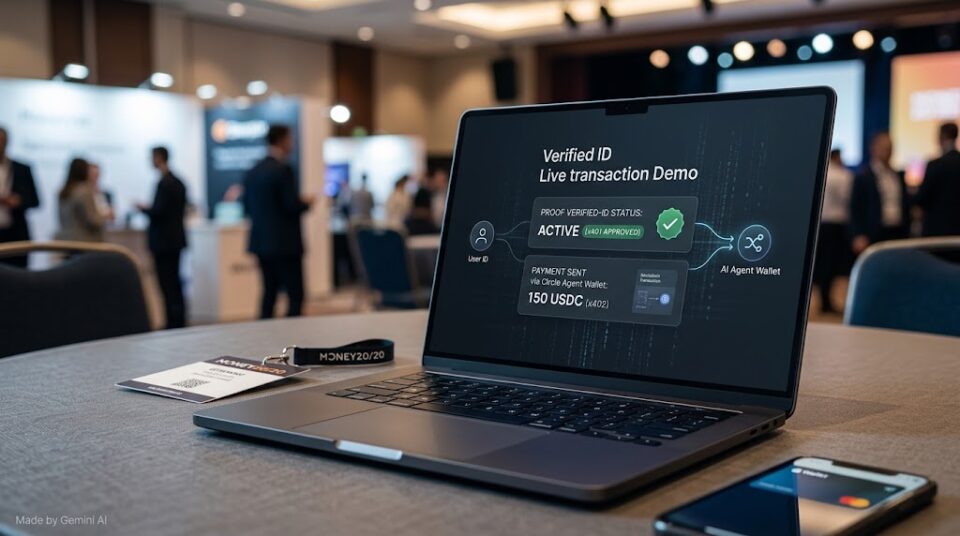
Circle Internet Group (NYSE: CRCL) and identity infrastructure firm Proofhave announced a collaboration to combine verified identity, transaction authorisation, and stablecoin payments for purchases initiated by artificial intelligence agents. Announced on October 19, 2026, ahead of a demonstration at Money20/20 in Las Vegas, the partnership addresses a growing challenge in agentic commerce: how merchants can establish who authorised an AI agent to purchase while managing fraud and chargeback risks.
The demonstration combines two open protocols, Proof’s x401 and Circle’s x402, to establish the identity and authority behind an agent’s request and determine how payment is completed. The approach is intended to help businesses accept authorised AI-driven transactions without requiring agents to bypass identity and security checks.
Under the proposed transaction flow, a merchant uses x401, which builds on the HTTP 401 “Unauthorised” response, to request verifiable identity credentials and evidence of a person’s authorisation. The agent presents a credential through Proof’s wallet, with identity verification based on the NIST Identity Assurance Level 2 (IAL2) standard, alongside a signed approval tied to the specific purchase.
The system is designed to disclose only the relevant identity information rather than transmit an entire identity document, while providing the merchant with evidence that can be independently checked if a transaction is disputed. Once the identity and authorisation requirements are met, the agent uses x402, which builds on the HTTP 402 “Payment Required” response, to pay in USDC through a Circle Agent Wallet.
Proof founder and chief executive Pat Kinselsaid the demonstration shows how a single transaction flow can establish both verified identity and payment, potentially giving merchants a practical way to accept AI agents.
The collaboration also explores a micropayment model for identity verification, allowing merchants to pay credential issuers for individual checks through the x402 payment channel rather than relying exclusively on pre-existing commercial contracts.
This could make verified identity services easier to access across different platforms, although broader adoption will depend on implementation, trust arrangements, and merchant requirements. The protocols are part of a wider effort to develop infrastructure for agentic commerce, alongside initiatives involving verifiable credentials and agent authentication. Regulatory acceptance remains a key consideration: while NIST IAL2 provides a recognised framework for identity proofing, its use does not automatically satisfy every financial institution’s know-your-customer or anti-money-laundering obligations.
The Circle–Proof demonstration therefore illustrates a potential model for more accountable AI-driven payments, but its wider commercial and regulatory impact will depend on how businesses and regulators assess the credentials, authorisation records and controls involved.