Middle East Mayhem: Saudi Pipeline Attack Threatens Europe's Oil Lifeline
Europe faces an imminent oil supply shock as Saudi Arabia's East-West pipeline shuts down due to drone attacks, disrupting 4-5% of global oil supply. This event, tied to regional geopolitical tensions, forces European refineries to seek costly alternatives, driving up crude and diesel prices and threatening renewed inflation across the continent.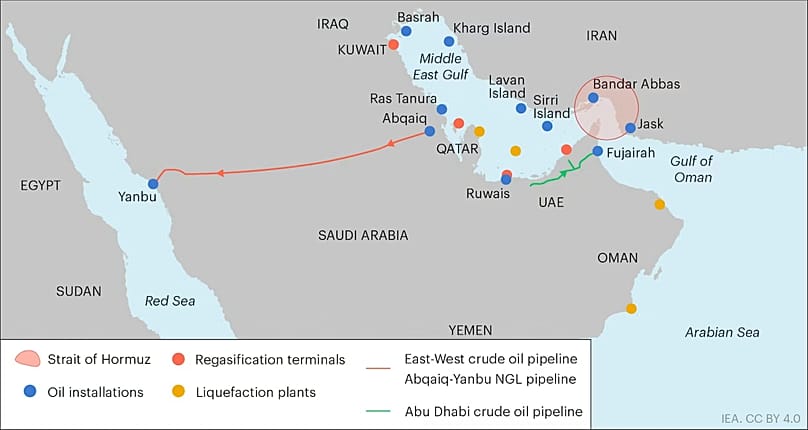
Europe is facing a potential oil supply shock following the precautionary shutdown of Saudi Arabia's East-West pipeline, also known as Petroline, on September 10. This critical infrastructure closure came in response to drone attacks on the pipeline in the Riyadh and Medina regions the previous day, carried out by Iran-backed allied Houthis and Iraq. The East-West pipeline is a vital alternative to the blockaded Strait of Hormuz, which typically handles 20% of the world's oil and gas supplies, a blockade in effect since US and Israel military actions against Iran on February 28. Prior to its shutdown, the pipeline transported approximately 4–5 million barrels per day, accounting for roughly 4–5% of global oil supply, underscoring the vulnerability of the EU's energy diversification strategy.
The attacks are part of a coordinated strategy by Tehran and its regional proxies, aiming to entirely block Saudi Arabia's oil exports through its eastern flank via the Red Sea. The 1,200-kilometre East-West pipeline, constructed in 1981 after the Iranian Revolution, facilitates crude oil transportation from the kingdom’s eastern fields to the Red Sea port of Yanbu, thereby bypassing the Strait of Hormuz chokepoint. The disruption to this route has significant implications for global oil markets.
European refineries are particularly affected, having been compelled to reconsider their crude supply arrangements. Energy pricing agency Argus reported on September 15 that at least three European refiners experienced cancellations or postponements of cargoes scheduled for late September, some extended until November. To mitigate the impact, companies like Poland's Orlen, a major buyer, procured an additional 16 cargoes from diverse sources including Norway, Britain, Algeria, Kazakhstan, Azerbaijan, and the Americas to sustain refinery operations through October. European refineries depend on specific Saudi crude grades, particularly medium and heavier, relatively sour crude, which match their configurations. Replacing these specific barrels is challenging, potentially costly, and may necessitate complex operational adjustments, exacerbating the continent's existing high energy prices. According to June Goh, senior oil market analyst at Sparta Commodities, refineries reliant on Arab crude via the Red Sea must find alternatives, recognizing that not all crude types are interchangeable.
The global nature of oil markets means supply disruptions can trigger price increases far beyond the immediate affected region. The anticipation of a tighter market, especially with limited spare capacity and inventories, can drive prices up even before physical shortages occur. The East-West pipeline was capable of moving around 5.5 million barrels per day, and with an estimated 3.5 to 4 million barrels per day now at risk, the market gap has led to a surge in prices, with Brent crude oil recently trading above $113 a barrel. Several European countries are now attempting to cushion the impact of rising diesel prices, a direct consequence of the Saudi pipeline shutdown, which are being felt at the gas pump.
The severity of this crisis hinges on whether energy infrastructure continues to be a target for military attacks and how quickly Saudi Arabia can restore the pipeline to full operational capacity. While minor damage to the pipeline has reportedly been repaired, full restoration of damaged pumping stations and complete pipeline operations could extend up to six weeks, according to Kpler's head of oil analysis, Homayoun Falakshahi. In the interim, a bypass pipeline around the damaged pumping station is functioning as a short-term fix. Kpler noted on September 14 that Saudi West Coast refineries are reducing throughput and increasingly relying on inventories, with Yanbu exports partially disrupted. As of September 16, Saudi Arabia expressed expectations to fix half of the pipeline's capacity in the coming days, offering a more positive outlook to analysts. However, the infrastructure remains vulnerable to additional attacks. Should the pipeline not resume normal flows promptly, Europe faces the prospect of higher crude and refined-fuel prices and renewed inflationary pressures, posing a significant challenge for governments seeking to protect consumers and industry.