Meet the Woman whose body can't feel pain or fear
Discover the extraordinary story of a woman who lives without pain or fear—literally. Scientists are only beginning to understand the rare genetic condition that makes her nearly untouchable by physical suffering or anxiety, and what it could mean for the future of medicine.
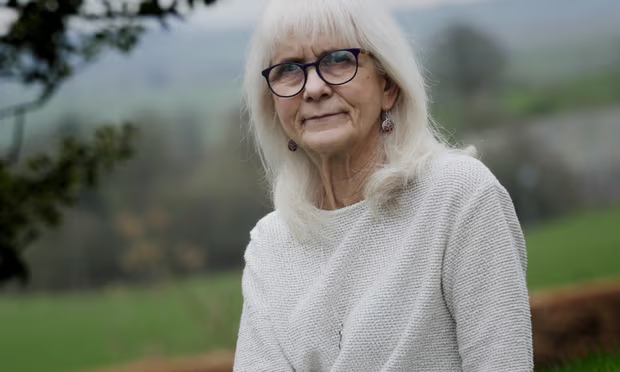
In the quiet hills of the Scottish Highlands, Jo Cameron lives a life unlike anyone else’s. She smiles easily, laughs often, and rarely—if ever—winces. But her cheerful demeanor is not just a matter of temperament. Jo Cameron literally cannot feel pain. Not from a broken arm. Not from a burn. Not even during childbirth or major surgery.
For most of her 70 years, Jo thought she was simply “lucky.” But in 2013, after undergoing a severe hand surgery that required almost no post-operative pain relief, her doctors became suspicious. Eventually, geneticists at University College London and the University of Oxford discovered what makes Jo Cameron different—and potentially revolutionary.
They found that Jo carries two rare genetic mutations: one in the FAAH gene, and another in an adjacent, previously unidentified pseudogene now called FAAH-OUT. Together, these alterations disrupt the production of an enzyme responsible for breaking down a neurotransmitter called anandamide—often referred to as the body’s natural version of THC, the psychoactive compound in cannabis. In Jo’s system, levels of anandamide are abnormally high. The result: a body that doesn’t register pain, and a mind that seems largely immune to anxiety or fear.
No Pain, No Fear, No Worry
Jo’s story reads like science fiction. She’s burned herself on stoves without noticing, had bones break without wincing, and once underwent dental surgery without anesthesia—because she simply didn’t feel it. “I didn’t know I wasn’t feeling pain until I was in my sixties,” she said in an interview. “I just thought it was normal.”
Even more extraordinary than her physical resilience is her psychological state. Jo reports almost no experience of anxiety, panic, or fear. Her mental health scores are astonishingly low for depression and stress, and she recalls managing life’s worst moments—from car accidents to family bereavement—with what she calls “a strange calmness.” Scientists believe this emotional balance may also stem from her elevated anandamide levels, affecting not only her pain responses but her mood and memory.
The Science of Suffering—and the Cure It Might Hold
Jo Cameron’s rare condition is scientifically known as congenital insensitivity to pain. Only a handful of cases exist worldwide, but hers is unique due to the dual genetic mutations and her psychological profile. Her case has triggered a wave of research into the FAAH gene and its role in both pain and mental health.
Researchers are now racing to develop drugs that mimic the effects of Jo’s mutations. In a world plagued by chronic pain, opioid addiction, and rising anxiety disorders, the idea of naturally regulating pain and fear—without narcotics—holds massive therapeutic promise.
Experimental FAAH inhibitors have already shown early potential in clinical trials, aiming to boost anandamide levels and treat everything from fibromyalgia to PTSD. “Jo’s case is a window into what’s possible,” one researcher remarked. “If we can learn to dial down pain without shutting off warning signals completely, we could reshape medicine.”
The Hidden Cost of Invincibility
But Jo’s condition isn’t all benefit.
Pain, after all, is a warning. It keeps us from harm, tells us when to rest, when to seek help, and when we’re in danger. Without it, Jo has suffered injuries she didn’t know she had—cuts that went untreated, infections unnoticed, burns left to fester. “I’ve smelled my own flesh burning before I felt anything,” she once confessed.
Her bones, too, have aged differently. She suffers from osteoarthritis, and because she doesn’t notice joint strain or minor fractures, long-term damage can go unchecked. In many ways, her body is a silent battlefield—wounded without alarm.
The Gift—and the Responsibility
Jo Cameron’s life has changed the way we think about suffering—not as a curse, but as a signal. Her genetic quirk is being studied by scientists hoping to develop the next generation of non-addictive painkillers, and perhaps even emotional resilience therapies.
But Jo sees her role differently. She’s not a superhero or a medical anomaly. She’s a woman who lived most of her life not knowing she was different, and now feels compelled to use that difference for good. “If this can help people live without suffering, then that’s all I want,” she said.
Her story reminds us that pain, while unpleasant, is often essential—and that understanding it, even through its absence, might be the key to relieving it for millions.

Image Credit: The Guardian