KCSE 2025 Unveiled: Kabarak Dominates, Regions Shine, Irregularities Rock Results!
The 2025 Kenya Certificate of Secondary Education (KCSE) results showcased improved performance, with more candidates qualifying for university and a rise in top grades. While celebrations were widespread in leading schools across Kenya, the exams also highlighted gender disparities in subject performance and an increase in reported irregularities. Notable individual success stories, like that of Erick Mbugua, underscore the diverse outcomes of this year's examinations.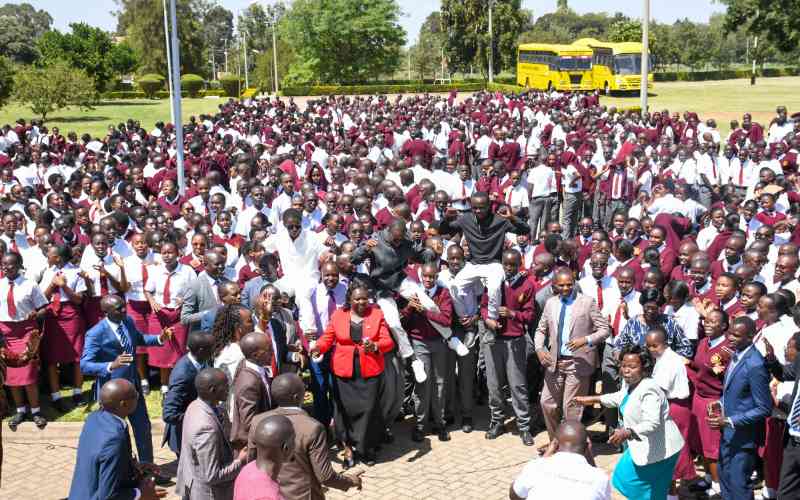
The 2025 Kenya Certificate of Secondary Education (KCSE) examination results were officially released by Education Cabinet Secretary Julius Ogamba in Eldoret on Friday, January 9, 2026. This year saw a total of 993,226 candidates sit for the national test, marking a 3.19 percent increase from the 962,512 candidates in 2024. The results revealed an improved academic performance across the board, with 270,715 candidates (27.18 percent) attaining the direct university entry qualification of a mean grade C+ and above, up from 246,391 (25.53 percent) in the previous year. Deputy President Kithure Kindiki extended his congratulations to the 2025 class, emphasizing that examination results are a means to an end, leading to training and skills development opportunities in various tertiary institutions.
A significant highlight of the 2025 KCSE examinations was the increase in top performers, with 1,932 candidates achieving a mean grade of A plain, a notable rise from 1,693 in 2024. Gender distribution among candidates showed a slight lead for female students for the second consecutive year, with 501,214 girls (50.46 percent) compared to 492,012 boys (49.54 percent). Further analysis of subject performance indicated that male candidates outperformed their female counterparts in 11 subjects, including Mathematics, Biology, Chemistry, Science, History, Geography, IRE, Building Construction, and Business Studies. Conversely, female candidates excelled in six subjects: English, Kiswahili, Kenyan Sign Language, Home Science, CRE, and Art and Design. Performance was comparable in seven subjects, such as Physics, Agriculture, Computer Studies, French, German, Arabic, and Music. Notably, subjects like Metalwork, Power Mechanics, Electricity, Drawing and Design, and Aviation Technology attracted very few female candidates, making meaningful comparisons difficult and exposing areas where girls are less represented.
The demographic analysis of the candidates also brought to light the trend of younger students sitting for the Form Four national exams. The number of candidates aged 16 and below rose to 26,391 in 2025 from 20,546 in 2024, indicating that thousands of students are completing secondary education at a relatively young age. However, the majority of candidates, 716,048, fell within the appropriate age bracket of 17 to 19 years for the KCSE.
Amidst the positive outcomes, the Kenya National Examinations Council (KNEC) cancelled the results of 1,180 candidates due to examination irregularities, a significant increase from 840 cancellations in 2024. Education CS Julius Ogamba warned that stringent action would be taken against anyone found liable, with investigations still ongoing for 22 reported cases of exam malpractice.
Across the nation, schools and communities erupted in celebration over outstanding performances. Moi High School Kabarak maintained its strong academic legacy, retaining the top position and posting an impressive mean grade of 10.6, a testament to its disciplined leadership and holistic education approach. Riabigutu Secondary in Kisii County celebrated a historic A- mean grade, while day schools, in general, demonstrated improved performance, sending more students to universities compared to their higher-ranked county counterparts. The Coast region's academic giants, including Sheikh Khalifa and Shimo La Tewa Boys, registered exemplary results, with individual top performers like Abdhul Mwatsuma Said and Victor Kombe from Shimo La Tewa scoring A plain (84 and 83 points respectively), and Yvonne Mona Mruu from Mama Ngina Girls achieving an A plain (84 points).
In the Nyanza region, academic giants such as Maranda, Asumbi, Mbita High School, Riokindo, Ng'iya, Maseno, Kisumu Girls, and Kisumu Boys bounced back with impressive results. Adem Stephen Packham from Chulaimbo Secondary School and Rebecca Ngoya from Ng'iya Girls High School were among the top achievers. The Mt Kenya region also reaffirmed its academic prowess, with leading schools like Murang'a, Nanyuki High School, Bishop Gatimu Ngandu Girls, and Kagumo High School posting outstanding results, showcasing a sustained culture of discipline. Notable students included Muriuki Ryan Gachihi from Kagumo High School (A, 83 points) and Karuga Saleh Kabi Nyambura from Bishop Gatimu Ngandu Girls High School (A plain). In Nairobi and Kiambu counties, several national schools, including Maryhill Girls (with 64 plain A's), Nairobi School, Alliance, and Starehe, recorded significant improvements. Bruce Magata from Alliance Boys High School scored an A (84 points), and Petrina Sasha Ayuma from Limuru Girls achieved an A (81 points). Light Group of Schools celebrated a mean grade of 9.28 with a 99% university transition rate. Meanwhile, the Western region saw a mixed bag of fortunes, with some traditional giants like Kakamega High School (which produced 11 plain A's) experiencing a decline, leading to an uneasy silence in many schools.
Among the many success stories, Erick Mbugua, a 19-year-old student from Kwangethe High School in Kiambu County, defied immense personal challenges to score an A- (75 points). Despite a difficult childhood marked by the loss of his mother at birth, a drug-addicted father, and often living on the streets, Erick persevered, relying on school meals and the support of his teachers and schoolmates. He aims to pursue medicine and is appealing to well-wishers for support to achieve his dream, demonstrating remarkable resilience and determination against all odds.