Global Markets Reel: Middle East Tensions Escalate, Ghana Braces for Oil Price Shock from US-Israeli Strikes
The Middle East conflict, ignited by "Operation Epic Fury" against Iran and subsequent retaliations, has triggered severe global energy market disruptions and widespread flight cancellations. While African commodity exporters like Ghana and Nigeria anticipate economic windfalls from surging gold and oil prices, African consumers face rising inflation and fuel costs. Governments are balancing leveraging these benefits with safeguarding citizens and managing the broader economic fallout.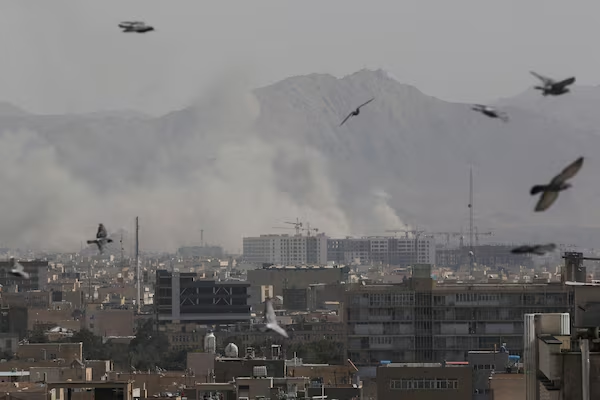
The Middle East has been plunged into a state of high alert and severe geopolitical instability following a dramatic weekend of military action. The United States and Israel launched "Operation Epic Fury" against Iran, an offensive that resulted in the assassination of Supreme Leader Ayatollah Ali Khamenei and other high-ranking regime figures. In a direct appeal to the Iranian populace, President Donald Trump urged citizens to "take over your government." Tehran's response was immediate and expansive, involving missile strikes against Israel and nine other countries across the Gulf and broader Middle East. The Pentagon confirmed the death of a fourth US military member in the initial attacks, with several US fighter planes also crashing in Kuwait due to an apparent friendly fire incident.
The global fallout was instantly visible across energy markets as they opened. Brent crude initially soared by 13% in early trading before settling 8.5% higher, with the global benchmark touching over $82 a barrel. Natural gas prices surged by as much as 42% at their peak. Supply chains experienced severe disruptions, with operations halted at Saudi Arabia’s largest oil refinery at Ras Tanura following a drone strike, and QatarEnergy ceasing liquefied natural gas (LNG) production. Maritime trade faced grave challenges; the UK Maritime Trade Operations Centre (UKMTO) confirmed that two vessels were struck and a third hit by an "unknown projectile," leading to at least 150 tankers dropping anchor in open waters. Stephen Innes of SPI Asset Management emphasized the critical role of the Strait of Hormuz, through which "roughly one-fifth of global oil and LNG flows," describing it as the "aorta of the global energy system." Homayoun Falakshahi from Kpler warned that due to Iran's threats and skyrocketing insurance costs, the strait was "effectively closed." In an attempt to stabilize the market, eight OPEC+ countries announced plans to boost production by 206,000 barrels per day in April. However, analysts noted that market watchfulness for the return of traffic through the Strait of Hormuz remained crucial for prices to subside. Further impacting global trade, Danish shipping giant Maersk announced it would pause sailings through the Suez Canal, rerouting ships around the Cape of Good Hope, a significant shift for African maritime logistics that adds considerable time and cost.
For African nations, this crisis presented a complex economic duality. While higher energy costs threatened to fuel inflation across the continent, major commodity exporters anticipated a significant fiscal boost. Ghana, recognized as Africa's leading gold producer, stood to gain substantially, with gold prices surging approximately 25% in 2026 to $5,426 per ounce, promising a massive revenue windfall. This price surge also benefited other major producers like South Africa, Mali, and Burkina Faso. Similarly, higher oil prices directly benefited exporters such as Nigeria, which exports around 1.5 million barrels of oil per day. Brendon Verster, a senior economist at Oxford Economics, noted that Nigeria's medium-term fiscal framework assumed global oil prices between $64 and $66 per barrel until 2028, implying that a prolonged conflict pushing prices over $100 could provide a major windfall for Nigeria, Libya, Angola, Algeria, and Egypt. President John Dramani Mahama of Ghana underscored the severity of these geopolitical events, stating that African nations must prepare to protect their people from inevitable economic shocks, especially given the Middle East's role as the "epicentre of global oil supplies." He also highlighted Ghana's aggressive approach to asserting sovereignty over its natural resources, citing an increase in small-scale gold exports from 63 to 104 tonnes within nine months, generating approximately $10 billion, and plans to locally process 400,000 tonnes of its cocoa crop from the next season to add value before export.
Despite potential windfalls for some commodity-exporting countries, the average African consumer, particularly in Ghana, faced the prospect of escalating costs. Edmund King, president of the AA, warned that the ongoing "turmoil and bombing... will inevitably lead to price hikes" at petrol pumps globally. Subitha Subramaniam, chief economist at Sarasin & Partners, cautioned that persistently high energy prices would "cascade into other prices such as food, agriculture, industrial commodities," leading to widespread inflationary pressure. Professor Godfred Bokpin, an economist at the University of Ghana, reiterated that the "pass-through effect" from crude prices to pump prices in Ghana was very strong, meaning consumers would directly feel the impact. He warned that an oil price shock could complicate Ghana’s fragile economic recovery under the International Monetary Fund (IMF) program and force the country’s monetary authorities to adopt a more cautious approach to interest rate cuts. The global "fear gauge," the VIX index, surged by nearly 17% since the previous week, indicating heightened market anxiety, with London's FTSE 100 falling and major banks like Barclays and Standard Chartered experiencing share price slides.
The escalating conflict severely disrupted global travel and aviation across the Middle East. Over 4,000 flights per day were cancelled across the region, affecting hundreds of thousands of passengers. Ian Petchenik, director of communications for Flightradar24, warned of "enormous repercussions" for the industry. Aviation analytics firm Cirium reported high cancellation rates, including 79% of global flights to Qatar, 71% to the United Arab Emirates (UAE), 81% to Israel, and 92% to Bahrain. Airlines like Etihad Airways temporarily suspended services, though some ad-hoc repatriation and cargo flights operated. Passengers described "pretty chaotic" scenes at Abu Dhabi Airport, experiencing sirens and alarm texts regarding potential missile strikes. Dubai Airports announced a "limited resumption of operations" from Dubai International and Dubai World Central, while Qatar Airways' operations remained suspended due to closed Qatari airspace. Many passengers remained stranded, with airlines advising them not to travel to airports without direct notification. The UK Foreign, Commonwealth and Development Office (FCDO) advised travelers to check its website for travel advice and warned that travel against FCDO guidance could invalidate insurance. Foreign Secretary Yvette Cooper acknowledged the "deeply stressful" situation for those affected and confirmed that the government was in close contact with airlines and Middle Eastern governments regarding potential evacuation options. Travel consultancy firm the PC Agency noted the global knock-on effect, with flights rerouting worldwide.
Beyond economic and travel disruptions, the conflict cast a significant shadow over international sports. Iran's participation in the 2026 FIFA World Cup, scheduled from June 11 to July 19 across the United States, Canada, and Mexico, was thrown into jeopardy. Mehdi Taj, president of Iran’s soccer federation, expressed deep skepticism, stating that after the attacks, the team "cannot be expected to look forward to the World Cup with hope," especially with a 40-day mourning period declared, effectively halting national team preparations. FIFA General Secretary Mattias Grafström acknowledged monitoring developments but stated it was "premature to comment." Andrew Giuliani, director of the White House World Cup task force, prioritized "their opportunity for freedom" over soccer games. Diplomatic hurdles, including previous U.S. visa denials for Iranian delegations, further complicated matters. Iran's Group G matches were entirely scheduled for U.S. territory, with no provisions announced for relocating these fixtures to neutral venues. The conflict also impacted other sports, with the Israel Gymnastics Federation suspending all training due to the security situation. Should Iran formally withdraw, FIFA would be compelled to name a replacement team, most likely the United Arab Emirates, based on qualifying standings.
In response to the volatile situation and humanitarian concerns, Ghana's Minister of Foreign Affairs, Samuel Okudzeto Ablakwa, assured citizens (on Tuesday, March 3) that the government remained committed to their safety overseas, affirming that "no Ghanaian would be abandoned in harm's way." Ghana's diplomatic missions were tasked with reinforcing measures to monitor and protect citizens abroad, with particular commendation for embassy staff in the UAE for supporting the Black Queens and other trapped nationals amidst airline cancellations. Separately, the Foreign Affairs Ministry advised Ghanaians planning the Umrah pilgrimage to Mecca to reconsider travel plans and temporarily suspend journeys until stability returned to the region (as of a statement dated March 2, 2026). For those already in Saudi Arabia, the Ministry urged composure, strict observance of Saudi directives, and close contact with travel agencies and Ghanaian diplomatic missions in Riyadh and Jeddah, providing emergency contact numbers. These governmental responses highlight the delicate balancing act facing African policymakers: leveraging unexpected commodity windfalls to cushion vulnerable populations from global energy inflation while ensuring the safety and welfare of their citizens abroad amidst unprecedented geopolitical turmoil. President Mahama, during bilateral talks with Tanzanian President Samia Suluhu Hassan, further emphasized the need for African nations to control their resources and protect their people, drawing parallels with the shared history and values of Ghana and Tanzania and reiterating the importance of continental cooperation.