Global Leaders Converge: G7 Summit in France Ignites Protests and High-Stakes Talks
Leaders of the G7 convene in Évian-les-Bains for a summit dominated by urgent geopolitical issues, including a potential Iran peace deal, strained US-Europe relations, and discussions on AI's safe deployment. The high-stakes meeting unfolds amidst significant anti-G7 protests and stringent security measures in nearby Geneva, highlighting global tensions and public discontent.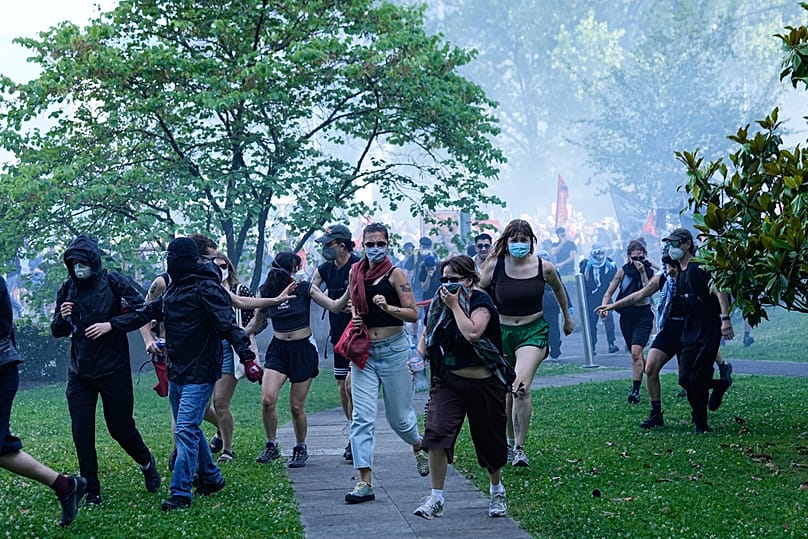
The alpine resort of Évian-les-Bains, typically recognized for its mineral water, is set to become a focal point of global diplomacy as leaders from the world's seven largest advanced economies convene for their annual G7 summit.
This 52nd meeting, held on the French shore of Lake Geneva from Monday to Wednesday, arrives at what many assess to be one of the most fraught geopolitical moments in recent memory.
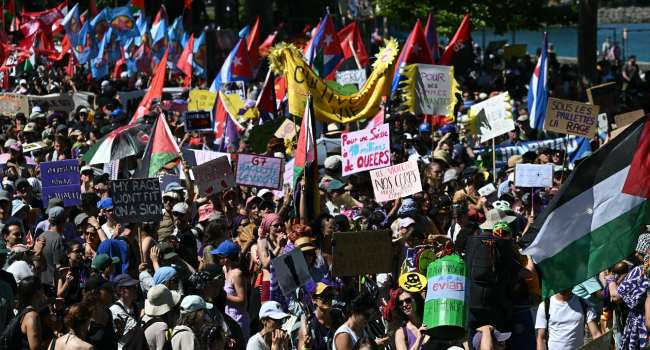
Coinciding with the summit's opening, thousands of demonstrators gathered in Geneva, Switzerland, on Sunday to protest against the G7 leaders, highlighting widespread discontent as the event commenced in the nearby French town.
The summit's schedule was notably affected by the delayed arrival of US President Donald Trump, who was expected tofly to France late Sunday after observing a mixed-martial arts bout on his 80th birthday.
His postponement necessitated the summit itself being pushed back by a day, and the French President Emmanuel Macron is scheduled to receive Trump privately on Monday at 17:00, followed by a formal welcome dinner titled "Responding together to the major international challenges."
Following the G7 proceedings, President Trump will travel to the Palace of Versailles for a dinner with President Macron, commemorating the 250th anniversary of American independence at a site significant for Franco-American friendship, where the treaty solidifying US independence was signed in 1783.
A primary focus of the summit is the potential peace agreement between Washington and Tehran, with a deal appearing closer than at any point since Trump initiated the war against Iran in February.
A senior administration official indicated that an agreement could be days away, though not "100%" certain, with Pakistan, a key mediator, describing the situation as closer to resolution than "ever before."
The economic implications are substantial; prior to the conflict, approximately a quarter of the world's seaborne oil trade transited through the Strait of Hormuz, which Iran closed to "unfriendly nations" in early March, leading to a sharp rise in global energy prices.
Even with a deal, the task of clearing mines from the strait presents a significant military undertaking.
The UK and France have already prepared a mine-clearing proposal, supported by military planners from over 15 countries, designed for rapid deployment.
This is to secured Trump's endorsement for this plan is a central objective of the summit, despite his recent downplaying of the threat posed by Iranian mines, contrasting with Secretary of State Marco Rubio's acknowledgement of large mined sections.
The relationship between host Emmanuel Macron and Donald Trump, once characterized by a famous white-knuckle handshake in 2018, is under scrutiny.
Their "bromance" has reportedly evolved into a more transactional dynamic, though a personal channel of communication through calls and texts persists.
The european officials noted a "grudging mutual respect" in the room. European leaders arrive with fresh grievances, including US tariffs on EU goods, Trump's ambiguous stance on NATO, and the economic hardship resulting from the Hormuz closure.
Experts like Max Bergmann of the Centre for Strategic and International Studies observed a shift in European attitudes, stating that while they might have accepted a "bend-the-knee strategy" in 2025, they are "less accepting of it in 2026."
Other significant geopolitical fault lines are also on the agenda, and the Ukrainian President Volodymyr Zelenskyy will attend a G7 working session on Tuesday, themed "Building peace and security for Ukraine and Europe."
However, his exclusion from a bilateral meeting with Trump signals Kyiv's diminished standing in Washington.
The Élysée schedule shows Zelenskyy arriving at 08:55 on Tuesday for the 09:00 session. Furthermore, a separate working lunch will bring leaders from Egypt, the UAE, and Qatar to the table to discuss "facing the crises and guaranteeing stability in the Middle East."

Trump is slated for one-on-one meetings with the leaders of France, Qatar, the UAE, Egypt, and India.
Canadian Prime Minister Mark Carney, on the eve of the summit, delivered a pointed address in Dublin, emphasizing that "Ireland and Canada are navigating a global rupture, not a quiet transition" and that the "post-Cold War world's rules-based order is breaking down."
Artificial intelligence also features prominently, with an unprecedented gathering of industry chiefs.
The CEOs of OpenAI (Sam Altman), Google DeepMind (Demis Hassabis), and Anthropic (Dario Amodei) have confirmed their attendance, marking the first G7 summit to host representatives from all three leading AI companies.
Macron personally extended the invitation to Altman, making this his inaugural G7 appearance.
A dedicated working lunch on Wednesday with business leaders is scheduled to focus on "ensuring a safe, rapid and effective deployment of artificial intelligence," which is described as the summit's most concrete institutional moment concerning the technology.
Amidst these high-level discussions, the summit is overshadowed by widespread public protests and extensive security operations.
In Geneva, thousands of demonstrators clashed with police on Sunday.
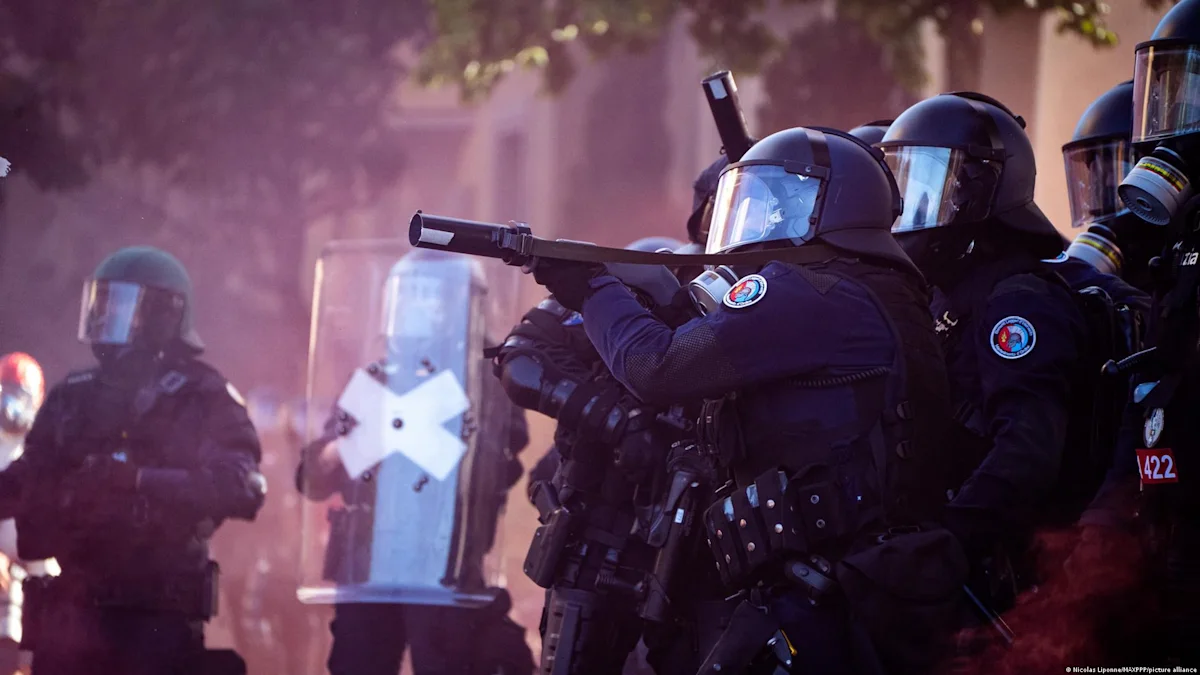
The protesters threw bottles, stones, pieces of cement, and firecrackers, met by police responses of tear gas and water cannons near the United Nations headquarters.
Geneva police spokesman Alexandre Brahier estimated around 20,000 participants, including approximately 600 "Black Bloc" militants.
The demonstration saw a diverse coalition of environmentalists, feminists, critics of imperialism, defenders of independent media, and supporters of Palestinian rights.
A violent standoff extended into the evening, with reports of a car set ablaze and a bank’s windows smashed.
French and Swiss authorities deployed thousands of security personnel for the three-day event, including over 13,000 police officers, alongside roadblocks and restrictions on public gatherings.
Many businesses in Évian-les-Bains closed or boarded up in preparation due to past unrest concerns.
The summit is also significant as it comes amid rising global tensions in the Middle East, affecting international stability and energy markets.