Ghana's Urban Crisis: Floods, Filth, and Furious Demolitions Rock Accra
Ghana is grappling with severe flooding, prompting nationwide clean-up exercises and strict enforcement against illegal structures. While government and various organizations actively participate, critics highlight the reactive approach and environmental concerns, underscoring the urgent need for comprehensive, long-term engineering and ecological solutions to manage urban growth and climate impacts.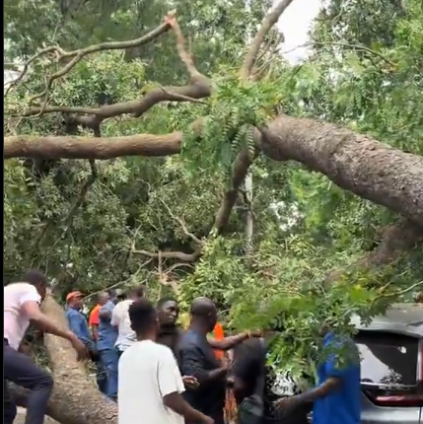
Ghana has recently experienced a series of devastating floods, particularly impacting the Greater Accra Region, leading to significant loss of lives, displacement of thousands of residents, destruction of homes, businesses, and public infrastructure. A notable incident involved a large tree falling onto several vehicles on the 37 Hospital stretch towards Kawukudi in Accra, causing major traffic obstruction, an event addressed by the National Disaster Management Organisation (NADMO) amid heightened safety concerns during the rainy season.
In response to these recurring disasters, the government has intensified efforts to address environmental sanitation and mitigate flood risks. President John Dramani Mahama declared a nationwide clean-up exercise on July 10 and 11, mobilizing various stakeholders including Ministries, Departments and Agencies (MDAs), Metropolitan, Municipal and District Assemblies (MMDAs), security services, educational institutions, waste management companies, and the general public. The aim of these exercises is to clear refuse, desilt choked drains, restore public spaces, and improve stormwater flow.
Various institutions and communities have actively participated in these clean-up initiatives. The Ghana Police Service, led by Inspector-General of Police Christian Tetteh Yohuno, joined citizens in a national cleaning exercise. The Bui Power Authority also deployed staff to clean drains and public spaces around its Accra offices and Bui Generation Station. CalBank PLC and the Bank of Ghana, led by Governor Dr. Johnson Pandit Asiama, also contributed by donating sanitation equipment and participating directly in desilting activities. Karpowership Ghana similarly supported the Effia Kwesimintsim Municipal Assembly (EKMA) with sanitation equipment and staff participation. Lele Group also donated 1,000 relief packages to flood-affected families in the Tema West Municipality.
Local authorities, such as the Ga South Municipal Chief Executive Mr. Moses Kabutey Ocansey, have urged residents to prioritize environmental sanitation, warning against building in waterways and earmarking about 1,200 illegal structures for demolition. The Kumasi Metropolitan Assembly (KMA) also intensified enforcement during the National Clean-Up Day, demolishing unauthorized structures and summoning sanitation offenders to court. The Deputy Minister for Lands and Natural Resources, Sulemana Yusif, joined his ministry's staff in clean-up efforts, stressing the importance of collective action.
A critical component of the government's strategy involves the strict enforcement of sanitation by-laws and the demolition of structures obstructing waterways. Greater Accra Regional Minister Linda Ocloo issued a stern warning that any MMDCE found to have approved construction on waterways would be dismissed, seeking to hold officials accountable for actions exacerbating perennial flooding. Felix Kwakye Ofosu, Minister of State for Government Communications, reiterated that sanitation by-laws would be enforced without compromise, and buildings posing a threat to public safety due to their location on waterways would be pulled down.
However, the government's response has faced criticism. Former MP Andrew Egyapa Mercer described the clean-up efforts as a