Ghana's Gold Strategy Unveiled: Bawumia Dives Deep into Game-Changing Domestic Gold Purchase Programme!
Ghana's former Vice President, Dr Mahamudu Bawumia, has shed light on the origins of the Gold-for-Oil and Domestic Gold Purchase programmes. He explained that these innovative initiatives were developed to address a severe balance of payments crisis, triggered by halted external financing and restrictive IMF conditions, by offering "out-of-the-box" solutions to stabilize the cedi and bolster national reserves. Other countries are now reportedly learning from Ghana's pioneering approach.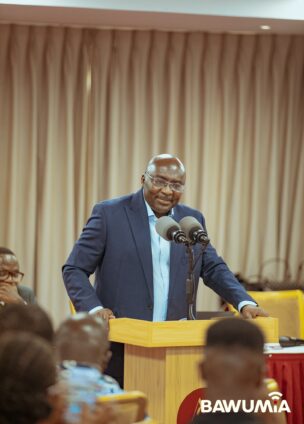
Dr Mahamudu Bawumia, the New Patriotic Party's 2028 flagbearer and former Vice President of Ghana, recently elucidated the critical circumstances that led to the pioneering introduction of Ghana's Gold-for-Oil (G4O) and Domestic Gold Purchase programmes. Addressing members of the Ghana National Association of Small-Scale Miners in Accra, Dr Bawumia revealed that these innovative policies were conceived as direct responses to two significant and interconnected economic challenges faced by the nation during his tenure as Vice President.
The primary catalyst for these unconventional economic strategies was the abrupt cessation of external financial inflows. Following the profound global economic disruptions caused by the COVID-19 pandemic and the geopolitical ramifications of the Russia-Ukraine war, many developing nations, including Ghana, experienced a severe constriction in external funding. Dr Bawumia metaphorically described this as the "tap (external financing) was shut for Ghana," which plunged the country into a precarious balance of payments crisis, necessitating urgent and creative solutions to stabilize the economy.
Compounding this crisis were the stringent conditions imposed as part of Ghana's International Monetary Fund (IMF) programme. While the IMF intervention was crucial for restoring confidence in the national economy, it came with restrictive covenants. Specifically, the Bank of Ghana was permitted to intervene in the foreign exchange market with a maximum of only $80 million per month. Dr Bawumia highlighted the stark imbalance this created, explaining that the monthly demand for foreign exchange in Ghana significantly exceeded this allocated amount. This disparity between demand and supply inevitably led to a continuous depreciation of the cedi against major international currencies, further exacerbating economic instability.
It was against this backdrop that the concept of the Gold-for-Oil programme emerged. Dr Bawumia explained that the fundamental objective was to circumvent the severe dollar constraint by utilizing Ghana's abundant gold reserves directly to procure essential commodities like fuel. This strategic move aimed to prevent a potential fuel shortage, which would have had devastating consequences for the economy and the populace, by creating an alternative payment mechanism that bypassed the need for scarce foreign currency.
The second groundbreaking initiative, the Domestic Gold Purchase Programme, was conceived during a moment of profound reflection. Dr Bawumia recounted how, while exercising, he pondered the paradox of Ghana, a significant gold-producing nation, having to export other valuable commodities such as cocoa to generate dollars for its foreign exchange reserves. This led him to the "out-of-the-box" question: "Why does Ghana, which mines gold every day, have to export cocoa to get dollars for its forex reserves? Why not buy the gold we already produce with cedis?" This insight laid the foundation for a programme where the Bank of Ghana could acquire domestically mined gold in local currency, thereby bolstering national reserves without depleting dollar reserves.
Dr Bawumia unequivocally characterized both initiatives as instances of "out-of-the-box thinking," emphasizing their departure from conventional economic theories. He stated that "It was not a textbook idea. There’s no textbook in economics that will tell you about the Gold-for-Reserves programme." The unprecedented nature of these proposals meant that their implementation required meticulous preparation. Dr Bawumia noted that he initially suggested the Domestic Gold Purchase Programme to the Bank of Ghana, which then undertook nearly a year of rigorous due diligence. This extensive review period was necessary due to the unorthodox nature of the proposal, with officials expressing concerns about "getting into trouble for doing something that was very unorthodox."
Ultimately, after thorough vetting, the Bank of Ghana assented, leading to Ghana becoming a pioneer in this economic innovation. Dr Bawumia proudly declared that Ghana was "the first country in Africa, and probably the world," to successfully implement such a programme. He concluded by noting the global impact of this pioneering approach, observing that "other countries are coming to learn from Ghana," underscoring the success and international recognition of these unique economic solutions.