Ghana's Education System on the Brink: UEW Lecture Series Sparks Urgent Reform Debate

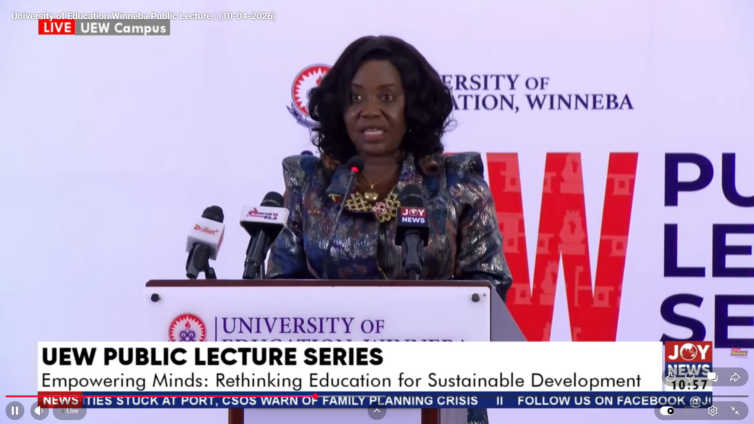
Ghana's education system faces a critical juncture, with leaders calling for a fundamental rethinking to align academic training with evolving industry needs and national development goals. This urgent call to action was the central theme of the University of Education, Winneba (UEW) Public Lecture Series 2026, held on Friday, April 10, under the theme “Empowering Minds: Rethinking Education for Sustainable Development.”
Ing. Patricia Obo-Nai, CEO of Telecel Ghana, spearheaded the discussion, describing the forum as a vital “national conversation” demanding reflection on how Ghana prepares its youth for a future shaped by rapid technological advancements, growing inequality, and shifting economic demands. She lauded UEW’s pivotal role in shaping generations through teacher training, emphasizing that education must remain relevant to avoid creating a disconnect between learning and employability. “If education remains unchanged whilst everything around it changes, we are creating a gap between learning and relevance,” Obo-Nai warned, noting that students, employers, and eventually the economy feel the brunt of this mismatch.
Echoing this sentiment, Prof. Stephen Jobson Mitchual, Vice-Chancellor of UEW, urged Ghanaian universities to prioritize innovation and the production of impactful graduates over merely expanding academic programs. He critically questioned whether the continuous graduation of thousands of students without adequate preparation was solving or exacerbating the nation’s biggest problem: unemployment. Prof. Mitchual stressed that education extends beyond academic attainment, aiming to shape critical thinkers, problem-solvers, and responsible citizens prepared for work, citizenship, leadership, and service.
Dr. Mohammed Ibn Chambas, the African Union High Representative for Silencing the Guns, broadened the perspective, calling for a continent-wide transformation of education. He situated this within the African Union’s Agenda 2063 and the Sustainable Development Goals, highlighting education as a strategic pillar for achieving socioeconomic transformation, lasting peace by 2030, and sustainable development. Dr. Chambas commended Ghana’s significant progress in expanding education access since independence, citing high enrollment rates and initiatives like Free Senior High School. However, he cautioned that expansion alone is insufficient if the system prioritizes rote learning and certification over critical thinking and competence, leaving graduates with degrees but lacking employable skills.
All speakers underscored the visible consequences of this educational gap: students feeling unprepared, employers struggling to find skilled talent, and the national economy suffering. Dr. Chambas specifically pointed to persistent challenges in foundational learning, where many primary students struggle with basic literacy and numeracy, leading to “learning poverty.” He also noted the alarming statistic that fewer than 18 percent of Ghanaian university students pursue STEM subjects, far below national and international targets.
To bridge these gaps, speakers proposed several solutions. Ing. Obo-Nai highlighted Telecel Ghana’s initiatives, including the Next Generation Graduate Programme for practical work experience, the Female Engineering Scholarship Programme to boost gender inclusion in technical fields, and the Telecel Digitech Academy, which has trained thousands in robotics, coding, and web design. These programs aim to instill digital literacy, deemed a basic requirement for relevance in any sector.
Dr. Chambas advocated for comprehensive curriculum reform that connects learning to local contexts such as agriculture, environment, and industry needs. He passionately called for elevating Technical and Vocational Education and Training (TVET), stressing that TVET professionals are the “backbone of an industrialised, self-reliant Ghana” and should not be relegated to second-class status. Furthermore, he urged a shift from STEM to STEAM education, integrating arts and humanities to foster ethical and creative problem-solving, recognizing that “STEM without creativity is just mechanics.” He also emphasized the importance of preparing learners for uncertainties like climate change, digital disruption, and economic volatility by embedding climate education across all learning levels.
A recurring theme was the indispensable need for stronger collaboration between academia, industry, policymakers, government, civil society, and international partners. Ing. Obo-Nai asserted that “Industry must participate by helping shape graduate readiness for work.” Prof. Mitchual described the public lecture series as “a call to reflection, a call to partnership, and a call to action.” Dr. Chambas likened education transformation to a “traditional drum, [that] produces rhythm only when struck by many hands.”
Ultimately, the discussion converged on three core principles for rethinking Ghana’s education system: relevance, resilience, and responsibility. The leaders urged a national mindset shift that views education not as something to be completed but as a continuous journey of learning, questioning, and building beyond formal qualifications. The quality of a country’s life, they concluded, is a direct reflection of its quality of education, demanding human capability to grow at the same pace as national infrastructure and technological advancements.
Recommended Articles
Ghana's Education Revolution: Dr. Ibn Chambas Unleashes Vision for Future Learners!

Dr. Mohammed Ibn Chambas, AU High Representative, advocates for comprehensive education reform in Ghana. Speaking at UEW...
NYA CEO Ayariga Drives Youth Empowerment with Massive National Apprenticeship Programme

The National Youth Authority's National Apprenticeship Programme (NAP) has begun distributing essential tools to benefic...
Education Alarm: AI Decimating Pupils' Critical Thinking & Spelling Skills, New Survey Reveals

A recent survey of English teachers reveals significant concerns about AI's impact on pupils' critical thinking and spel...
Nigeria Leads the AI Chatbot Revolution: 88% Adoption Crushes Global Averages

A new Google and Ipsos report highlights Nigeria's exceptional AI chatbot adoption, with 88% of adults using them for le...
Governor Lawal Unleashes Sweeping Reforms in Zamfara

Governor Dauda Lawal of Zamfara State launches sweeping reforms, recruiting teachers, boosting technology, supporting vu...
You may also like...
Arsenal's Bournemouth Blunder: Title Hopes Dented, Arteta Calls it a 'Big Punch'

Arsenal's Premier League title challenge suffered a significant blow with a shock 2-1 home defeat to AFC Bournemouth, le...
‘Faces of Death’ Creators Unveil Shocking Vision for Internet-Obsessed Killer

The cult classic "Faces of Death" receives a 21st-century reimagining from Isa Mazzei and Daniel Goldhaber, exploring ho...
Netflix in Legal Showdown: $351M Blockbuster Blocked!

"It Ends with Us," starring Blake Lively and Justin Baldoni, is currently blocked on Netflix's ad-supported tier due to ...
Unveiled: Bruno Mars' 'The Romantic Tour' Kicks Off with Electrifying Setlist!

Bruno Mars received the key to Las Vegas and had a street named in his honor, coinciding with the launch of his new 'The...
Coachella Shocker: Anyma's Epic Performance Axed by Unrelenting Winds!

Anyma's eagerly awaited Coachella 2026 performance was cancelled due to strong winds impacting his stage build, prioriti...
Malcolm in the Middle's Shocking Comeback: Stars Reveal Revival's True Impact!

Frankie Muniz discusses Hulu's 'Malcolm in the Middle: Life's Still Unfair' revival, revealing Malcolm's surprisingly ha...
Billionaire Hotspots Revealed: Charting the States Producing the Wealthiest Elites

The United States is home to nearly half of the world's billionaires, with a fascinating distribution across birth state...
Gaming Revolution: Super Battle Golf Unleashes Mayhem on the Links!

The A.V. Club introduces "The Playfield," a new weekly column exploring games across various platforms, featuring writer...