Ghana's Anti-Corruption Body Declares 'Rebirth,' Exposing Massive Graft
The Special Prosecutor, Kissi Agyebeng, has declared the "rebirth" of the Office of the Special Prosecutor (OSP), highlighting its resilience against sustained attacks and a recent Supreme Court victory affirming its independent prosecutorial mandate. Agyebeng defended the OSP's performance with quantifiable achievements, including financial recoveries and significant savings, while also outlining future plans to strengthen anti-corruption efforts through enhanced lifestyle audit powers and a reverse-onus clause for unexplained wealth. The OSP also provided an update on its ongoing domestic investigation into the Asante Kwaku Berko corruption case.
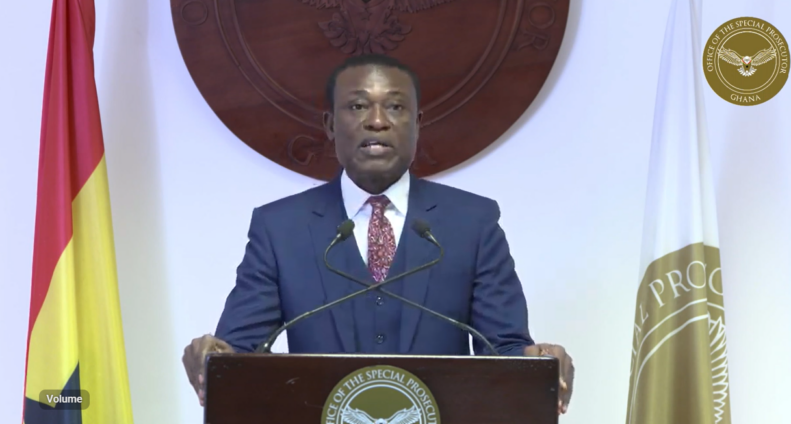
Special Prosecutor Kissi Agyebeng, on August 26, 2026, declared the “rebirth” of the Office of the Special Prosecutor (OSP), asserting the institution's resilience in the face of persistent attacks and calls for its abolition. Speaking at a press conference, Mr. Agyebeng revealed that some criticisms targeting the OSP were not driven by concerns over its performance but by personal animosity towards its leadership and operational directors. He stressed that undermining a public institution dedicated to fighting corruption due to personal preferences for office holders, rather than any proven misconduct, is detrimental to national development.
Mr. Agyebeng highlighted that the OSP has consistently endured attacks, some of which were official actions by public officers whose duty it is to protect the Office. These attacks included attempts to abolish the OSP through a withdrawn private member’s bill in Parliament, baseless claims of underperformance, and efforts to diminish its public standing. He firmly stated that such actions, intended to strangle the OSP, were without reasonable basis. While acknowledging that the OSP, like any human institution, is not perfect and has made common mistakes, Mr. Agyebeng argued that these errors are insufficient to justify calls for its collapse or the removal of its essential powers. He contended that the coordinated assaults on the OSP are largely traceable to its powers and functions, particularly its independent prosecutorial and investigative mandates, which represent a "spectre of discomfort" among some public officers.
The Special Prosecutor challenged critics who claim the OSP has achieved nothing or is ineffective to examine its performance statistics. He invited a dispassionate comparison with other institutions, considering their respective mandates, years of establishment, resources, case complexity, and legal constraints. Mr. Agyebeng maintained that such an assessment would demonstrate the OSP's credible performance, emphasizing its commitment to openness and transparency in its operations.
Detailing the OSP's measurable achievements, Mr. Agyebeng disclosed that as of December 31, 2025, the Office was prosecuting 33 persons, with 79 cases under full investigation and 161 cases undergoing preliminary investigation. The OSP had also secured seven convictions through court-sanctioned plea bargains. Financially, the Office had recovered GH¢8.518 million and US$2 million, in addition to substantial movable and immovable assets involved in ongoing recovery proceedings. Beyond investigations and prosecutions, the OSP’s mandate includes preventing corruption and protecting state resources. Interventions in sectors such as natural resources, seaports, and the customs regime have prevented significant financial losses. Notably, the OSP safeguarded the Tema Oil Refinery, which is now operational after years of inactivity, and its intervention in the customs sector has led to more robust auction systems and a reduction in the abuse of the customs advance ruling regime. Furthermore, the OSP's shake-up of the government payroll system has saved the nation over GH¢100 million. Mr. Agyebeng asserted that the OSP has saved the nation more than twenty times the total amount of money released to it since its establishment, thereby far exceeding the resources invested.
The OSP's work faced a significant legal challenge on April 15, 2026, when an Accra High Court controversially struck down parts of the Office of the Special Prosecutor Act, 2017 (Act 959), ruling that the OSP lacked an independent prosecutorial mandate. This decision invalidated all OSP prosecutions, nullified convictions and asset recoveries, and directed that all OSP cases be handed over to the Attorney-General, effectively bringing its investigative and prosecutorial work to a standstill. The OSP had attempted to join the pending Supreme Court case of Noah Ephraem Tetteh Adamtey v. Attorney-General, suspecting the Attorney-General's intention not to defend the suit. This suspicion was later confirmed when the Attorney-General supported the plaintiff's case. However, several civil society organizations intervened as amici curiae (friends of the court) to defend the OSP's mandate.
On July 29, 2026, the Supreme Court delivered a landmark 7-0 verdict, unequivocally upholding the constitutionality of the OSP’s prosecutorial function and its legal framework under Act 959, L.I. 2373, and L.I. 2374. This decision expressly overturned all lower court rulings to the contrary, clarifying the functions of the OSP and its co-existent relationship with the Attorney-General. Mr. Agyebeng expressed gratitude to the defending civil society organizations, including the Ghana Center for Democratic Development, Transparency International Ghana, Ghana Anti-Corruption Coalition, and IMANI Centre for Policy & Education, among others, for their civic vigilance, which he deemed essential to safeguarding Ghana’s anti-corruption architecture and the rule of law. This Supreme Court decision is the bedrock upon which the Special Prosecutor declared the OSP's rebirth.
Moving forward, the OSP pledges to operate without fear or favor, remaining resolute in the lawful discharge of its mandate through rigorous investigations, vigorous prosecutions where evidence dictates wrongdoing, active asset recovery, and comprehensive steps to prevent corruption. Recognizing the persistent pushback from corrupt actors, the OSP champions the enlargement and enhancement of anti-corruption agencies' powers in two critical areas: first, granting express and effective lifestyle audit and non-conviction-based asset recovery powers. This aims to ensure individuals demonstrate legitimate income sufficient to justify property ownership, with unexplained wealth liable to confiscation. Second, instituting a reverse-onus clause, providing a presumption of corruption tied to lifestyle audits, where disproportionate property holdings necessitate proof of legitimate acquisition. These mechanisms, while not shortcuts around justice, aim to establish a legal threshold for confiscating unreconciled assets.
Despite the challenges following the High Court ruling on April 15, the OSP has actively reviewed all cases, uncovering more evidence and identifying additional suspects. Some major pending cases will be refiled based on these new discoveries. The Special Prosecutor reiterated the extraordinary complexity of corruption cases, which require immense time, painstaking information gathering, forensic analysis, adequate resources, and international cooperation, cautioning against judging them solely by the swiftness of arrests or prosecutions.
Regarding the Asante Kwaku Berko case, where a federal jury in Brooklyn, New York, on August 6, 2026, convicted Mr. Berko for conspiring to pay over $1 million in bribes to Ghanaian officials, the OSP confirmed its significant investigative and evidentiary assistance to the FBI. Domestically, the OSP has been carefully investigating the Ghanaian dimension, clarifying that a conviction in a foreign jurisdiction does not automatically establish criminal liability under Ghanaian law. Each person's actions must be assessed with lawfully obtained evidence specific to Ghanaian legal standards. The OSP has identified the following as main persons of interest: Kwabena Donkor (former Minister of Power), Francis Walkson Kwesi Dzata (Technical Advisor), Solomon Adjetey Sowah (Deputy Director at Ministry of Power), Lyndon George Nii Saul Mettle (Director at Tricorp Group Limited), and Baffour Ankoma Brobbey (employee at Tricorp Group Limited), along with present and former employees of the Volta River Authority, Ghana Grid Company Limited, Electricity Company of Ghana, Public Utilities Regulatory Commission, and the former Ministry of Power. Mr. Agyebeng strongly emphasized that a "person of interest" is distinct from a "suspect" and does not imply criminal culpability until guilt is proven beyond reasonable doubt. He also pushed back against claims that the OSP lacks the capability to investigate this matter domestically, given its crucial role in the successful U.S. prosecution.
Concluding his address, Mr. Agyebeng urged sister investigative, intelligence, and prosecutorial institutions to prioritize cooperation and collaboration over competition. Citing historical examples of negative outcomes from inter-agency rivalry, he called for shared intelligence and concerted efforts, affirming that all institutions serve the singular goal of making the Republic of Ghana great and strong.