Ghana in Turmoil: US Deportee Deal Sparks Outrage and Legal Warnings
Ghana's government faces intense scrutiny over an agreement to receive deported West African nationals from the United States. The parliamentary Minority asserts the deal is unconstitutional, demanding immediate suspension and parliamentary ratification due to legal, security, and foreign policy concerns.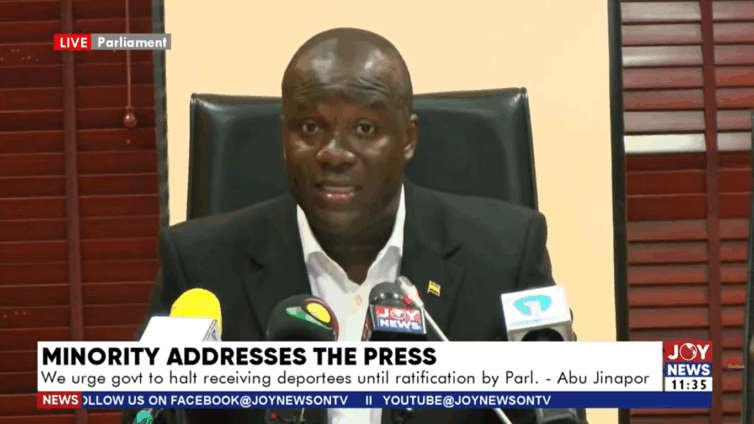
Ghana is currently embroiled in a significant constitutional and foreign policy debate concerning an agreement with the United States to receive West African nationals deported from the US. The Minority caucus in Parliament, spearheaded by Member of Parliament for Damongo and former Minister for Lands and Natural Resources, Samuel Abu Jinapor, has vehemently called for an immediate suspension of this arrangement, branding it as “unconstitutional” and demanding full parliamentary scrutiny and ratification.
The core of the Minority’s argument rests on Article 75 of Ghana’s 1992 Constitution, which mandates that any treaty, agreement, or convention entered into by the President or under his authority must be laid before Parliament for ratification. Mr. Jinapor, speaking on behalf of the Minority on Wednesday, September 24, expressed profound disappointment that MPs only became aware of the deal through media reports. He underscored that operationalizing such an agreement without parliamentary approval directly violates this constitutional provision and undermines the Supreme Court’s authority, citing precedents like the 2016 Guantanamo Bay detainee case and the Banful v. Attorney-General case, both of which affirmed the necessity of parliamentary ratification for international agreements, regardless of their form, including Memoranda of Understanding (MoUs) or even Note Verbales.
In response to the government’s assertion that the arrangement is merely a Memorandum of Understanding (MoU) and therefore does not require parliamentary ratification, Mr. Jinapor stressed that the Constitution makes no such distinction. He found the Foreign Affairs Minister Samuel Okudzeto Ablakwa’s claim that MoUs only require approval if “elevated” to formal agreements “deeply disturbing” in the face of clear constitutional requirements and Supreme Court rulings.
Beyond the constitutional impropriety, the Minority and international relations analysts have raised serious concerns about the broader implications of the agreement. Abu Jinapor warned of severe foreign policy ramifications, stating that aligning Ghana with US immigration enforcement policies, which are often criticized as harsh and discriminatory, could significantly damage Ghana’s international standing. He argued that Ghana, with its proud reputation for principled diplomacy rooted in non-alignment, regional solidarity, and respect for human rights, could be perceived as complicit in a system that violates the dignity and rights of deportees. This, he suggested, could strain relationships with sister African nations and undermine Ghana's image as a champion of Pan-Africanism and human rights.
International Affairs and Political Analyst Nana Karikari echoed these sentiments, highlighting potential legal, security, and economic challenges. She questioned the lack of clarity regarding the deportees’ backgrounds, asking, “Are they criminals? Do they have jobs? What exactly are these deportees coming to Ghana for?” Madam Karikari warned that Ghana could face lawsuits from deportees over human rights violations, further tarnishing its international reputation. Economically, she pointed out the strain on the job market as deportees compete with locals, alongside difficulties in cultural adjustment and integration into Ghanaian society.
The Minority also emphasized that the ECOWAS Protocol on Free Movement, often cited in discussions of regional integration, pertains strictly to voluntary travel within the region and cannot be stretched to justify forced deportations orchestrated by non-ECOWAS states. They expressed alarm that despite legal and constitutional concerns, the government was preparing to receive more deportees, noting that some foreign nationals already received have instituted legal actions against the government for breaches of their fundamental human rights. Reports indicate that while 14 deportees were initially accepted, 40 more are expected from the U.S.
International relations analyst Ishmael Hlorvor, while downplaying the idea that acceptance of deportees inherently damages global standing, strongly affirmed that bypassing parliamentary approval is indeed “worrying” and problematic. He insisted that, given the history of such transactions, it is “just appropriate” for the government to present the agreement before Parliament for open scrutiny.
The Minority has therefore reiterated its urgent call for the government to suspend the agreement immediately. They demand full transparency regarding the processes, safeguards, diplomatic protocols, and security measures put in place to protect Ghana’s national interests, stressing that Parliament must duly exercise its constitutional mandate to scrutinize and ratify the agreement before any further steps are taken. The ongoing situation highlights a significant tension between executive action and legislative oversight in Ghana's foreign policy implementation.