Germany's Far-Right Rises: AfD Shakes European Politics and Rattles Leadership
The radical-right Alternative for Germany (AfD) secured a landslide victory in the Saxony-Anhalt regional election, signaling a significant shift in German and European politics. This outcome, with AfD taking 43.8% of the vote, raises concerns about the erosion of the political center and the potential for far-right parties to lead governments across the continent, prompting calls for mainstream parties to adapt before upcoming high-stakes elections.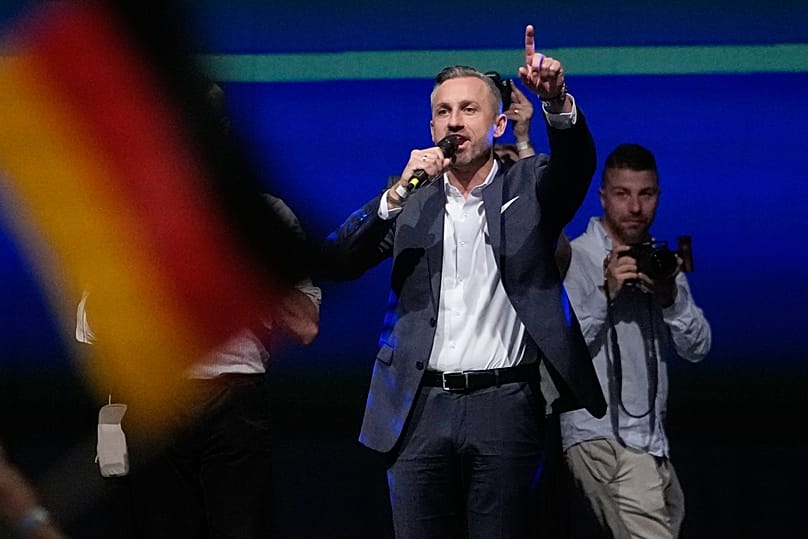
The radical-right Alternative for Germany (AfD) achieved a resounding landslide victory in the Saxony-Anhalt regional election, a result that analysts suggest could be the first significant crack in the post-World War II European power structure. On Sunday, the AfD secured 43.8% of the vote in the eastern German region, more than doubling its support from five years prior. This triumph dealt a severe blow to Chancellor Friedrich Merz’s Christian Democratic Union (CDU), which saw its support collapse to 17.2%, while its junior coalition partner, the Social Democrats (SPD), managed only 9.3%.
This outcome has set the stage for unprecedented political negotiations, as local AfD leader Ulrich Siegmund could potentially become president of the region, marking the first time since the Nazi period that a German region might be led by a far-right force. The AfD, officially classified as 'right-wing extremist' by Germany's domestic intelligence agency, fell just short of an absolute majority, requiring potential coalition talks with parties like the far-left BSW, which leans hard-right on immigration, or by attracting defectors from other parties.
The election result sent shockwaves through Germany and Berlin, where the governing coalition is already deeply unpopular. Merz, who leads the CDU, faced intense scrutiny following the defeat, with calls for a re-evaluation of his strategy. AfD's triumphant lead candidate, Ulrich Siegmund, openly mocked Merz, stating that the Chancellor was 'a very good campaigner' for the AfD and that 'every day this man is in the chancellery is one day too many.' Inside the CDU, the vote was labeled a 'watershed moment' by figures like Dennis Radtke, chairman of the party's employee wing, while political scientist Oliver Lembcke of Ruhr University Bochum described it as a 'tectonic shift in the party system,' transforming a protest party into one with a realistic prospect of holding power in parts of east Germany.
The AfD, founded in 2013 as a eurosceptic protest party, evolved into an Islamophobic and anti-immigration force, notably railing against former CDU chancellor Angela Merkel's open-door policy. AfD national co-leaders Alice Weidel and Tino Chrupalla urged the state branch to pursue forming a government, viewing it as a blueprint for national elections in 2029. Weidel emphasized their platform of representing German interests, not those of other countries like Ukraine, and promised to control borders, deport criminals, and cut unnecessary spending if they gained federal power, even expecting early federal elections and Merz's replacement.
Beyond German domestic politics, the Saxony-Anhalt result immediately triggered mixed reactions across Europe, exposing a widening fault line between the continent's establishment center and its emboldened populist right. Far-right forces eagerly capitalized on the victory, with René Aust, head of the AfD delegation to the European Parliament, declaring it 'a signal to the rest of Germany and to Europe' and predicting the AfD's emergence as a leading governing party in Germany. Conversely, some European politicians downplayed the impact, such as Andreas Schwab (Germany/EPP), who noted Saxony-Anhalt's small size and the AfD's limited power in Berlin, suggesting the impact in Brussels might be limited to reinforcing the EU's simplification agenda and a more nationally oriented budget.
Nevertheless, the result raised alarm bells, particularly because Germany’s grand-coalition tradition historically provided a foundation for the political consensus at the heart of European integration. The long-standing dominance of the centre-right European People's Party (EPP) and centre-left Socialists and Democrats (S&D) in Brussels, often supported by the centrist Renew Europe group, is now being called into question by the rise of extremist parties and the steady erosion of the political center. Projections from last month suggested that for the first time, these three centrist forces might fail to secure an absolute majority if European Parliament elections were held today.
The prospect of far-right parties entering government outright is growing across Europe. In Italy, Giorgia Meloni has successfully steered her coalition towards the center, making her European party (ECR) more mainstream, though she now faces competition from a new far-right force. In Spain, the Popular Party has already partnered with the hard-right Vox to govern several regions. While the EPP group in the European Parliament has maintained a flexible approach to forming variable majorities, at times seeking support from hard-right parties on specific issues, a move to a more structural alliance would fundamentally reshape EU power-sharing, a step explicitly excluded by EPP leader Manfred Weber, despite some member parties wishing for it.
The political landscape across Europe is set for further shifts, with high-stakes national elections scheduled in 2027 for countries like France, Italy, Poland, Spain, Estonia, Greece, Finland, Malta, and Slovenia. French far-right presidential candidate Marine Le Pen is currently projected to win against any other candidate in a run-off. These elections will precede the next EU elections in 2029, which, if current trends persist, could be the first not to grant mainstream parties a governing majority.
For mainstream parties, the Saxony-Anhalt election serves as a 'very strong warning signal.' MEP Hildegard Bentele (Germany/EPP) emphasized the need to mobilize non-voters, who were a main driver of the AfD's surge, and to select better-suited candidates. Sergey Lagodinsky (Germany/Greens-EFA) underscored the critical challenge of restoring disappointed voters' faith in liberal democracy, warning that failure could lead to the demise of democracy. Meanwhile, the AfD's René Aust asserted that voters over 70 were the only factor preventing an absolute majority for his party regionally, reinforcing his belief that 'the future belongs to patriotic forces' and that the CDU will become 'the party of yesterday.'