From Banter Era to Champions: How Africa Celebrated Arsenal's Historic Premier League Title
Arsenal ended a 22-year Premier League drought on May 24, 2026, lifting the trophy at Selhurst Park. From Nairobi's CBD to Lagos, Africa erupted, a celebration of loyalty, longsuffering, and the kind of faith that rivals spent two decades laughing at.
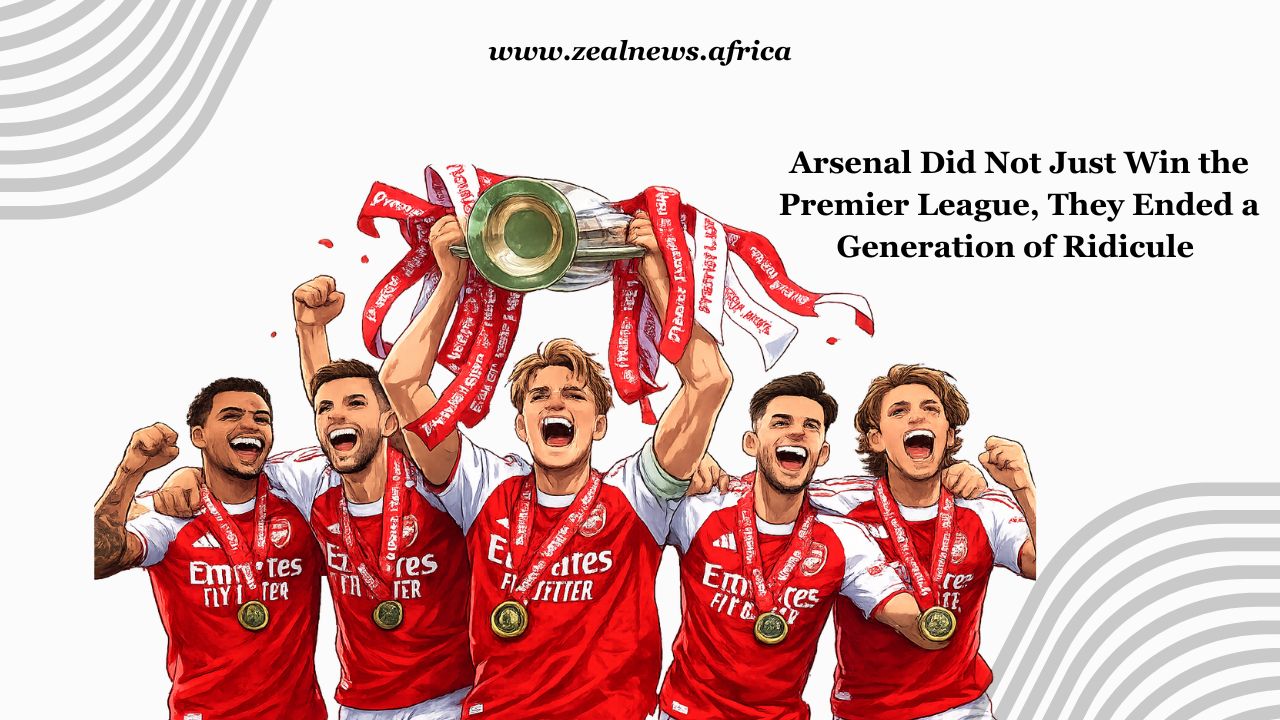
Scenes erupted at Selhurst Park in south London on May 24, 2026, when Arsenal's players lifted the Premier League trophy after defeating Crystal Palace 2-1 in their final game of the season.
Captain Martin Odegaard hoisted the silverware into the evening sky amid fireworks and confetti, and what followed was not just a celebration inside a football stadium in London.
It was a simultaneous, continent-wide eruption across Africa, in cities and towns where millions of people had waited 22 years for this exact moment.
Football is never just a game, it never has been and will never be. The 90-minute sport determines the mood of households, the confidence of managers, the trajectory of players' careers, and the monthly income of the millions, in Africa especially, who have made football their primary livelihood, whether through betting, jersey trade, football viewing centres, commentary, or club commerce.
The outcome on the pitch carries consequences that stretch far beyond the final whistle and it is a lived reality for all those who are devoted fans of football.
The Arsenal Story — From a Factory in Woolwich to the World
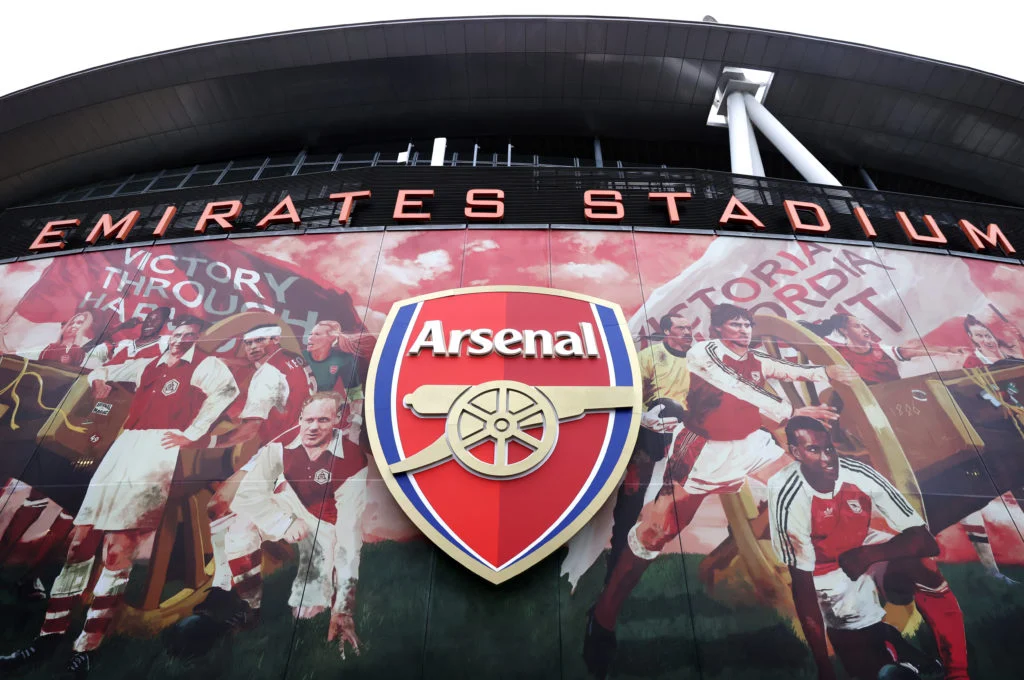
Arsenal Football Club was founded in October 1886, not in a fancy football room or sports hall, but by a group of munitions workers at the Royal Arsenal factory in Woolwich, southeast London.
They named their first team Dial Square, after their workshop, and played their first match on December 11, 1886. The club went through several name changes before settling on Arsenal in 1914, a year after relocating to north London's Highbury.
What followed over the next century was the building of one of English football's most storied institutions. The club won its first top-flight title in 1931 under Herbert Chapman, one of the most innovative managers in football history.
By the time Arsene Wenger arrived from Japan in 1996, Arsenal was a respected club and by the time he left in 2018, it was a global phenomenon.
Wenger's most celebrated achievement was the 2003-04 season, a complete Premier League campaign of 38 matches played without a single defeat, a record that earned the squad the immortal nickname 'The Invincibles.' Thierry Henry, Patrick Vieira, Dennis Bergkamp, Robert Pires, these were not just footballers.
They were cultural icons in countries that had no geographic connection to north London whatsoever.
Then the trophies stopped and then there was the Champions League final loss to Barcelona in 2006, coupled with the years of fourth-place finishes, as well as the repeating occurrence of chronic near-misses.
Amidst all of this, the fan base held together through something harder than victory: hope, loyalty, and a particular kind of unbreakable devotion that rivals found difficult to understand and even harder to respect.
The Banter Era and Why It Hurt So Much
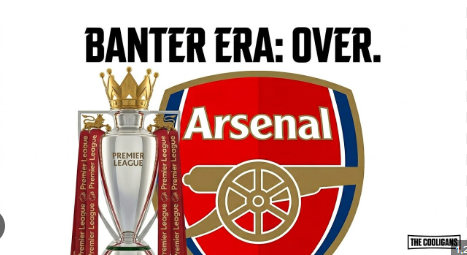
For the better part of two decades, Arsenal were the internet's most reliable football punchline and the timing was uniquely cruel.
Facebook launched in 2004, the same year Arsenal last won the league, twitter followed in 2006 and instagram in 2010.
The entire era of social media football banter was born and raised during Arsenal's trophy drought, which meant that the jokes compounded with every platform and every passing season.
Arsenal once trolled Tottenham through their own online shop, any fan who checked out without adding anything to their basket was met with the message: 'Your basket is as empty as Tottenham's trophy cabinet.' Rivals spent the next decade turning the same joke back on Arsenal."
A compilation of Arsenal banter jokes that circulated widely online captured the mood of what the average Arsenal felt— one read: "What do you tell your girlfriend who needs space? To check Arsenal's trophy cabinet."
Supporters from other clubs called Arsenal fans 'the beautifully broken,' a congregation mocked for their passion, weighed down by the tag of bottlers, three-time runners-up under Mikel Arteta in 2023, 2024, and 2025 before the 2026 breakthrough.

A Football365 reader mailbox that went viral put it most bluntly: "Arsenal are a joke that has been running for over two decades." Another contributor in the same thread went further, describing Arsenal fans as "the living version of the meme of the person in second place celebrating while the actual winners take the trophy in silence."
A Nigerian pastor jokingly mocked Arsenal fans before the recent win, declaring the club "cursed". After Arsenal's triumph, he released an apology video saying: "Congratulations Arsenal".
Amidst all of this banter, Arsenal fans in Africa and the rest of the world absorbed every joke but still kept their flags high up anyway.
When Africa And The World Turned Red
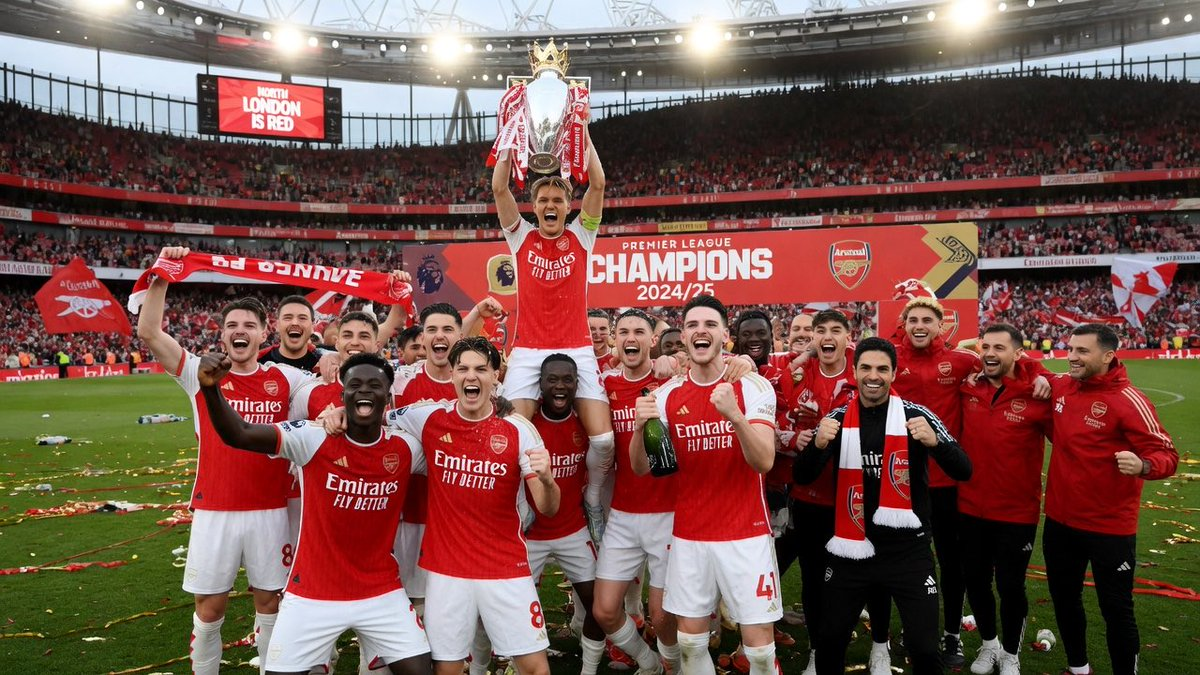
Arsenal clinched the title on May 19, 2026, when Manchester City failed to beat Bournemouth, mathematically confirming the Gunners as champions with one match remaining.
The celebrations that erupted immediately were documented across the continent. In Lagos, celebrities could not stay quiet, Falz, Seun Kuti, Davido, DJ Cuppy, Tiwa Savage, and singer Chiké all had something to say, each in their own way, about a night 22 years in the making.
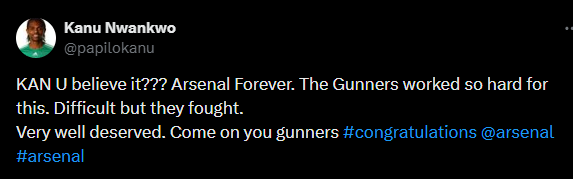
Nwankwo Kanu, Arsenal's own Nigerian legend from the Wenger era, posted: "KAN U believe it??? Arsenal Forever. The Gunners worked so hard for this. Difficult but they fought. Very well deserved. Come on you Gunners."
Business mogul and United Bank for Africa chairman, Tony Elumelu did not miss the moment either.
The billionaire shared a video of himself on X, on a treadmill, with an Arsenal shirt on, and walking to the soundtrack of "Stand Up for the Champions," a caption that said everything that needed saying: "EPL champions 2026.
Some Nigerians did not just celebrate Arsenal’s win, they turned it into full-blown theatre. Videos circulating on X (formerly Twitter) showed fans dancing in churches, while others flooded the streets of Port Harcourt in raw excitement.
In London, a Nigerian man went viral for wearing an agbada made from Arsenal fabric as he walked confidently through the streets. The excitement was not contained — it was performed, shared, and amplified across timelines.
In Nairobi, the response was really felt. Thousands of Arsenal supporters flooded the central business district on May 24, the day of the Crystal Palace trophy presentation, turning Kenyatta Avenue and the area around Nation Centre into a sea of red and white.
In Kisumu, hundreds marched through the streets, riding bikes and driving in convoy. In Nakuru, fans gathered at Wave XO club under a poster that read simply: 'Let's show Nairobi what it means to be Gooners. You are all invited.'
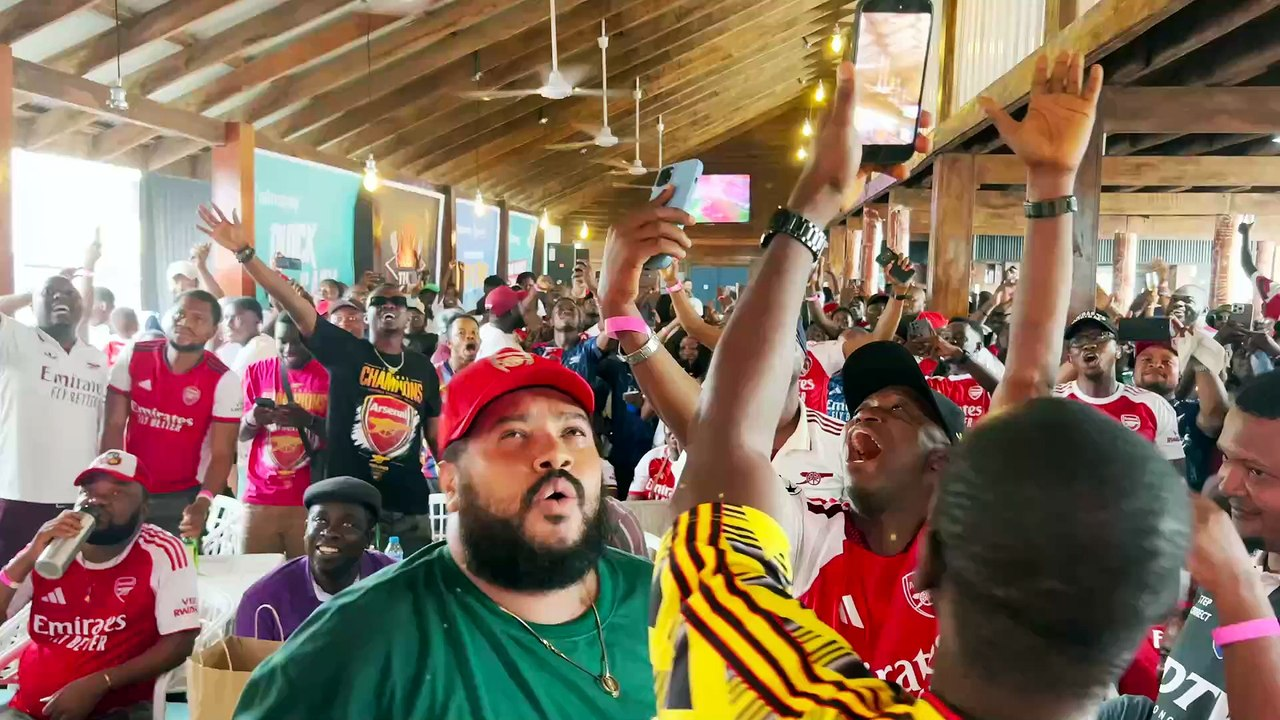
In Addis Ababa, Ethiopia, footage of fans celebrating in the streets circulated widely on the internet.
In Nairobi, the celebrations also carried a particular emotional weight: fans remembered the late Raila Odinga, former Kenyan prime minister, a known Arsenal supporter who had visited the Emirates Stadium several times before his passing, and whose name was invoked repeatedly during the celebrations.
One post on instagram read: 'BABA WHILE YOU WERE AWAY, ARSENAL FINALLY WON!.'
Ghana had its own distinct moment, the British High Commissioner's residence in Accra became an unlikely venue for one of the continent's more official celebrations, hosted by High Commissioner Dr Christian Rogg. Arsenal's title was being toasted inside a diplomatic residence. That alone tells you what the win meant.
Then there was the story that made the whole continent laugh. A document circulated in Botswana, complete with the Republic of Botswana coat of arms and a presidential stamp, announcing a public holiday for Arsenal supporters.
The news spread faster than anyone would imagine, the excitement was real but the document was not. Botswana's government had to clarify that it was fake news but it revealed what the level excitement that Arsenal fans had.
Across the African continent, Arsenal's Premier League victory was met with jubilant celebrations and palpable excitement that no one could dispute.
What Loyalty Finally Looked Like
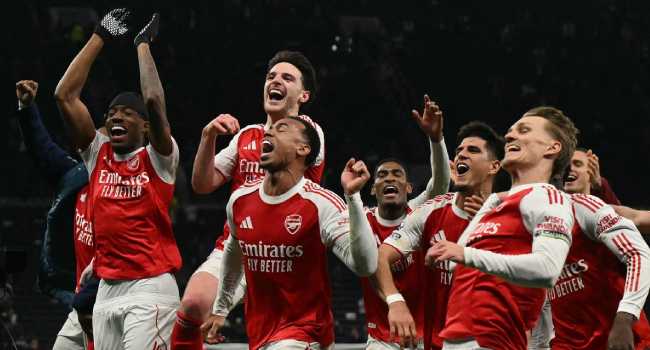
There is something to be said about a fan base that stayed, rivals spent two decades laughing but the support did not collapse. The names on the jerseys changed, from Henry and Bergkamp to Saka, Odegaard, and Martinelli, but the loyalty held.
In Africa, where the Premier League is not just entertainment but community shared feeling, Arsenal supporters built watch parties, supporter clubs, and social groups around a team that kept finishing second. That was not naivety, it was faith.
The 2025-26 title was Mikel Arteta's first as a manager. He had been runner-up three consecutive times, each season more agonising than the last. He stayed, his team stayed and the fans stayed closer more than ever.
And on the evening of May 19, when Manchester City drew with Bournemouth and the mathematics confirmed what the season had been building toward, the payoff was not just a trophy.
It was the vindication of a kind of stubborn belief that sporting culture consistently undervalues: loyalty through the years when loyalty costs something.
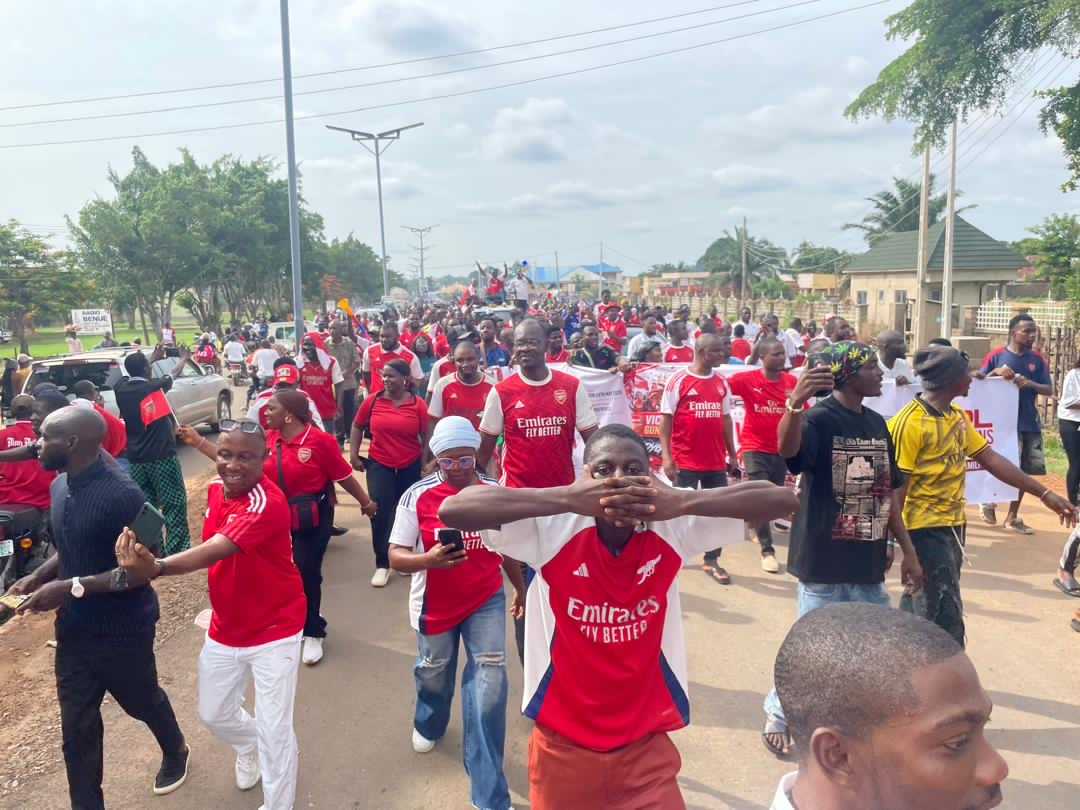
The scenes in Nairobi, Lagos, Kisumu, Addis Ababa, and across the continent on May 24 were not just celebrations of a football result.
They were celebrations of staying, of being the person who never switched allegiance when switching was easier, cheaper, and socially safer.
Arsenal's African supporters wore their red through the banter era and came out the other side holding a trophy.
Football teaches a specific lesson, and the Gunners just taught it loudly: do not leave before the end and the best experiences are always worth the wait.