EXPLOSIVE DRONE SWARM ROCKS MOSCOW: Refinery Ablaze, Casualties Mount in Ukraine's Largest Assault!
Moscow was hit by a multi-wave drone attack on the final day of Russia's parliamentary elections, leading to significant damage at the Moscow Oil Refinery, residential areas, and causing casualties. Despite Russian claims of extensive interceptions, the assaults penetrated defenses, visibly bringing the war's consequences to the capital and disrupting aviation.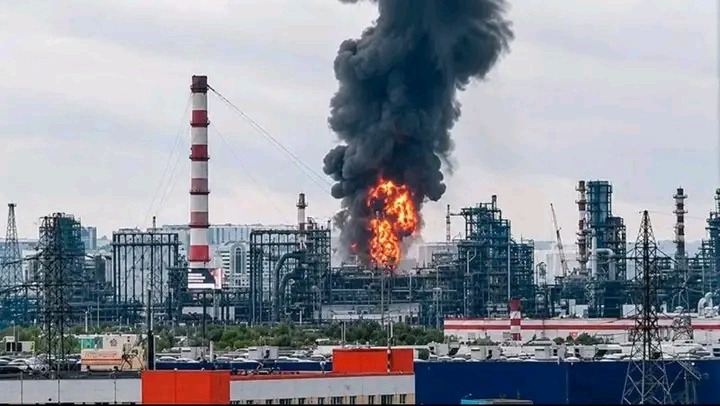
Moscow experienced a significant and unprecedented layered drone attack, sustained in repeated waves over several hours, which forced Russian air defenses to engage across multiple districts. This was not an isolated incident but a coordinated operation involving numerous drones advancing towards their targets, challenging the capital's extensive defensive capabilities.
The assault resulted in confirmed impacts across several key locations within Moscow and its wider region. The Moscow Oil Refinery sustained damage to part of its facility, triggering substantial fires that sent enormous columns of black smoke rising above the city, visible even after sunrise. Beyond this critical energy infrastructure, residential buildings and other civilian infrastructure were also affected. A building near Orekhovy Boulevard was struck, as was another facility near a major highway in the capital. Footage reportedly showed a Ukrainian drone striking a separate Russian facility close to the refinery complex, reinforcing the multi-point nature of the operation.
Tragically, the attacks led to casualties. Russian authorities reported two deaths and multiple injuries across the wider Moscow region, with figures suggesting up to 20 individuals injured. Specific incidents included the death of a 44-year-old woman in Sofyino after a drone struck a three-story residential building, and an elderly man killed in Orekhovo-Zuyevo when a private house was hit. Five other people, including two children, were also reported injured. Hundreds of residents were evacuated from a damaged apartment building, highlighting the direct impact on the civilian population.
The scale of the alleged interception efforts was considerable, though largely unverified. Moscow Mayor Sergei Sobyanin claimed that over 1,600 drones were intercepted across the wider defensive operation since September 19, with 450 allegedly destroyed while approaching Moscow. Separately, Moscow Region Governor Andrei Vorobyov stated that 249 drones were intercepted or electronically suppressed across 17 districts between 3:00 and 5:00 a.m. Despite these claims of extensive interceptions, confirmed impacts underscore an undeniable fact: Moscow’s highly concentrated air defenses were penetrated, with several drones successfully reaching their intended targets.
The attack severely disrupted daily life and infrastructure. Major aviation disruption was reported, leading to temporary flight restrictions at two airports and leaving the airspace surrounding the capital nearly empty on flight-tracking maps. This forced Russia to protect its capital, restrict civilian aviation, and respond to drones approaching from multiple directions, yet it could not prevent the strategic refinery from being struck.
The timing of this extraordinary assault carried immense political weight, occurring on the final day of Russia’s parliamentary elections. Moscow’s mayor suggested the attack was specifically intended to disrupt voting. As Russians traveled to polling stations, they were confronted with the stark visual evidence of war hanging above their capital—smoke from a burning refinery darkening the election-day sky. The Kremlin’s long-standing efforts to present its invasion as a distant conflict, separate from everyday life within Russia, became increasingly difficult to maintain. The sustained drone strikes represent Ukraine’s ongoing strategy to exert pressure on Russia’s energy infrastructure and challenge its domestic security, bringing the consequences of the war directly to the heart of Russia.