2027 Battle Lines Drawn: Wike, APC Govs at War, Tinubu Woos Traditional Leaders
Political tensions are escalating in Nigeria as the 2027 general election approaches, highlighted by a clash between APC governors and Minister Nyesom Wike over party loyalty and support for President Tinubu. Simultaneously, the APC campaign council is seeking royal endorsements, while a dispute over the Mambilla power project involves the APC and Atiku Abubakar. The Obi-Kwankwaso Movement has also unveiled its presidential campaign council, setting the stage for a dynamic election cycle.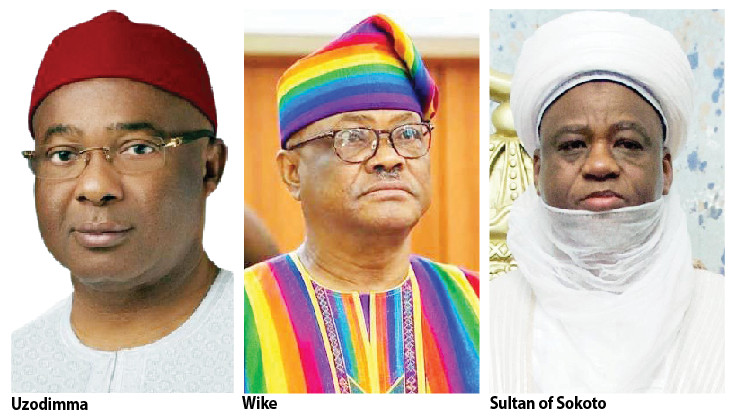
As the 2027 general election in Nigeria draws closer, significant political realignments and disputes are emerging, particularly within the ruling All Progressives Congress (APC) and among opposition figures. A major point of contention has surfaced between the governors elected under the APC platform, operating as the Progressive Governors Forum (PGF), and the Minister of the Federal Capital Territory, Nyesom Wike. The APC governors have unequivocally declared their commitment to supporting only official APC candidates at all levels, vowing to reject any alliance or political arrangement that could undermine President Bola Tinubu's re-election bid, weaken the party, or adversely affect its candidates. This firm stance, articulated by Senator Hope Uzodimma, Chairman of the PGF and Governor of Imo State, following a closed-door meeting in Abuja, specifically targets arrangements that might create confusion, divided loyalties, or competing interests within the party.
The PGF's declaration is widely perceived as a direct challenge to Minister Nyesom Wike's "Rainbow Coalition." Wike has stated that his coalition is primarily focused on mobilizing support for President Tinubu's re-election but not necessarily extending that support to other APC candidates in governorship or legislative elections. Reacting to the governors' position, Wike asserted that only President Tinubu has the authority to question his political decisions, emphasizing his support is exclusively for Tinubu's presidential bid and not a blanket endorsement of the APC. He clarified that he never aligned his coalition with the APC Governors' Forum, maintaining his independence in supporting Tinubu without commitment to other APC candidates.
Concurrently, the APC Presidential Campaign Council (PCC) has intensified its outreach efforts. Led by its Director-General, Senator Abdulaziz Yari, the PCC has embarked on a nationwide consultation with prominent traditional rulers. These visits, which included the Sultan of Sokoto, Alhaji Sa’ad Abubakar III; the Oba of Lagos, Rilwan Akiolu I; and the Oba of Benin, Omo N’Oba N’Edo Uku’Akpolokpolo, Oba Ewuare II, aimed to garner royal blessings, prayers, and support for President Tinubu's re-election. Traditional rulers, in their responses, urged for violence-free campaigns and emphasized continuity. Oba Akiolu notably declared Tinubu's second term assured, stating "no vacancy in Aso Villa," while Oba Ewuare II advised against change merely for its own sake, advocating for continuity in the national interest. Senator Yari underscored the PCC's campaign message by arguing for regional justice, suggesting that after former President Buhari's eight years, the South should also produce the president for eight years. He also claimed improvements in key economic indicators under the Tinubu administration, citing an increase in annual GDP growth from 2.7% to 3.9% and a decline in inflation from 22.9% to 15.9%.
Another significant political development involves a renewed dispute between the APC Presidential Campaign Council and former Vice President Atiku Abubakar, the presidential candidate of the African Democratic Congress (ADC), concerning the International Chamber of Commerce (ICC) arbitration over the Mambilla Hydroelectric Power Project. The APC Campaign Council, through its spokesman Dele Alake, accused Atiku of compromising Nigeria’s interests for personal gain, urging him to withdraw from the 2027 presidential race. These accusations followed revelations of a $500,000 payment made in 2003 to Atiku’s then-wife, Jennifer Douglas, by Leno Adesanya, promoter of Sunrise Power and Transmission Company Limited. Alake alleged that Atiku and former Power Minister Olu Agunloye collaborated to execute an unlawful contract despite reservations from then-President Olusegun Obasanjo and the Federal Executive Council, linking the payment to Douglas with the purported contract award to Sunrise.
Atiku Abubakar, however, swiftly rejected the APC's interpretation, with his Senior Special Assistant on Public Communication, Phrank Shaibu, accusing the ruling party of misrepresenting an arbitration proceeding as a corruption verdict that the tribunal never delivered. Atiku challenged the APC to provide specific evidence from the final award that directly links him to receiving a bribe, directing the Mambilla contract, abusing his office, or participating in a corrupt conspiracy.
Meanwhile, beyond the internal APC dynamics and inter-party disputes, a new political force, the Obi-Kwankwaso Movement, has formalized its intent for the 2027 elections. This pressure group, dedicated to mobilizing grassroots support for a joint presidential ticket featuring Peter Obi and Rabiu Kwankwaso of the Nigeria Democratic Congress (NDC), unveiled a comprehensive 59-member Presidential Campaign Council. The council's leadership includes John Ughulu as Director-General and Saadatu Sani as National Secretary. Its structure is extensive, comprising zonal and state coordinators across all 36 states and the Federal Capital Territory, alongside directors for critical functions such as grassroots mobilization, women affairs, strategy, security, legal affairs, contact and engagement, special duties, procurement, information technology, and administration, signaling a broad-based approach to the upcoming elections.