Europe Scorches: Record-Breaking Heatwaves Grip Continent, Sparking Climate Alarms!
Western Europe experienced its hottest June on record, contributing to the second-warmest June globally and signaling an alarming accumulation of heat in the climate system. These extreme temperatures, driven by human-induced climate change and exacerbated by phenomena like the 'heat dome,' have led to significant health impacts, increased wildfires, droughts, and infrastructure disruptions across the continent. Experts warn of worsening conditions and urge immediate action on emission reductions and climate adaptation plans.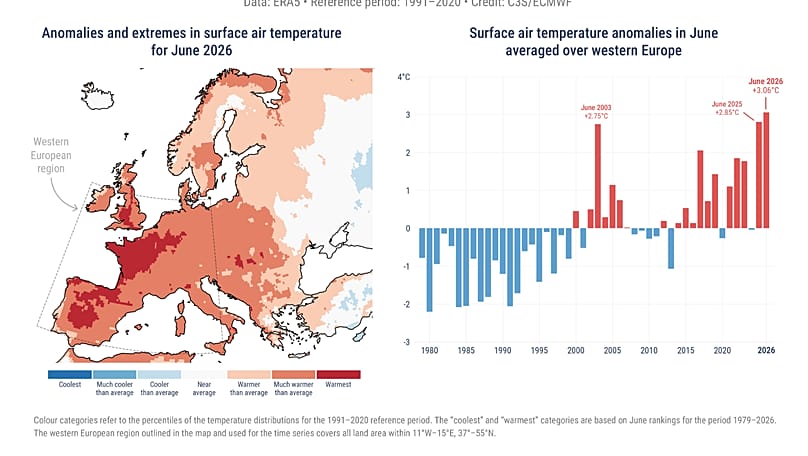
June of this year marked a critical period for Earth's climate, with western Europe experiencing its hottest June on record, and globally, it was the second-warmest June ever observed, registering 1.39°C above the estimated pre-industrial average. This coincides with the warmest June sea surface temperatures globally, signaling a continuous accumulation of heat within the Earth's climate system, according to data from the European Union's Copernicus Climate Change Service and the European Centre for Medium-Range Weather Forecasts (ECMWF).
Europe, identified as the world's fastest-warming continent, endured an average temperature of 20.74°C in western Europe in June, more than 3°C above the 1991-2020 norm, breaking the region's previous record from June 2025. This record-breaking month followed an unusually severe heatwave in May and was succeeded by another in early July, illustrating an increasingly persistent pattern of extreme summer heat. Meteorological experts, observing a new heat dome, or 'omega high', over Europe until mid-July, note that such high-pressure systems act like a lid, trapping heat and leading to shattered monthly and all-time temperature records across several countries, including Germany and the Czech Republic.
The consequences of these relentless heatwaves have been profound and widespread. Thousands of deaths were linked to the June heatwave, notably in France, Spain, and Belgium, with 1,300 deaths tied to Europe's recent heatwaves. More than two-thirds of Europeans, an estimated 410 million people, endured temperatures exceeding 35°C during the June 15-30 heatwave. Furthermore, nearly 300 million people, including vulnerable populations, may have been exposed to harmful levels of ozone pollution. Beyond health impacts, dry conditions across much of Europe, especially the Iberian Peninsula, southern France, and parts of eastern Europe, have intensified drought risk, undermined food production, reduced river flows, and increased wildfire activity. Marine heatwaves have also spread across the western Mediterranean and Atlantic coastlines, threatening fragile marine ecosystems.
Scientists attribute these extreme conditions primarily to long-term human-driven climate change, with greenhouse gas emissions, mainly from burning fossil fuels, at an all-time high. While strengthening El Niño conditions – a climate pattern involving warmer tropical Pacific Ocean waters – also played a part, EU climate data emphasizes that human activity remains the dominant factor. Experts, including Samantha Burgess of ECMWF/Copernicus, warn that these records demonstrate a climate system storing increasing amounts of heat, leading to more frequent, intense, and geographically widespread heatwaves with growing consequences for public health, ecosystems, and infrastructure. Dr. William Lamb of the Potsdam Institute for Climate Impact Research projects global temperatures will surpass 1.5°C in about four years, stressing the rapid accumulation of heat in the Earth system.
In southern Germany, for instance, the weather service WetterOnline reported air feeling like it came from a hairdryer, with temperatures between 30 and 35°C, leading to an increased risk of wildfires due to prolonged dry conditions and gusty winds. Cities like Stuttgart and Munich are expected to see temperatures well above 30°C, with the Rhine-Main region anticipating tropical nights from the weekend due to daytime temperatures rising above 35°C, potentially reaching 38°C. Travel infrastructure has already been impacted, with motorways like the A2 near Burg in Saxony-Anhalt being completely closed and requiring repairs due to concrete swelling from extreme heat, raising concerns about potential travel chaos as summer holidays begin across more federal states.
Facing the daunting task of curbing greenhouse gas emissions and mitigating rising temperatures, Professor Ottmar Edenhofer, chair of the EU's independent climate advisory body, emphasized the need for