EU Leader Ursula von der Leyen's High-Stakes Trip to Kyiv Signals Shifting Tides
Ursula von der Leyen's latest trip to Kyiv highlights a significant transformation, with her declaration that "the tide is turning" for Ukraine. This optimism is underpinned by a new EU-Ukraine defence partnership focusing on drone technology and tangible progress in Ukraine's EU membership bid, despite ongoing challenges from Russian attacks and internal political shifts.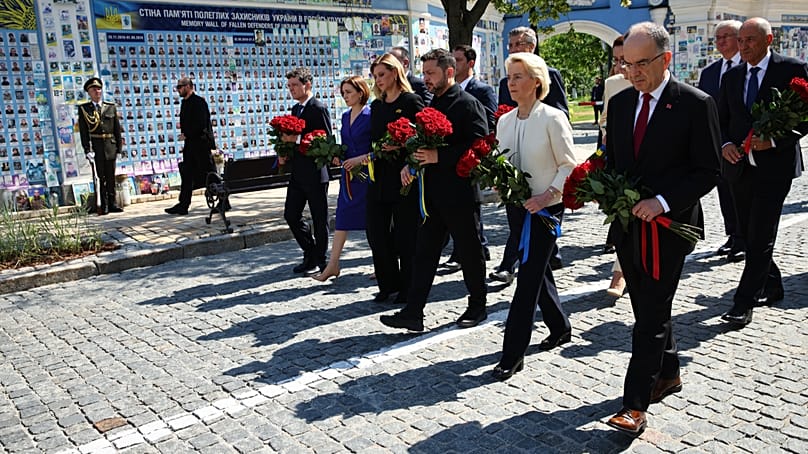
Ursula von der Leyen's recent trip to Kyiv in July marked a stark contrast to her visit in late February, when Ukraine was enduring a severe winter with widespread blackouts and sub-zero temperatures due to Russian strikes. This time, upon her arrival, she declared, "The tide is turning," signaling a remarkable transformation within less than five months. While battle lines remain largely static in a war of attrition, Ukraine has shifted its strategy to aerial combat, deploying long-range drone strikes against Russian oil refineries, some located thousands of kilometers from the contact line. This new approach has strained Moscow's war chest and compelled Russia to restrict fuel exports. Von der Leyen, standing alongside Ukrainian President Volodymyr Zelenskyy, emphasized that "Russia's momentum is weak. Ukraine, on the other hand, continues to resist," asserting that no "cloud of smoke can hide the reality on the battlefield."
Fittingly, her one-day visit, under the blazing July sun, heavily focused on drones. Von der Leyen and Zelenskyy signed a landmark EU-Ukraine defence industrial partnership dedicated to building unmanned aerial vehicles. This unprecedented agreement aims to combine the European Union's industrial scale with Kyiv's cutting-edge expertise through joint ventures. A key provision of the deal allows for the storage of drones on EU soil before their deployment to Ukraine. Funding for this initiative will be drawn from the military component of the €90 billion support loan and approximately €10 billion still available under the SAFE defence program. Plans are also in place for the partnership to expand to missile technology in the future.
However, the declaration that "the tide is turning" does not equate to Ukraine securing victory. Russia continues to exploit Ukraine's critical shortage of US-made Patriot interceptors, vital for deflecting ballistic missiles, to relentlessly bombard cities. In recent weeks, residential blocks, supermarkets, warehouses, railway stations, schools, and museums have all been hit, resulting in hundreds of civilian casualties. Von der Leyen herself experienced this extreme vulnerability firsthand when she was escorted to an underground shelter during an air raid alert. Shortly after, she toured the Kyiv-Pechersk Lavra, a historic monastery where the golden-domed cathedral was set ablaze by a Russian attack in June, noting areas still blackened by flames—a stark reminder that for Moscow, nothing, not even holy sites, is off limits.
Meanwhile, during her visit, murmurs of turmoil within Zelenskyy's government grew louder due to a sudden reshuffling. The day after von der Leyen departed, Ukrainians took to the streets to protest the dismissal of Mykhailo Fedorov, the highly popular defence minister who was widely credited for advancing Ukraine's drone warfare capabilities to new frontiers.
Beyond the battlefield, the "tide turning" also encompasses Ukraine's coveted path to EU membership. In February, the accession process was stalled by Hungary's veto, making formal decisions impossible and dimming hopes for progress as long as Viktor Orbán remained in office. At that time, von der Leyen also faced an ambitious request from Zelenskyy for full membership by 2027, a date that had emerged during US-led peace negotiations as part of future security guarantees. While Zelenskyy expressed a desire for a "fast track," von der Leyen diplomatically underscored that "dates by themselves are not possible," reaffirming nonetheless the EU's support for Ukraine to achieve its goals.
This week, the narrative surrounding accession was vastly different. Von der Leyen arrived in Kyiv just one day after Ukraine opened a new cluster of negotiations, marking the second such breakthrough in a single month. This progress, made possible after the Hungarian elections in April, has established a reasonable pathway to unblock the remaining four clusters following the summer break, making tangible progress finally visible. Much to von der Leyen's relief, Zelenskyy has ceased advocating for the 2027 deadline, his goals having shifted from aspirational to realistic after facing backlash from leaders. His current focus is on maximizing the tried-and-tested methodology of the accession process, stating, "Our relationship with Europe is now the strongest, most meaningful and most personal than at any other point in our history." Privately, von der Leyen and her team welcomed Zelenskyy's improved understanding of enlargement as a politically sustainable, step-by-step trajectory rooted in credible rules. As she told him, "You are preparing for your future as a member state of our Union. But the truth is, your actions are already shaping the future of our entire continent."