Nigeria’s Fishermen Are Going Farther to Sea and Returning With Less
Climate change is devastating Nigeria's coastal fishing communities, leading to dwindling fish stocks, severe economic hardship for fishermen, and encroaching sea levels. Despite national climate policies, implementation gaps leave residents struggling to adapt independently, threatening a way of life sustained for generations.
For most of his life, Christian Inyang could count on the waters around his community in Akwa Ibom State to provide a living.
Croaker, catfish and bonga were once caught relatively close to shore. A week-long fishing trip could bring in between ₦700,000 and ₦800,000.
Today, the 52-year-old fisherman says the same waters tell a different story.
The fish are harder to find, trips are becoming more expensive and fishermen increasingly have to venture farther offshore. On some trips, Inyang says he now returns with catches worth ₦150,000 or less before paying for fuel, food and workers.
For fishing communities along Nigeria's Niger Delta, from Akwa Ibom to Bayelsa, Rivers, Delta and Cross River, that decline is more than an environmental concern. It threatens a livelihood passed from one generation to another and an important source of food for millions of Nigerians.
The fish are moving, but not everyone can follow
Fishermen in communities such as Ikot Inua Eyet say species that were once accessible in shallow creeks are increasingly being found farther from shore.
That observation is consistent with a wider phenomenon scientists are tracking across the world's oceans.
The Food and Agriculture Organisation says climate change is altering the distribution and productivity of marine organisms, with changing ocean conditions capable of shifting where fish stocks can be found and how productive they are.
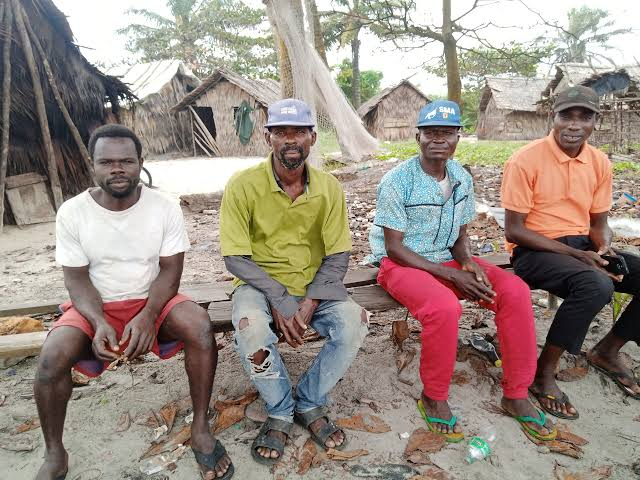
For small-scale Nigerian fishermen, following those fish is not straightforward.
Travelling farther offshore requires bigger boats, stronger engines and considerably more fuel. Those who cannot afford that equipment are left competing for declining catches closer to shore.
But climate change is not the only pressure on Nigeria's fisheries. Overfishing, pollution, habitat degradation, weak fisheries management and the activities of industrial vessels can also affect fish availability, making it difficult to attribute every declining catch to warming waters alone.
What fishermen can see, however, is that their business is becoming harder.
A bad catch now hurts twice
The economics of fishing have changed alongside the environment.
When fishermen travel farther and return with less, they still have to cover fuel, crew wages and food for the journey. A poor catch can therefore mean days of work with little profit to show for it.
Some fishermen are already adapting.
In Okorotip, Aniedi Uwem has turned increasingly to crab harvesting because the fish he once depended on in shallow waters have become difficult to find. Others are considering different sources of income altogether.
Consumers are feeling the pressure too.
Fishermen and traders say quantities of fish that previously sold for around ₦10,000 can now fetch more than ₦20,000, while some smaller varieties have more than doubled in price.
The problem feeds into a much larger challenge for Nigeria: the country consumes considerably more fish than it produces domestically, leaving the market dependent on imports and vulnerable to changes in local supply.
The sea is taking something else

For some Niger Delta communities, disappearing catches are only part of the problem.
Residents also describe water advancing into areas where families once lived and worked.
In Oborotip, homes and fishing equipment have reportedly been damaged by flooding and encroaching water. Some residents pile sand around their properties in an attempt to protect them.
Community leaders fear that continued erosion and flooding could eventually make parts of some settlements uninhabitable.
The danger facing these communities reflects the broader vulnerability of fishing populations to a changing climate. The FAO warns that rising seawater temperatures can push some fish stocks beyond the reach of small-scale fishing fleets, forcing fishermen farther offshore while simultaneously exposing coastal communities to sea-level rise, flooding and increasingly dangerous conditions.
For families whose income, food and homes are tied to the water, adaptation can be particularly difficult.
Nigeria has climate plans. Fishermen need practical help.
Nigeria has made international commitments to reduce emissions and strengthen its response to climate change, but national targets mean little to a fisherman who cannot afford an engine powerful enough to reach his traditional catch.
For communities like Inyang's, the immediate needs are much more practical: access to affordable credit, modern fishing equipment, cold storage, safer boats, better monitoring of commercial fishing and stronger protection of coastal ecosystems.
Inyang believes dredging the river near his community could also help. He says sections have become increasingly shallow since dredging operations stopped several years ago and hopes restoring the channel could improve fishing conditions closer to shore.
Whether dredging alone would bring the fish back is another question. The pressures affecting Nigeria's coastal fisheries are too complex for a single intervention to solve.
What is increasingly difficult to ignore is the experience of the fishermen themselves.
They are travelling farther, spending more and often returning with less.
For communities that have depended on the Niger Delta's waters for generations, the climate crisis is no longer something measured only in degrees of warming or centimetres of sea-level rise.
It can also be measured in an almost empty fishing boat returning home.