Border Blazes: Spain-Morocco Standoff Deepens Amid Tragic Migrant Deaths in Ceuta
Ceuta faces a complex crisis as 18 unidentified migrants from a deadly border incident are buried, while a humanitarian challenge persists with thousands of migrants remaining in the city. Concurrently, Morocco has reignited its territorial claims over Ceuta and Melilla, prompting a firm rejection from Spain.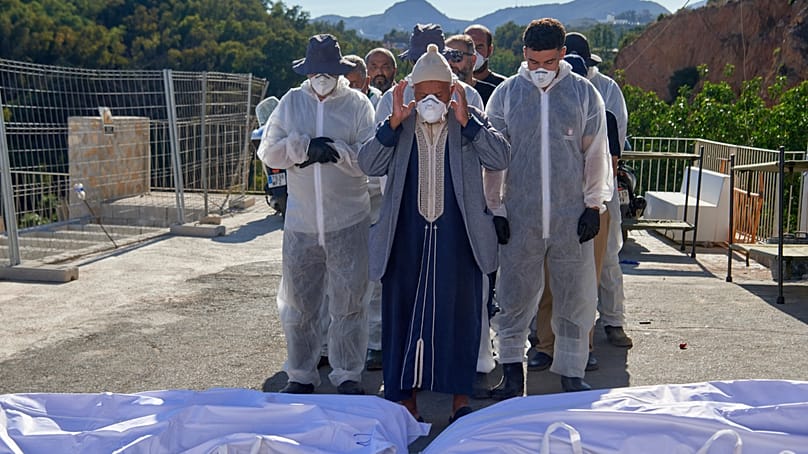
Eighteen unidentified migrants were laid to rest in the Muslim cemetery in Ceuta, three weeks after a severe border crisis that resulted in over 90 deaths and saw more than 72,000 people enter the autonomous Spanish city from Morocco. The bodies, all men, were buried without identification, their graves marked only with numbers for future potential recognition by relatives, as stated by interim cemetery director Said Mohammed. A Muslim cleric led prayers during the burial, as funeral workers placed the bodies, wrapped in white bags, into their graves, adhering to Islamic rites with bodies oriented towards Mecca.
These deceased individuals are among the victims of the mass influx of migrants recorded in Ceuta in late July, an event considered the deadliest incident to date on Spain's border. Many victims tragically drowned or perished in a stampede while attempting to cross a breakwater near one of the border crossings. Further burials are anticipated in the coming days as more bodies are processed.
The Moroccan Association for Human Rights (AMDH) has urged a halt to the burials in Ceuta, advocating for all avenues for victim identification and repatriation to Morocco to be exhausted. The NGO called upon the Moroccan Foreign Ministry to ensure that bodies are returned to families for dignified burials, branding the current burials in Ceuta as a "new human tragedy" that compounds the "disaster of displacement and missing people." However, a spokesperson for the Ceuta city government indicated that repatriation procedures had been completed, but Morocco had not accepted the bodies. The Moroccan Foreign Ministry has not commented on these claims or the ongoing burials.
While most of the 72,000 people who crossed into Ceuta in late July have since returned to Morocco, thousands remain in the city, exacerbating a humanitarian crisis. Estimates of the remaining migrant population vary, with local officials suggesting up to 10,000 migrants, including women and children, while Spain's central government places the number around 5,000. Both Spanish and Moroccan authorities attribute the mass arrivals to social media rumors and people-smuggling networks, though migrants themselves cite unemployment and low wages as primary motivators for their desperate crossings.
Amidst this migration crisis, Morocco has once again brought its territorial claims over Ceuta and Melilla to the forefront. Moroccan Justice Minister Abdellatif Ouahbi publicly defended his country's "historical and geographical" rights to the two autonomous cities and proposed a bilateral dialogue mechanism with Spain to determine their future, which he envisions would lead to their integration into Morocco.
The Spanish government, through its Foreign Ministry, swiftly rejected these claims, reiterating its "categorical rejection" and affirming that Ceuta and Melilla are integral parts of Spain's sovereignty and territorial integrity, and thus, of the European Union. Spain underscored that these long-standing Moroccan territorial aspirations, maintained since its independence in 1956, have consistently been dismissed.
This is not the first instance Ouahbi has challenged Spanish sovereignty over the cities during the current migration crisis, having made similar statements in early August. The renewed assertion of claims during such a sensitive period highlights the persistent tension surrounding the status of Ceuta and Melilla in Spain-Morocco relations.