AI Alarm: State Warns Of Automated Job Takeover Targeting Women's Office Roles
Governor Kathy Hochul warns that artificial intelligence poses a significant threat to administrative roles, predominantly held by women, in New York State. With job projections showing declines in these sectors, the state is developing policies to help workers adapt, train for AI-resistant jobs, or leverage AI's potential while acknowledging the irreplaceable human element in certain roles.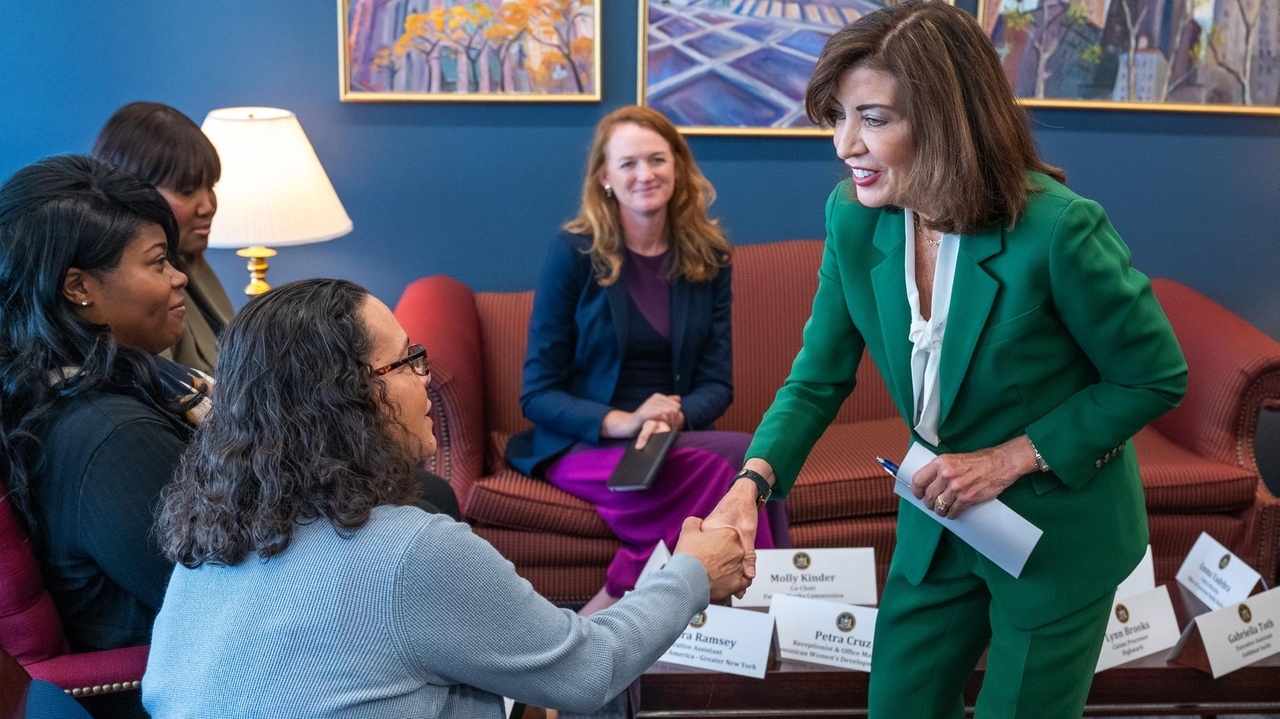
Governor Kathy Hochul recently voiced significant concerns regarding the potential impact of artificial intelligence on administrative roles, particularly those predominantly held by women across New York State. During a Wednesday meeting in her midtown Manhattan office, Governor Hochul engaged with women from various parts of the state who articulated their worries about companies utilizing AI for job candidate screening and as a justification for layoffs, highlighting an impending disruption to the workforce.
The state's Labor Department data underscores the scale of this issue. On Long Island, office and administrative positions constitute approximately 13% of all jobs, employing around 169,000 individuals in roles such as executive assistants, bookkeepers, and customer service representatives. Projections indicate a sluggish growth in new openings for these occupations on Long Island, with an expected annual increase of just 0.3% through 2032. The statewide outlook is even more somber, forecasting an annual decline of 7,100 job openings in office and administrative occupations through 2034, representing a 0.6% yearly decrease.
Governor Hochul pointed out the disproportionate impact on women, who hold approximately 84% of these administrative roles statewide. She emphasized the critical need for New York to proactively manage this shift, especially concerning women in the workforce. This looming disruption from AI arrives at a time when New York State has achieved notable progress in narrowing the gender pay gap. Recent analysis of U.S. Census data by the state Department of Labor shows that the median pay for women working full time rose to 91.9% of the median pay for men in 2024, an improvement from 86.9% a decade prior. However, these gains are not uniform, with a wider pay gap persisting between Black and Hispanic women and white men.
Molly Kinder, co-chair of the governor’s FutureWorks Commission and a former researcher at the Brookings Institution, underscored that office and administrative jobs are among the categories most susceptible to displacement by technology powered by large language models, like ChatGPT. Kinder stressed the importance of state preparation for the significant alterations AI could bring to the workforce. While acknowledging the opportunity for AI to free up time for potentially higher-paid tasks, she expressed primary concern over the risk of displacement. Kinder noted that this displacement might differ from previous economic shifts, such as factory closures, manifesting as the gradual elimination of one or two jobs within offices. She cautioned that these are middle-class jobs, and the women in them often have fewer financial cushions to withstand rapid change.
Despite these challenges, there are differing perspectives on the extent of AI's threat. Steven Kent, an economics professor at Molloy University, suggested that Long Island’s economy is relatively well-positioned to absorb AI disruption due to a concentration of jobs in sectors less susceptible to automation, such as healthcare, education, and tourism. Kent also highlighted that productivity gains from AI could potentially stimulate new business activities, thereby generating administrative roles that require human interaction, as customers often prefer speaking to people.
This sentiment was echoed by Petra Cruz, an administrative assistant at the Dominican Women’s Development Center, who shared a poignant example with the governor. Cruz argued that certain job responsibilities, particularly those requiring empathy and non-judgmental support, are irreplaceable by AI. She cited the scenario of a domestic violence victim seeking help, emphasizing that a robot would be incapable of providing the emotional support, human connection, or practical assistance like referencing to a shelter.
In response to these complex issues, Governor Hochul’s 20-member FutureWorks Commission is tasked with developing a set of recommendations by the fall. These proposals are intended to inform the governor's State of the State policy agenda in January. Hochul indicated that these policies would focus on equipping workers with the skills to effectively integrate AI into their existing jobs or facilitate retraining for roles in industries more resistant to AI-driven displacement, such as healthcare. The governor concluded by affirming the state's commitment to finding viable solutions for this evolving challenge.