Afro Trailblazers Series(Part 14): Wangari Mathai, First African Female Nobel Peace Winner
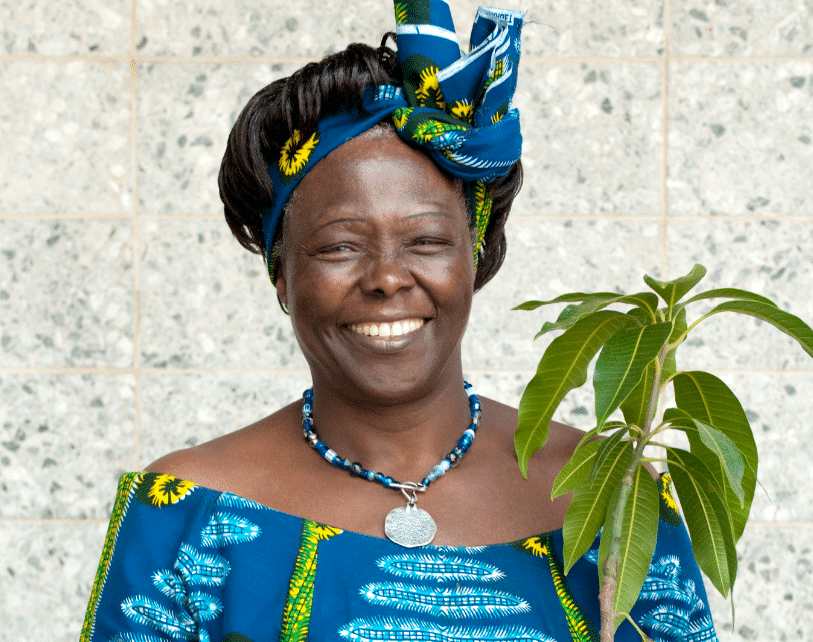
Under Maathai’s stewardship, more than 20 million trees were planted across Kenya, and she became the first African woman to receive a Nobel Peace Prize.
Introduction: Bridging Ecology and Peace
In a world increasingly defined by environmental crisis and political instability, few individuals have drawn a line so clearly between ecology and peace as Wangari Maathai. Born in Nyeri, Kenya, in 1940, Maathai emerged from modest beginnings to become one of the most visionary figures of the 20th century—an environmentalist, political activist, and the first African woman to win the Nobel Peace Prize. Her life’s work offers a blueprint for how grassroots action, academic rigor, and fearless political advocacy can coalesce into global change.
Early Days: Roots in Rural Kenya
Wangari Maathai was born on April 1, 1940, in the village of Ihithe, Nyeri County, located in the central highlands of Kenya, then a British colony. She was the third of six children and the first girl born to Muta Njugi and his wife Wanjiru Muta, who were peasant farmers. Her family belonged to the Kikuyu ethnic group, the largest ethnic community in Kenya, and had lived in the area for several generations.
Her early upbringing was shaped by a rural, bucolic environment in Nyeri, where she spent her childhood before attending school. Around 1943, her family moved to a white-owned farm in the Rift Valley near Nakuru for her father’s work, but by 1947 she returned to Ihithe with her mother to attend primary school alongside her brothers, as no schooling was available near the farm.
Education and Formative Influences
She started school at Ihithe Primary School in 1948 and excelled academically, consistently achieving top grades and earning scholarships that enabled her to attend mission schools such as St. Cecilia Intermediate Primary School and later Loreto High School, Limuru, where she was recognized for outstanding academic performance.
Her education at St. Cecilia’s, a Catholic mission school, exposed her to English language fluency and Catholicism, which influenced her worldview and values. She was involved with the Legion of Mary, a Catholic lay organization focused on serving others, which helped shape her commitment to community service and social justice.
Observing firsthand the environmental degradation in her rural community, such as deforestation and soil erosion, deeply influenced her decision to found the Green Belt Movement to promote tree planting and sustainable development.
Leading in Academia: Breaking Barriers
Maathai’s journey into the spotlight began not with politics or protest, but with a scalpel and microscope. She was the first woman in East and Central Africa to earn a Ph.D.—a doctorate in veterinary anatomy from the University of Nairobi in 1971. She shattered glass ceilings within academia, becoming chair of the Department of Veterinary Anatomy in 1976 and associate professor in 1977. At a time when female leadership in science was rare in Kenya, Maathai was rewriting the narrative.
Her academic ascent was grounded in international scholarship. She earned a B.S. in Biological Sciences from Mount St. Scholastica College in 1964 and an M.S. from the University of Pittsburgh in 1966. But even as she thrived in the university system, Maathai saw the glaring disconnect between intellectual debate and lived experience. Rural communities in Kenya, especially women, were struggling with deforestation, soil erosion, and food insecurity. The ecosystem was collapsing—and with it, hope.
The Birth of a Movement: Planting Trees, Growing Justice
Then she planted a tree.
That simple act in 1976—initiated while she served on the National Council of Women of Kenya—bloomed into a movement. The Green Belt Movement (GBM) would become one of the most influential grassroots environmental campaigns in African history. Under Maathai’s stewardship, more than 20 million trees were planted across Kenya, taking root in farms, schools, and church compounds. But the GBM was never just about trees. It was about justice.
By mobilizing women to restore the land, Maathai empowered a generation to challenge systemic poverty and ecological degradation. She drew a direct line from barren landscapes to social unrest and political instability, arguing that sustainable development is the soil from which peace must grow. In this philosophy, tree planting became not only environmental restoration but a revolutionary act.
From Local to Global: Political and International Impact
Her leadership reached beyond Kenyan borders. From 2002 to 2007, Maathai represented the Tetu constituency in Kenya’s parliament and served as Assistant Minister for Environment and Natural Resources. Her impact rippled globally: she addressed the United Nations repeatedly, advocating for women’s rights, environmental stewardship, and democracy. She was appointed Goodwill Ambassador to the Congo Basin Forest Ecosystem in 2005 and co-founded the Nobel Women’s Initiative in 2006. In 2009, the UN named her a Messenger of Peace, with a focus on environment and climate change.
Legacy and Recognition: A Life of Honors and Influence
Recognition followed. The 2004 Nobel Peace Prize acknowledged her rare ability to weave together sustainable development, democracy, and peace. But it was far from her only accolade. She received the Right Livelihood Award in 1984 for converting ecological debate into grassroots action, and the Goldman Environmental Prize in 1991. Universities across the globe—Yale, Williams College, University of Norway—bestowed honorary doctorates upon her. Each honor marked a step in redefining what leadership in the 21st century should look like: data-driven, community-centered, and ecologically conscious.

Her influence extended into the cultural sphere. The 2008 documentary Taking Root: The Vision of Wangari Maathai captured the spirit of her activism, while her four books—The Green Belt Movement, Unbowed: A Memoir, The Challenge for Africa, and Replenishing the Earth—chronicled the intellectual and emotional foundations of her work. In 2010, she founded the Wangari Maathai Institute for Peace and Environmental Studies, ensuring future generations could bridge academic research with real-world environmental action.
Conclusion: An Enduring Blueprint for Change
Wangari Maathai died on September 25, 2011, at the age of 71, but her legacy is measurable—in trees, in policy, in minds changed and women empowered. She proved that environmental activism is not an isolated cause, but a cornerstone of social justice and political stability. The numbers she left behind—millions of trees planted, decades of political service, countless lives transformed—are not just statistics. They are seeds of a more sustainable and equitable future.
In the age of climate anxiety, Wangari Maathai stands as a testament to what is possible when intellect, integrity, and action converge.
Checkout our entrepreneurship category for more stars in the Afro Trailblazers series