Africa United: Mahama's Fierce Demand for Reparatory Justice Rocks AU Summit with Historic UN Resolution
Ghana, led by President John Dramani Mahama, has secured unanimous African Union endorsement for a landmark resolution recognizing the transatlantic slave trade as a foundational crime against humanity. This historic achievement paves the way for a global diplomatic offensive at the United Nations and CARICOM, advocating for reparatory justice, including the restitution of looted African cultural objects, and aims to initiate a sustained "Decade of Reparations".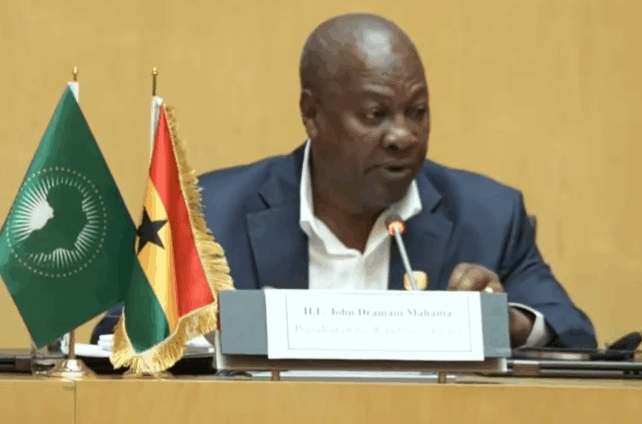
At its 39th Ordinary Session, the African Union (AU) Assembly of Heads of State and Government made a historic decision by adopting a Ghana-led resolution that formally recognizes the transatlantic slave trade and racialized chattel enslavement as foundational crimes against humanity. This consensus adoption, announced by President John Dramani Mahama during a press conference on Sunday, February 15, provides Ghana with a clear and unified continental mandate to pursue justice on a global scale. President Mahama, who serves as the AU Champion for Reparations, emphasized that this move is a matter of moral courage and confronting historical truths, not division, acknowledging the profound and foundational crimes that have shaped the modern world and whose consequences continue to manifest in structural inequality, racial discrimination, and economic disparity.
The resolution underscores that slavery is prohibited under international law as a peremptory norm, a principle from which no derogation is permitted. Ghana's comprehensive approach to this landmark initiative rests on three central pillars: historical accuracy, legal defensibility, and strong continental as well as diaspora alignment. To ensure the resolution reflects rigorous scholarship, moral clarity, and diplomatic credibility, Ghana undertook extensive consultations with numerous international and African institutions. These included UNESCO, the Global Group of Experts on Reparations, the Pan-African Lawyers Union, various academic institutions, the AU Committee of Experts on Reparations, and the AU Legal Experts Reference Group. An inaugural joint meeting of these expert bodies was hosted in Accra to refine the text, and consultations also extended to the Ghana Diaspora Summit held in December 2025, ensuring an inclusive and deliberative process.
Following this thorough preparatory work and expert input, the resolution’s title was precisely refined to "Declaration of the Trafficking in Enslaved Africans and Racialised Chattel Enslavement of Africans as the Gravest Crime Against Humanity." This specific wording deliberately acknowledges the systematic trafficking of millions of Africans, the racialized and institutionalized nature of chattel enslavement, and the unprecedented scale and enduring consequences of these crimes. President Mahama stressed that this resolution is not merely symbolic; it provides a vital legal and moral foundation for reparatory justice, fostering African unity, and facilitating engagement with the global community on the historical injustices that continue to shape societies worldwide.
President Mahama further declared that the fight for reparatory justice for the descendants of enslaved Africans cannot be a passive endeavor. Drawing parallels to Africa's struggle for sovereignty, he asserted that justice must be actively claimed through unity and determination. He introduced the concept of a "Decade of Reparations," a strategic framework designed to transform the movement from a series of commemorative events into a sustained, global political commitment. This shift requires member states to prepare for a long-term, coordinated campaign, signifying a profound evolution in the approach to addressing historical injustices.
Building on this continental unity, Ghana is spearheading a robust diplomatic offensive at the United Nations. A draft resolution, mirroring the refined title of "Declaration of the Trafficking in Enslaved Africans and Racialised Chattel Enslavement of Africans as the Gravest Crime Against Humanity," will be formally moved by Ghana on the floor of the UN General Assembly. While one source indicates March 25th, another specifies that the resolution is scheduled to be formally tabled on March 26, 2026. This resolution aims to codify the transatlantic slave trade and enslavement as distinct crimes against humanity. President Mahama highlighted that this initiative has already garnered significant international backing from CARICOM countries and other allies, with the AU endorsement ensuring Africa speaks with one unified voice on the global platform. Ghana’s next major engagement involves the 50th regular meeting of the Caribbean Community (CARICOM) later this month, followed by intensive diplomatic engagements in New York from February 20, 2026, with various regional groupings including CARICOM, the Non-Aligned Movement, the Group of 77 in China, and the European Union. Informal consultations on the draft text are anticipated between February 23 and March 12, 2026, all aimed at building broad consensus for truth, recognition, and reconciliation.
The pursuit of reparatory justice extends beyond formal recognition to include the demand for the return of cultural objects unjustly held outside the continent. As AU Champion for Reparations, President Mahama called for a united African front, asserting that restitution must transcend mere relocation to museums. Instead, these objects must be returned "to a people, returned to a living culture, returned to its rightful spiritual and historical origin." He underscored that the restitution debate is fundamentally about addressing historical injustice, restoring cultural identity, and healing the spiritual disruption caused by colonial-era expropriation, as these artefacts carry deep spiritual and historical significance and should be reconnected with the societies that created them.
Ghana's Minister of Foreign Affairs, Samuel Okudzeto Ablakwa, congratulated President Mahama and the nation for securing the unanimous AU endorsement, praising it as a collective achievement. He emphasized that this milestone signifies not only a diplomatic success but also a symbol of continental unity and moral leadership, reflecting a broader commitment to "reset the development paradigm of our continent." The ongoing dialogue, involving the United Nations Secretary-General, the African Union Commission, relevant UN bodies, and interested Member States, is set to continue, initiating a sustained process of reparatory justice and healing.