Accra's Flood Nightmare: Illegal Structures and Bureaucratic Blunders Exacerbate Crisis
Accra faces persistent flooding due to widespread encroachment and weak planning enforcement, prompting the Flood Mitigation Task Force to target illegal structures around Tesa Dam and in Oyarifa for demolition. Physical planners accuse MMDAs of regulatory failures and political interference, while residents appeal for compensation amidst calls for a greater focus on preventive flood management and enhanced resources.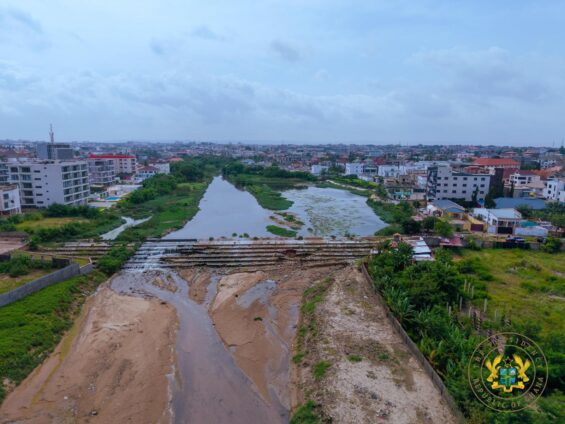
Ghana's capital, Accra, continues to grapple with persistent flooding challenges, prompting intensified efforts from the government and specialized task forces to address the root causes. A key focus of these efforts is the identification and removal of unauthorised structures and encroachments that disrupt natural water systems and reduce the capacity of crucial flood control infrastructure.
The Flood Mitigation Task Force, operating under the Jubilee House, has pinpointed significant encroachments around the Tesa Dam near East Legon Boundary Road. During inspections, the task force observed that illegal structures and retention walls had substantially reduced the dam's capacity, impeding its natural function in managing floodwaters. These structures have been marked for demolition to restore the dam's effectiveness. Additionally, a densely populated settlement composed largely of wooden structures near the dam was identified as a source of serious health and sanitation concerns and is also earmarked for removal as part of broader flood risk reduction measures.
Similar issues were uncovered in Oyarifa, another Accra suburb, where developments have disrupted natural water channels and drainage patterns. The task force found structures built directly over water channels and unauthorised interventions altering the natural flow of water. Notably, apartments were observed constructed over a water channel, with nearby developments impacting water movement from higher ground. A retention wall under construction in Oyarifa's New York area was also found to be diverting natural water flow, contributing to flooding in previously unaffected areas. Several improperly sited structures in Oyarifa have been marked for demolition to restore natural drainage pathways.
These widespread illegal developments are partly attributed to systemic failures within Metropolitan, Municipal and District Assemblies (MMDAs). Gifty Nyarko, President of the Local Government Services Association of Physical Planners, has accused some MMDAs of failing to comply with building permit regulations. She highlighted that assemblies often demand full upfront payment for permits, contrary to the legal requirement of an initial processing fee followed by the balance upon approval. Furthermore, some assemblies reportedly prefer collecting penalty fees over demolishing illegal structures, even those built in wetlands, directly contravening the law which mandates demolition for structures erected without notice. This lax enforcement has led to a proliferation of unauthorised developments, including on environmentally sensitive Ramsar sites.
Ms. Nyarko further pointed to political and traditional interference, coupled with a general disregard for planning regulations and indiscipline among professionals and citizens, as factors that weaken MMDA enforcement capabilities. She stressed that MMDAs, as the legal custodians of physical development regulation, must accept responsibility for these failures. Her colleague, Mr. Ansong, National General Secretary of the Association, added that MMDAs frequently prioritise revenue generation over their core planning functions. He noted that Accra's rapid urban expansion sees construction in both planned and unplanned areas, often facilitated by illegal land sales and purchases that bypass proper procedures.
To combat these challenges, Mr. Ansong advocates for deploying more resources and technology to strengthen planning systems. He calls for adequate funding for special planning committees, improved resources for assemblies, and greater investment in spatial intelligence and technological interfaces to reduce human interference in planning decisions. He also emphasised the need for training and capacity building for personnel in physical planning and works departments, as well as members of the Spatial Planning Committee, ensuring a comprehensive understanding of the multi-institutional planning process.
As these demolition exercises loom, residents of areas like Alajo in Greater Accra are appealing for government support and compensation to facilitate relocation. While acknowledging the risks posed by structures along waterways, residents expressed their inability to move without financial assistance, urging the government to provide aid and ensure proper desilting of drains post-demolition to prevent further flooding from debris and choked gutters. The Municipal Chief Executive, however, has indicated that authorities will soon commence desilting operations and demolitions, with steps being taken to compensate affected residents.
The government's overall flood management strategy has also drawn criticism. Former Dormaa East MP, Paul Twum Barimah, questioned the prioritisation of post-disaster responses over preventive measures. He highlighted that while significant funds are allocated for flood response, preventive programmes like the US$350 million World Bank-backed Greater Accra Resilient and Integrated Development Project (GARID) allegedly face funding restrictions from the Ministry of Finance, leading to unpaid contractors and a downgraded implementation rating. Barimah also noted an inactive US$7 million flood early warning system and continued encroachment on drainage buffer zones, advocating for investment in preventive infrastructure, operationalised early warning systems, and strict enforcement of environmental regulations to better protect lives and property.