A Rollercoaster Friendship: The Timelines of Elon Musk and Donald Trump's Alliance
In an era defined by shifting loyalties, the relationship between Elon Musk and Donald Trump stands out as one of the most unpredictable and consequential. This article traces the dramatic evolution of their alliance—from good times to public spats. Spanning nearly a decade, the article offers a window into the union of Silicon Valley influence and politics.
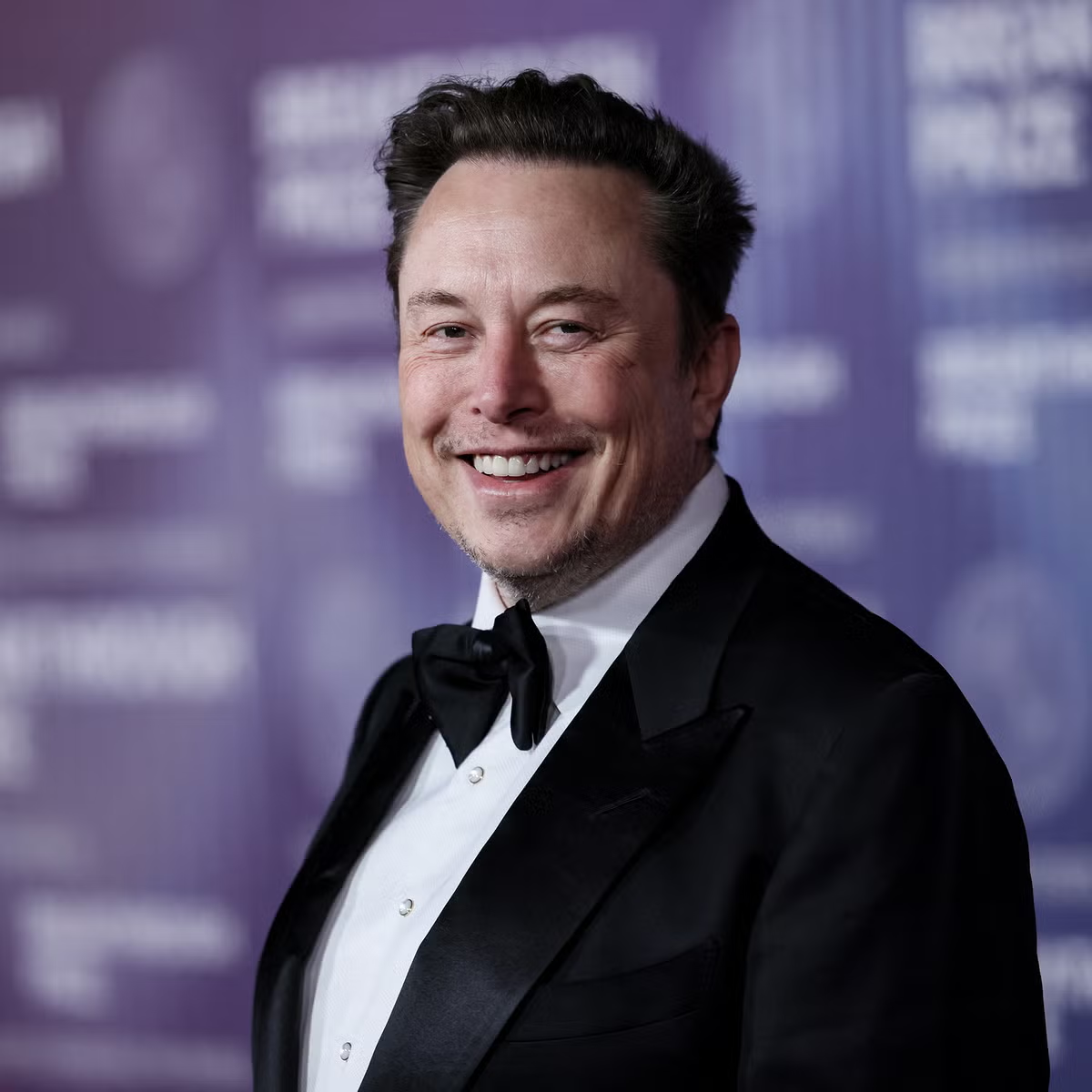
In the kaleidoscope of modern American politics, few relationships have swung as wildly—and as publicly—as that between Elon Musk and Donald Trump. What began with skepticism in 2016 spiraled into a high-stakes dance of power, betrayal, and political brinkmanship. Over nearly a decade, their saga has threaded through boardrooms, tweets, and even the halls of the White House, culminating in a crescendo that now threatens to rupture the fragile fabric of America’s elite political-tech alliance.
2016–2017: From Public Disdain to an Unexpected Partnership
In November 2016, shortly after Donald Trump’s surprise election to the U.S. presidency, Elon Musk didn’t mince words. He publicly stated that Trump was “not the right guy,” criticizing his character and raising concerns about his suitability for high office. At the time, Musk was best known as the CEO of Tesla and SpaceX—two companies symbolic of futuristic, globalist ambition. Trump, on the other hand, had campaigned on a fiercely nationalistic, anti-establishment platform.
Yet one month later, in December 2016, the first twist in their saga arrived. Despite the initial antagonism, Trump appointed Musk to two prestigious White House advisory councils: the President’s Strategic and Policy Forum and the Manufacturing Jobs Initiative. These bodies were assembled to offer the president business advice and input on economic issues. Musk accepted—hoping, as he later explained, to influence critical policy areas from within, especially climate change mitigation and immigration reform, which were increasingly under threat.
The uneasy alliance shattered just six months later. In June 2017, Trump announced the U.S. would withdraw from the Paris Climate Agreement, a global pact signed by nearly 200 nations to reduce greenhouse gas emissions. Musk resigned from both councils in protest, tweeting, “Climate change is real. Leaving Paris is not good for America or the world.” It was the first of many high-profile walkouts—and a clear signal that Musk wouldn’t follow Trump blindly.
2017–2022: Ideological Distance, Occasional Convergence
Despite the public break, Musk and Trump remained fixtures in the American consciousness—sometimes colliding, sometimes running parallel. Between 2017 and 2020, Musk continued to push back against major elements of Trump’s domestic agenda. He spoke out against the Muslim travel ban, criticized restrictive changes to H‑1B visa rules (a program that allows U.S. employers to temporarily employ skilled foreign workers), and took unpredictable stances on COVID-19 lockdowns, at times calling them authoritarian.
But Trump also recognized Musk’s cultural and economic influence. In January 2020, during a visit to the World Economic Forum in Davos, Trump unexpectedly praised Musk as “one of our great geniuses,” and even backed him in his campaign to reopen Tesla’s Fremont, California factory against local COVID orders. For a moment, the two titans—one representing Big Tech and the other Big Government—seemed to be in sync.
That détente evaporated again in July 2022 when Musk, by then the new owner of Twitter (renamed X), tweeted that Trump should “hang up his hat and sail into the sunset.” Trump returned fire at a rally, calling Musk a “bulls*** artist.” The relationship had become personal—and combustible.
2023–2024: A Sudden Alignment on the Road to Trump 2.0
Of course, the next phase of their relationship caught many by surprise. Between September 2023 and March 2024, as Trump positioned himself for a return to power, Musk appeared to edge closer to the Republican fold. He began posting messages that hinted at alignment with conservative causes—particularly around border security, one of Trump’s cornerstone issues.
Then came a dramatic shift. In July 2024, following an assassination attempt on Trump at a campaign event, Musk publicly endorsed the former president on X. More shockingly, he committed millions of dollars per month to the America PAC, a political action committee designed to support Trump’s reelection bid. The richest man in the world was now one of Trump’s biggest political funders.
By October 2024, Musk had gone full MAGA. He was frequently seen wearing Trump campaign gear, boosting pro-Trump messages through his X platform, and lobbying for Trump’s Twitter (X) account to be reinstated after being banned following the January 6 Capitol riot.
Late 2024 – Early 2025: Inside the Trump-Musk White House
By fall 2024, Musk wasn’t just adjacent to Trump’s campaign—he was shaping it. He began advocating for a new federal body he dubbed the “Government Efficiency Commission”, a bureaucratic reform proposal meant to cut waste and streamline operations. Trump, ever receptive to business-style governance, turned the idea into a major campaign promise.

In November 2024, after winning the election, Trump announced the creation of a new executive department: the Department of Government Efficiency (DOGE)—a tongue-in-cheek nod to Musk’s beloved Dogecoin meme, and a serious move toward centralizing regulatory control. Musk was named co-chair, alongside entrepreneur and former presidential candidate Vivek Ramaswamy, both tasked with overhauling how the federal government operated.
On January 20, 2025, Musk was officially sworn in as a senior advisor. DOGE began executing a radical agenda: slashing budgets, conducting audits, firing thousands of federal employees, and eliminating what Musk called “bureaucratic fat.” Musk boasted of savings up to $160 billion, though initial projections claimed it could be over $2 trillion. The experiment was bold—and increasingly controversial.
Mid‑2025: The Breaking Point
But the alliance was already unraveling behind closed doors.
By May 2025, Musk was disengaging—working remotely, skipping briefings, and allowing DOGE’s staff to shrink. The idealistic reform project had become mired in internal conflict and public skepticism.
On June 1, Musk detonated a political grenade. He called Trump’s new legislative centerpiece—nicknamed the “One Big Beautiful Bill”, a sweeping tax cut and infrastructure-spending package—a “disgusting abomination.” He argued it would explode the national debt and undo the very savings DOGE had claimed to generate.
The gloves were off.
Just days later, on June 5, Musk went further. In a rare media appearance, he accused Trump of political betrayal and even alluded to potential ties to Jeffrey Epstein, the disgraced financier whose connections to powerful figures have sparked endless speculation. Trump immediately retaliated—threatening to cancel federal contracts with Tesla and SpaceX, both of which had benefited from billions in government subsidies and defense contracts.
Wall Street panicked. Tesla stock plunged. The once-powerful partnership had become a full-fledged war, with economic and political fallout.
Now: The Future Unwritten
As of June 2025, the Musk–Trump saga is spiraling toward an uncertain but dramatic conclusion.
Musk is now teasing the creation of a new political movement—a centrist “America Party” aimed at disrupting the traditional two-party system. Trump allies have responded with fury, calling for congressional investigations and efforts to strip Musk of any remaining White House influence. Some even advocate banning DOGE altogether.
What was once a transactional alliance between Silicon Valley and populist conservatism has devolved into mutual character defamation war.
As Musk and Trump hurtle toward a final reckoning, the country is left watching—stuck between two titans locked in a battle for control not just of the narrative, but of the future itself.